
1735 Mexico 8 Escudos Gold (Felipe V): Value Guide
The 1735 Mexico 8 Escudos Gold : Value Guide is worth between $51,365 and $86,510 MXN depending on its grade of preservation.
Prices updated: August 2026
Viceroyalty · Mexico City Mint · Assayer MF
Viceroyalty · Mexico City Mint · Assayer MF
The 1735 Mexico 8 Escudos Gold : Value Guide is worth between $51,365 and $86,510 MXN depending on its grade of preservation.
Prices updated: August 2026
How much is the 1735 Mexico 8 Escudos Gold (Felipe V): Value Guide worth?
The estimated value of the 1735 Mexico 8 Escudos Gold (Felipe V): Value Guide ranges from $51,365 (circulated, XF) up to $86,510 (official blister pack), with $73,730 as a reference for an uncirculated (UNC) piece. The estimate is based on the official mintage and the historical behavior of the family.
The real price depends on four factors: the grade of preservation (a circulated piece is worth the low end of the range; an uncirculated one, or one still in its official blister pack, the high end), the finish (satin vs mirror/proof), the rarity within the series based on the mintage, and the metal spot price on the day of the deal when the piece is silver or gold. Check the value-by-grade table above and compare with equivalent pieces before buying or selling.
Where to buy or sell this coin?
Browse the national directory of numismatic shops or the community forum to trade directly with other collectors.
Description
If you inherited or found a 1735 Mexico 8 Escudos, you are holding one of the most valuable colonial coins struck in the Americas. Even a worn example carries a floor of roughly one troy ounce of gold, and genuine, well-graded specimens sell for USD 5,000 to over USD 30,000 at major auction. This is not a coin you dump on the first buyer.
What you actually have
This is a gold 8 Escudos (the Spanish colonial equivalent of a doubloon) struck in 1735 at the Casa de Moneda de México (the Mexico City mint) during the first reign of Felipe V, the first Bourbon king of Spain. Nueva España, colonial Mexico, produced these to fund the Spanish Crown, and they circulated worldwide as the gold standard of their era.
Hard specs, verify yours against these:
- Metal: gold, .875 fine (21 karat)
- Weight: 27.01 grams
- Diameter: 37 mm
- Edge: diagonal reeding
- Mint: Mexico City
- Assayer mark: MF
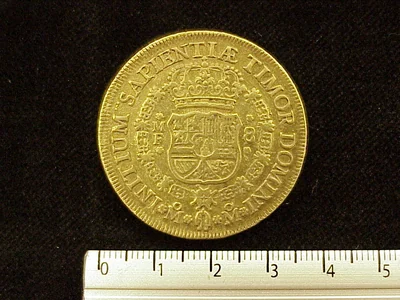
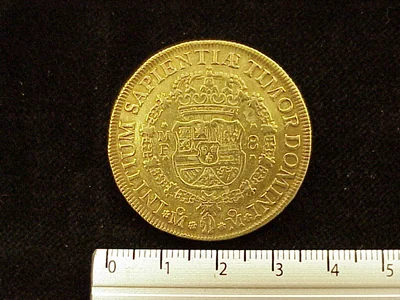
- Type: Royal / milled 8 Escudos, Felipe V portrait or shield-and-pillars design depending on the exact issue
At about 23.6 grams of pure gold, the melt value alone puts a hard floor under this coin. As of recent gold prices, that intrinsic content is worth well over USD 1,500 no matter the condition. But nobody who knows what this coin is sells it for melt.
What it's really worth in 2026
Most old coins are worth pocket change. This one is the opposite. Value is driven by three things: the gold content (the floor), the historical rarity of pre-1740 Mexican gold, and the grade.
| Condition | Typical value (USD) |
|---|---|
| Damaged / heavily worn (jewelry, holed, cleaned) | 1,500 - 2,500 (near melt) |
| Circulated, honest wear (VF) | 3,000 - 6,000 |
| About Uncirculated (AU) | 7,000 - 15,000 |
| Mint State, certified (MS-62 and up) | 15,000 - 35,000+ |
Early Bourbon Mexican 8 Escudos in high grade are genuinely scarce. Well-struck pillar-type and portrait 8 Escudos from the 1730s regularly cross USD 10,000 at Heritage Auctions and Stack's Bowers when certified by NGC or PCGS. Shipwreck-recovery examples with documented provenance can command premiums on top of that.
The honest caveat: exact hammer prices depend on the specific die type, the assayer combination, and eye appeal. Treat the table as a working range, not a fixed quote.
The myth to ignore
Online listings love to slap "rare 1735 doubloon, worth millions" on anything colonial. That is clickbait. No standard-issue 1735 Mexico 8 Escudos has sold for a million dollars. The genuine record territory for exceptional colonial Mexican gold is in the tens of thousands, not the millions. If a listing quotes a seven-figure price, walk away.
Also ignore the "any old gold coin is the same" thinking in the other direction. This is not a modern bullion coin. Grade and authenticity matter enormously, and a cleaned or repaired example can lose half its numismatic premium.
How to tell if yours is genuine
Counterfeits of colonial gold are common, and most of them fail on the basics:
- Weigh it. A genuine coin weighs 27.01 grams. Chinese-made fakes are almost always underweight or struck in low-purity gold or gold-plated base metal. A digital scale settles most fakes on the spot.
- Measure it. 37 mm diameter. Off by a millimeter or two and you have a problem.
- Check the edge. Diagonal reeding should be crisp and consistent. Cast fakes show mushy or seamed edges.
- Look at the strike. Real dies produce sharp, defined lettering and design. Casts look soft and grainy under magnification.
- Get it certified. For any coin worth over a few thousand dollars, professional grading by NGC or PCGS is the definitive insurance. They authenticate, grade, and seal the coin in a tamper-evident holder that buyers trust worldwide.
Given the value at stake here, we always recommend certification before selling. It typically pays for itself several times over.
Where to sell it (and get a fair price)
Because this is a high-value precious-metal coin, do not sell blind:
- Major auction houses (Heritage, Stack's Bowers) are the best venue for certified high-grade examples. They reach the international collector base that pays top dollar for colonial gold.
- Established coin dealers who handle world and ancient gold will make offers and can broker to serious buyers. Get more than one quote.
- A verified numismatic shop from the Pesoteca shop directory can appraise it in person.
- The Pesoteca buy/sell forum connects you with collectors directly.
Whatever route you choose: photograph the obverse, reverse, and edge, note the exact weight, and never let a coin like this go to the first casual offer on social media. Get it graded first if it looks uncirculated.
This piece belongs to the Colonial Escudos gold series and the broader Colonial / Viceroyalty era. You can also compare other Mexican 8 Escudos and coins from 1735.
Not sure what grade your coin is, or whether it might be a fake? Post clear photos of both sides and the edge in the Pesoteca forum and let the community weigh in before you sell.
Historical context
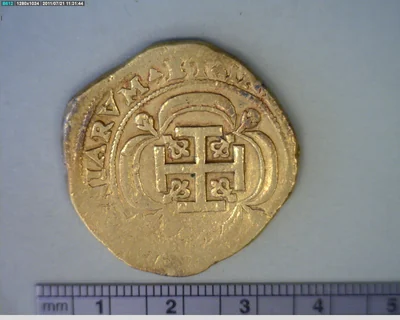
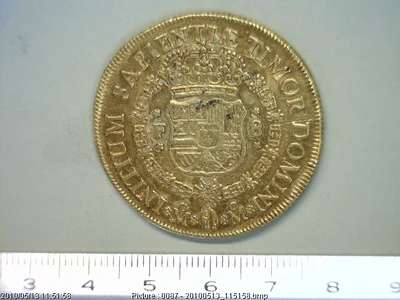
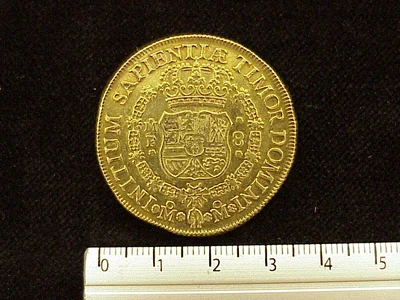
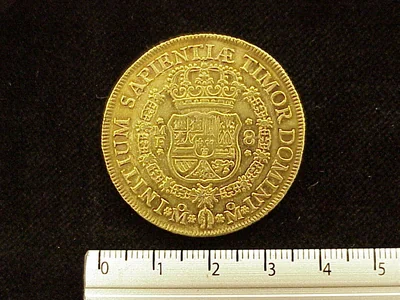
Eight escudos, Philip V second period, 1735, Mexico mint, assayer MF. The record lists the catalog reference as KM#748, atypical within the normal range of Mexican pillar coinage and a probable supplement variant documented by Krause. In 1735 New Spain was governed by Juan Antonio de Vizarrón y Eguiarreta, Archbishop of Mexico and interim viceroy since 1734. His government was especially significant because it faced the matlazáhuatl epidemic of 1736-1739 that devastated the indigenous population of the country's central region. The ounce weighs 27.06 grams with the .916 fineness typical of the early pillar coinage. It was already produced with the new mill technology introduced in 1732: a prefabricated round planchet and press striking rather than hammer striking. This made it possible to standardize weight and diameter, and for the first time there was an edge treated with an inscription or mechanical decoration that made clipping difficult. The obverse shows the crowned royal shield with the legend PHILIP V DEI GRATIA, and the reverse the pair of crowned Pillars of Hercules over the sea with the band PLVS VLTRA, iconography declaring Spain's overseas empire. The MF signature represents two assayers of the capital's workshop whose combined mark dominates the gold output of the years 1734-1747.
This piece belongs to the era
Colonial / Virreinato →Explore all the Mexican coins of this era, their historical context and how they connect to the monetary system of the period.
Value range of this piece
Market estimate: $51,365 - $86,510 MXN depending on the grade of preservation (typical range between a circulated and an uncirculated piece).
See the full breakdown by grade (VG, F, VF, EF, AU, MS-60, MS-63, MS-65) for the whole series →
Same denomination, other years
8 escudos Oro 0.875 (21k) · Escudos Coloniales (oro)
Frequently asked questions
How much is a 1735 Mexico 8 Escudos gold coin worth?
It depends heavily on condition and authenticity. A worn or damaged example is worth roughly its gold content, around USD 1,500 to 2,500. Circulated coins with honest wear run USD 3,000 to 6,000, and certified Mint State examples regularly bring USD 15,000 to over 35,000 at Heritage or Stack's Bowers auctions. Get it professionally graded before assuming a number.
Is the 1735 8 Escudos rare?
Yes. Early Bourbon Mexican gold from the 1730s is genuinely scarce, especially in high grade. It was struck at the Mexico City mint in .875 fine gold and survived in far smaller numbers than later coinage. That scarcity, on top of the gold content, is what pushes prices into five figures for well-preserved examples.
How do I tell if my 8 Escudos is genuine?
Start with weight and size: a real coin is 27.01 grams and 37 mm with diagonal reeded edges. Counterfeits, often from overseas, are usually underweight or made of lower-purity gold, so a scale catches most fakes. The strike and lettering should be sharp, not grainy. For any coin worth more than a few thousand dollars, certification by NGC or PCGS is the definitive proof of authenticity.
Where can I sell a 1735 8 Escudos?
For high-grade or certified coins, major auction houses like Heritage and Stack's Bowers reach the international buyers who pay the most. Established world-gold dealers will also make offers, get more than one. You can also use a verified numismatic shop from the Pesoteca directory for an in-person appraisal, or the Pesoteca buy/sell forum to reach collectors directly. Always photograph both sides and the edge, and never sell to the first casual offer.
Conversation
0 comments
Sources
Images for informational and educational purposes, attributed to their original source. Reference values; the real price depends on the grade, the specific variant and demand.
Loading comments…