
8 Escudos 1738 Felipe V: Colonial Gold Cob Value
The 8 Escudos 1738 Felipe V: Colonial Gold Cob Value is worth between $51,403 and $86,574 MXN depending on its grade of preservation.
Prices updated: August 2026
Viceroyalty · Mexico City Mint · Assayer MF
Viceroyalty · Mexico City Mint · Assayer MF
The 8 Escudos 1738 Felipe V: Colonial Gold Cob Value is worth between $51,403 and $86,574 MXN depending on its grade of preservation.
Prices updated: August 2026
How much is the 8 Escudos 1738 Felipe V: Colonial Gold Cob Value worth?
The estimated value of the 8 Escudos 1738 Felipe V: Colonial Gold Cob Value ranges from $51,403 (circulated, XF) up to $86,574 (official blister pack), with $73,785 as a reference for an uncirculated (UNC) piece. The estimate is based on the official mintage and the historical behavior of the family.
The real price depends on four factors: the grade of preservation (a circulated piece is worth the low end of the range; an uncirculated one, or one still in its official blister pack, the high end), the finish (satin vs mirror/proof), the rarity within the series based on the mintage, and the metal spot price on the day of the deal when the piece is silver or gold. Check the value-by-grade table above and compare with equivalent pieces before buying or selling.
Where to buy or sell this coin?
Browse the national directory of numismatic shops or the community forum to trade directly with other collectors.
Description
If you inherited a heavy gold coin marked "8 escudos" with a 1738 date and a Spanish king's name, you have something real. This is genuine colonial gold, struck in Mexico City under King Felipe V. The floor value is the gold itself, roughly 1,300 to 1,500 USD depending on the spot price. Well-preserved examples sell for far more.
Here is the honest picture, without the myth that every old coin is a fortune.
What you actually have
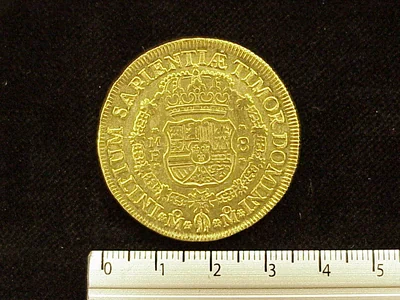
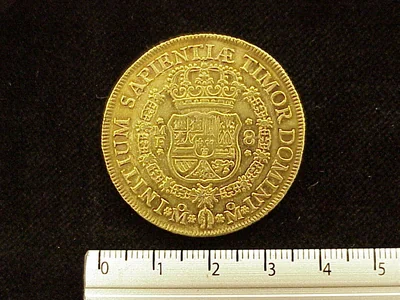
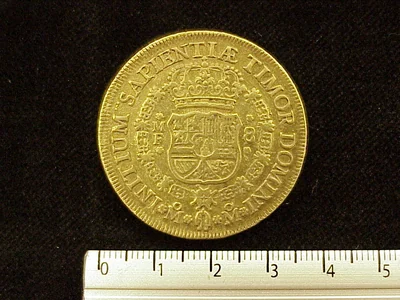
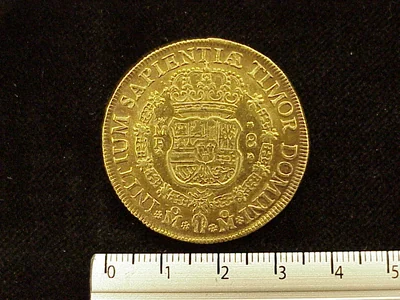
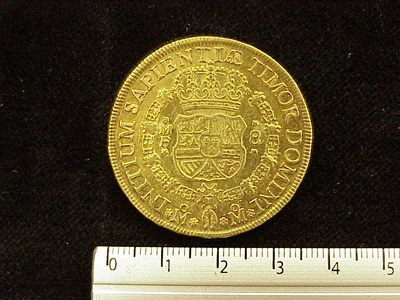
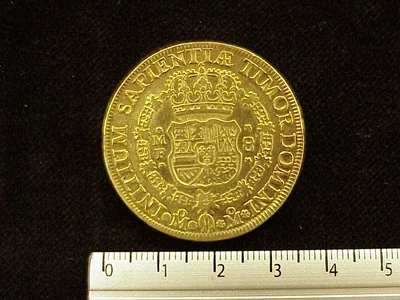
The 8 Escudos was the largest gold denomination of the Spanish colonial system, the coin the world called the "doubloon." Yours was struck in 1738 during the first reign of King Felipe V, the first Bourbon on the Spanish throne, at the Casa de Moneda in Mexico City (the mint in New Spain, colonial Mexico). The assayer's mark for this piece is MF, the initials of the mint official who certified the metal.
Hard specs, verify these against your coin before anything else:
| Feature | Value |
|---|---|
| Denomination | 8 Escudos (gold) |
| Year | 1738 (single-year issue in this listing) |
| Metal | Gold, .875 fine (21 karat) |
| Weight | 27.03 grams |
| Diameter | 37 mm |
| Edge | Diagonal reeded |
| Mint | Mexico City |
| Assayer | MF |
At .875 fineness and 27.03 grams, the coin contains about 23.65 grams of pure gold, roughly 0.76 troy ounces. That is your melt floor. At current gold prices that alone is worth well over 1,300 USD, and a genuine 8 Escudos never sells below its gold content.
What it is really worth
Value splits into two questions, and most people only ask the first one.
As gold: the bullion floor is around 1,300 to 1,500 USD, moving with the spot price. Even a worn, damaged, seawater-recovered example holds this value because the gold is the gold.
As a collectible: this is where prices climb, and where grade decides everything. Colonial 8 Escudos from Mexico City in solid collector grade routinely bring 2,000 to 6,000 USD at auction. High-grade, sharply struck examples with clear king's portrait or full pillars-and-arms design go well into five figures. The Bourbon-era "portrait" and "pillar" types are among the most collected colonial gold coins in the world, and US and international buyers compete for them.
Be realistic about condition. Colonial gold circulated hard, and many surviving pieces are the earlier hand-struck "cob" style, irregular and crudely struck. A coin that looks lumpy, off-center, or has weak legends is not defective, that is how many were made, but it grades lower than a fully round, sharp milled example.
The myth to kill
Age alone does not make a coin rare. A 1738 date sounds ancient and valuable, and the coin genuinely is old, but Mexico City produced 8 Escudos across many years and the type is well known to collectors. What lifts one above the melt price is grade, eye appeal, sharpness of strike, and certified authenticity, not the fact that it is from the 1700s.
Also ignore any "worth millions" claims you find on content-farm sites. Genuine record prices for Spanish colonial 8 Escudos sit in the thousands to low tens of thousands for exceptional pieces, not the millions. A specific known example commands a specific known price, and no ordinary circulated 1738 doubloon is a seven-figure coin.
How to tell if yours is genuine
The single fastest fake-killer is the weight. A real one is 27.03 grams. Counterfeits, especially low-fineness gold-plated fakes from overseas, almost never match both the correct weight and the correct 37 mm diameter at the same time. Weigh it on a jeweler's scale.
Checklist before you trust it:
- Weight: should be very close to 27.03 g. A light coin is a red flag.
- Diameter: 37 mm.
- Edge: diagonal reeding, not smooth and not a modern straight reed.
- Sound and feel: solid gold has a specific density; a coin that feels light for its size is suspect.
- Detail consistency: cast fakes show soft, mushy detail and sometimes a seam on the edge.
For anything you believe is worth more than a few hundred dollars, get it graded and encapsulated by NGC or PCGS, the two internationally recognized grading services. A certified holder is what turns "I think it's real" into a coin buyers will pay top price for.
Where to sell it (and where not to)
Because this is a precious-metal coin, you always have a buyer at the melt price. But if it is a nice example, selling it as scrap gold leaves money on the table.
- Major auction houses (Heritage Auctions, Stack's Bowers) are the right home for a high-grade, certified example. They reach the international collector base that pays the strongest prices for colonial gold.
- Reputable coin dealers will make an offer on the spot; expect them to pay below retail since they resell.
- The Pesoteca buy-and-sell forum connects you directly with collectors of Mexican and colonial numismatics.
- Verified shops in the Pesoteca directory can appraise it in person.
Whatever route you choose, photograph the obverse, reverse, and edge clearly, and never ship a gold coin without insured, tracked shipping. Get the coin graded first if it looks premium; the grading fee is small next to the price difference a slab makes.
Related on Pesoteca
This piece belongs to the Colonial Escudos gold series from the Colonial / Viceroyalty era. Compare it with other Mexican 8 escudos and other coins dated 1738.
Have a 1738 doubloon and not sure if it is a cob or a milled strike? Post clear photos of both sides and the edge in the Pesoteca forum and the community will help you place it.
Historical context
Eight escudos Felipe V second period, 1738, Mexico Mint, assayer MF. Krause references the type as KM#148. Third year of the matlazahuatl epidemic that had afflicted New Spain since 1736, with Vizarron y Eguiarreta serving simultaneously as interim viceroy and archbishop. In Europe, the preliminary Treaty of Vienna was being signed in November, closing the War of the Polish Succession, a conflict in which Spain recovered Naples and Sicily for Felipe V's son Carlos, the future Carlos III. The ounce weighs 27.06 grams with 0.916 fineness. Produced by mill with a round planchet standardized since the reform of 1732. The pillar reverse showed the two crowned columns of Hercules and the banners with PLVS VLTRA, symbol of the overseas Spanish empire. The assayers MF sign the fineness guarantee in the field. Pieces from this year were part of the annual shipment of precious metals to Cadiz aboard the fleet of New Spain, a route that called at Havana before crossing the Atlantic. Gold production in 1738 held up despite the internal epidemic context.
This piece belongs to the era
Colonial / Virreinato →Explore all the Mexican coins of this era, their historical context and how they connect to the monetary system of the period.
Value range of this piece
Market estimate: $51,403 - $86,574 MXN depending on the grade of preservation (typical range between a circulated and an uncirculated piece).
See the full breakdown by grade (VG, F, VF, EF, AU, MS-60, MS-63, MS-65) for the whole series →
Same denomination, other years
8 escudos Oro 0.875 (21k) · Escudos Coloniales (oro)
Frequently asked questions
How much is a 1738 Felipe V 8 Escudos worth?
The gold content alone is worth about 1,300 to 1,500 USD, and no genuine example sells below that. As a collectible, solid circulated pieces bring roughly 2,000 to 6,000 USD at auction, and high-grade certified examples reach five figures. Grade and authenticity drive the difference, so certified NGC or PCGS coins always sell for more.
Is the 1738 8 Escudos rare?
It is genuine colonial gold and desirable, but age alone does not make it rare. Mexico City struck 8 Escudos across many years, and the type is well known to collectors worldwide. Real value comes from grade, sharp strike, and certified authenticity rather than the 1738 date by itself.
How can I tell if my 8 Escudos is genuine?
Weight is the fastest test: a real one is 27.03 grams at 37 mm with diagonal reeded edge. Overseas fakes rarely match both correct weight and diameter. Cast counterfeits show soft, mushy detail and sometimes an edge seam. For anything you think is valuable, have it graded by NGC or PCGS, which is the definitive verification.
Where can I sell a 1738 8 Escudos?
For a high-grade certified example, major auction houses like Heritage Auctions or Stack's Bowers reach the strongest international buyers. Reputable dealers will make an on-the-spot offer below retail. The Pesoteca buy-and-sell forum connects you with collectors directly. Photograph the obverse, reverse, and edge, and get it graded first if it looks premium.
Conversation
0 comments
Sources
Images for informational and educational purposes, attributed to their original source. Reference values; the real price depends on the grade, the specific variant and demand.
Loading comments…