
8 Escudos Fernando VI 1755: Value of the Mexican Gold Onza
The 8 Escudos Fernando VI 1755: Value of the Mexican Gold Onza is worth between $51,346 and $86,478 MXN depending on its grade of preservation.
Prices updated: August 2026
Viceroyalty · Mexico City Mint · Assayer MM
Viceroyalty · Mexico City Mint · Assayer MM
The 8 Escudos Fernando VI 1755: Value of the Mexican Gold Onza is worth between $51,346 and $86,478 MXN depending on its grade of preservation.
Prices updated: August 2026
How much is the 8 Escudos Fernando VI 1755: Value of the Mexican Gold Onza worth?
The estimated value of the 8 Escudos Fernando VI 1755: Value of the Mexican Gold Onza ranges from $51,346 (circulated, XF) up to $86,478 (official blister pack), with $73,703 as a reference for an uncirculated (UNC) piece. The estimate is based on the official mintage and the historical behavior of the family.
The real price depends on four factors: the grade of preservation (a circulated piece is worth the low end of the range; an uncirculated one, or one still in its official blister pack, the high end), the finish (satin vs mirror/proof), the rarity within the series based on the mintage, and the metal spot price on the day of the deal when the piece is silver or gold. Check the value-by-grade table above and compare with equivalent pieces before buying or selling.
Where to buy or sell this coin?
Browse the national directory of numismatic shops or the community forum to trade directly with other collectors.
Description
If you inherited a heavy gold coin marked "FERDIN VI" dated 1755, you are holding a genuine piece of colonial history with real weight behind it. This is a Spanish colonial 8 Escudos struck in Mexico City, and its floor value in 2026 is set by the gold it contains: roughly 23.6 grams of pure gold, worth well over 1,400 USD at spot even in worn condition. A collectible, authenticated example can reach several thousand dollars or more.
Unlike most "old coins" that turn out to be worth pocket change, the 8 Escudos is different. It is a large gold coin, so it can never be worth less than its melt value. The question is never "is it worth anything," it is "how much above melt," and that depends on authenticity, grade, and how the market values this specific date.
What this coin actually is
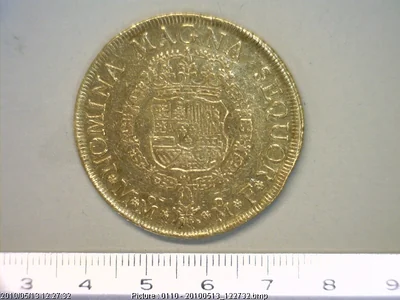
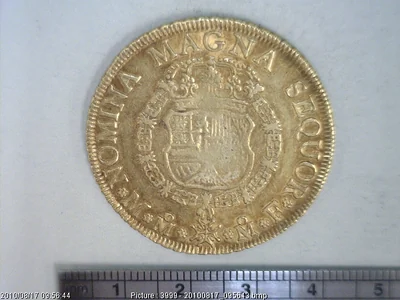
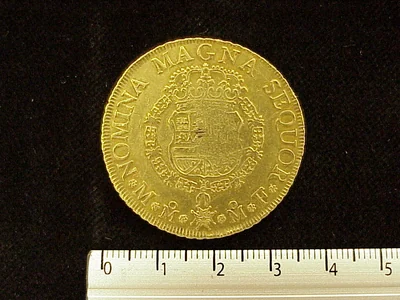
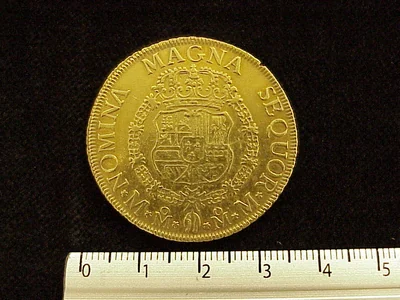
The 8 Escudos was the largest gold denomination of the Spanish colonial system, often called an "onza" (ounce) in Spanish, though it is not a full troy ounce of gold. This one was struck in 1755 under King Fernando VI of the Bourbon dynasty, minted at the Casa de Moneda in Mexico City (then the capital of the viceroyalty of New Spain).
Collectors in the US often know these coins by another name: the doubloon. The 8 Escudos is the classic gold doubloon of pirate and treasure-fleet lore, which is part of why demand for genuine examples stays strong.
Key specifications (check yours against these)
| Specification | Value |
|---|---|
| Denomination | 8 Escudos (gold) |
| Year | 1755 |
| Ruler | Fernando VI |
| Mint | Mexico City (Casa de Moneda) |
| Assayer mark | MM |
| Weight | 27 grams |
| Diameter | 36 mm |
| Fineness | 0.875 gold (21 karat) |
| Pure gold content | approx. 23.6 grams |
| Edge | reeded and incuse |
That weight and diameter matter. If your coin does not weigh close to 27 grams or measure about 36 mm, treat it as suspect. Gold does not lie: a fake in lower-purity metal will almost always come in under weight or off on size.
What it is worth in 2026
There are two ways to value a coin like this, and you need to understand both.
Melt value (the floor). With roughly 23.6 grams of pure gold, the coin's intrinsic metal value tracks the gold spot price. In 2026, that puts the absolute floor well above 1,400 USD, and it moves with the gold market. No genuine example will ever sell below this figure to a dealer who tests the metal.
Numismatic value (the real prize). Genuine, well-preserved colonial 8 Escudos routinely sell for multiples of melt. Circulated but authentic examples of Fernando VI 8 Escudos commonly trade in the 2,000 to 4,000 USD range, and pieces in high grade with strong eye appeal, especially those certified by NGC or PCGS, can reach five figures. Type and rarity of the exact date and assayer combination drive the premium.
Because auction results for this specific 1755 Mexico City date vary widely by grade and condition, treat any single quoted price with caution. What holds true: this is a coin worth thousands, not tens of dollars, if genuine.
The catch: fakes are everywhere
Here is the honest part. The 8 Escudos, especially the doubloon-era Spanish colonial pieces, is one of the most heavily counterfeited coin types in the world. Gold-plated base metal fakes and lower-purity copies flood online marketplaces, and many were produced decades ago as tourist souvenirs.
The good news is that weight and dimensions catch most of them instantly. A real coin is 27 grams of 21-karat gold. A plated fake is usually lighter or heavier depending on the base metal, and rarely matches both weight and diameter at once. If yours is even a few grams off, be skeptical.
For a coin worth this much, do not guess. Certification by NGC or PCGS, the two major US grading services, is the definitive test. They authenticate, grade, and seal the coin, which also raises its resale value.
How to check what yours is worth
- Weigh it on a jeweler's or kitchen scale accurate to 0.1 gram. It should read close to 27 grams.
- Measure the diameter. It should be about 36 mm.
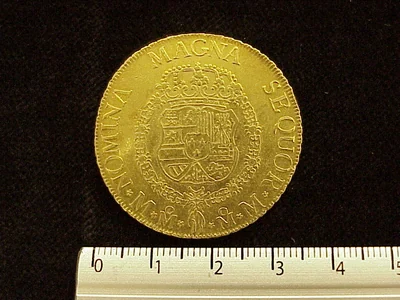
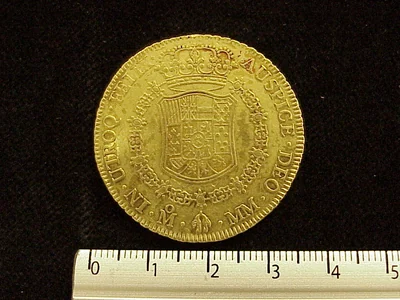
- Photograph both sides and the edge in good light. The edge should show the reeded, incuse pattern, not a smooth or seam-lined edge (a visible seam means a cast fake).
- Read the assayer mark and legends. Fernando VI, 1755, Mexico mint, assayer MM.
- Get it authenticated before selling anything above a few hundred dollars. A grading submission or a formal appraisal at a numismatic dealer is worth the fee on a coin at this value level.
Where to sell it
For a genuine gold 8 Escudos, you have real options and you should not accept the first lowball offer:
- A verified numismatic dealer from the Pesoteca shop directory, who can appraise and buy on the spot. For a coin this valuable, a dealer who tests the metal in front of you is worth the trip.
- The Pesoteca buy-and-sell forum, where collectors who understand colonial gold will pay closer to true market value than a pawn shop.
- Major auction houses (Heritage, Stack's Bowers) if the coin grades high. Certified colonial gold performs well at auction, and consignment reaches serious buyers worldwide.
Whatever you do, never sell to a buyer who will not let you show the coin's weight and edge, and never melt a genuine example. Its collectible value almost always beats its scrap gold value.
Do you have a 1755 Fernando VI 8 Escudos, or another colonial gold coin you inherited and can't identify? Post clear photos of both faces and the edge in the Pesoteca forum and let the community help you confirm what you have before you sell.
Historical context
Eight escudos Fernando VI, 1755, Mexico Mint, assayer MM, Krause KM#151. A year of transition in the viceroyalty: Francisco de Guemes y Horcasitas, Count of Revillagigedo, left the post in November after nine years in office. He was succeeded by Agustin de Ahumada y Villalon, Marquis of Las Amarillas, viceroy from 1755 to 1760. The signature also changes: MM appears in place of MF, a sign of turnover in the assayer team of the capital workshop. It was also the year of the great Lisbon earthquake on November 1, which was felt across the Iberian peninsula and shook the European Enlightenment conscience. The onza weighs 27.06 grams with 0.916 fineness. Produced by mill with a round planchet, classic pillar reverse with crowned Hercules columns and PLVS VLTRA. Krause keeps KM#151 for this final stretch of the reign.
This piece belongs to the era
Colonial / Virreinato →Explore all the Mexican coins of this era, their historical context and how they connect to the monetary system of the period.
Value range of this piece
Market estimate: $51,346 - $86,478 MXN depending on the grade of preservation (typical range between a circulated and an uncirculated piece).
See the full breakdown by grade (VG, F, VF, EF, AU, MS-60, MS-63, MS-65) for the whole series →
Same denomination, other years
8 escudos Oro 0.875 (21k) · Escudos Coloniales (oro)
Frequently asked questions
How much is an 8 Escudos Fernando VI 1755 worth?
It depends heavily on authenticity and grade. The gold content alone (about 23.6 grams pure) sets a floor above 1,400 USD in {{AÑO}}, moving with the gold price. A genuine circulated example typically sells for 2,000 to 4,000 USD, and high-grade certified pieces can reach five figures. Get it authenticated before selling anything at this value level.
How do I know if my 8 Escudos Fernando VI 1755 is genuine?
Weight and size are the fastest test. A real coin weighs 27 grams and measures 36 mm, in 0.875 gold. Fakes are usually off on weight or diameter, and cast copies show a visible edge seam instead of the reeded, incuse edge. This is one of the most counterfeited coin types in the world, so for a piece worth thousands, certification by NGC or PCGS is the definitive proof.
Where can I sell an 8 Escudos Fernando VI 1755?
Use a verified dealer from the [Pesoteca shop directory](/tiendas) who can appraise and pay on the spot, the [Pesoteca buy-and-sell forum](/foro/compra-venta) among collectors, or a major auction house like Heritage or Stack's Bowers for high-grade certified coins. Photograph both faces and the edge, and never sell to a buyer who won't let you show the coin's weight.
Is the 8 Escudos Fernando VI 1755 rare?
Colonial gold 8 Escudos are scarce and desirable, and the 1755 Mexico City date under Fernando VI is a sought-after type. Exact mintage figures for this issue are not reliably documented. Rarity within the type is driven mostly by grade and condition: worn examples are relatively available, while high-grade certified pieces are genuinely hard to find and command strong premiums.
Conversation
0 comments
Sources
Images for informational and educational purposes, attributed to their original source. Reference values; the real price depends on the grade, the specific variant and demand.
Loading comments…