
8 Escudos Carlos III 1761: Gold Colonial Coin Value
The 8 Escudos Carlos III 1761: Gold Colonial Coin Value is worth between $51,384 and $86,542 MXN depending on its grade of preservation.
Prices updated: August 2026
Viceroyalty · Mexico City Mint · Assayer MM
Viceroyalty · Mexico City Mint · Assayer MM
The 8 Escudos Carlos III 1761: Gold Colonial Coin Value is worth between $51,384 and $86,542 MXN depending on its grade of preservation.
Prices updated: August 2026
How much is the 8 Escudos Carlos III 1761: Gold Colonial Coin Value worth?
The estimated value of the 8 Escudos Carlos III 1761: Gold Colonial Coin Value ranges from $51,384 (circulated, XF) up to $86,542 (official blister pack), with $73,757 as a reference for an uncirculated (UNC) piece. The estimate is based on the official mintage and the historical behavior of the family.
The real price depends on four factors: the grade of preservation (a circulated piece is worth the low end of the range; an uncirculated one, or one still in its official blister pack, the high end), the finish (satin vs mirror/proof), the rarity within the series based on the mintage, and the metal spot price on the day of the deal when the piece is silver or gold. Check the value-by-grade table above and compare with equivalent pieces before buying or selling.
Where to buy or sell this coin?
Browse the national directory of numismatic shops or the community forum to trade directly with other collectors.
Description
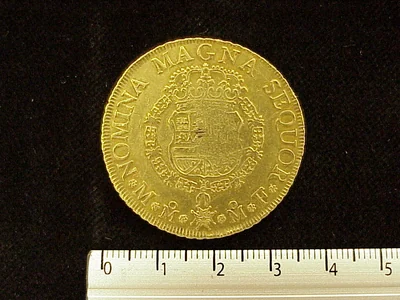
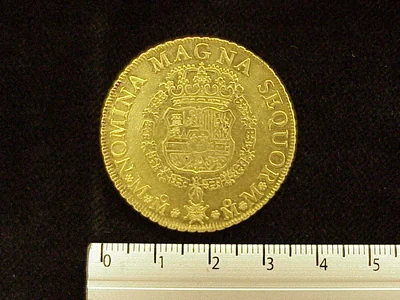
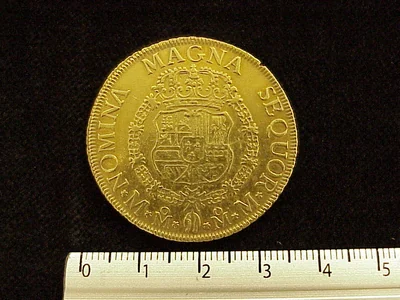
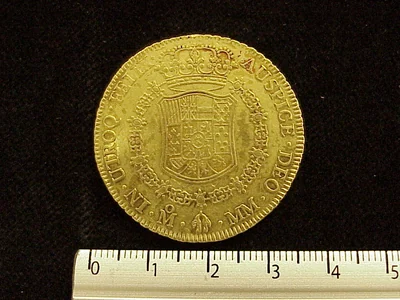
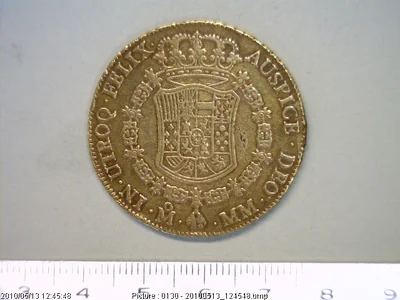
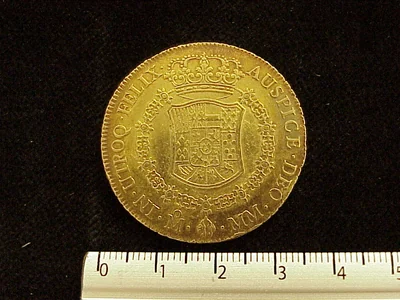
If you inherited an 1761 8 Escudos with Carlos III on it, you are holding a serious piece of gold, not pocket change. This is a 27.02-gram coin struck in 0.875 fine gold (about 21 karat). Even at melt, that puts a hard floor of well over 1,500 USD under it in 2026, and a genuine, well-preserved example sells for far more.
Here is the honest breakdown of what it is, what it is worth, and how to make sure yours is real before you sell.
What you actually have
The 8 Escudos was the largest gold denomination of the Spanish colonial era. This one was minted in 2026's distant past, in 1761, at the Mexico City Mint (Casa de Moneda de México) during the reign of Carlos III, when Mexico was still the viceroyalty of New Spain under the Spanish Crown. Collectors and dealers sometimes call these coins "doubloons."
The hard specs, which matter for both value and authentication:
| Spec | Detail |
|---|---|
| Denomination | 8 Escudos (gold) |
| Year | 1761 (single year for this type) |
| Metal | Gold, 0.875 fine (about 21k) |
| Weight | 27.02 grams |
| Diameter | 36 mm |
| Edge | Chain (cordoncillo) pattern |
| Mint | Mexico City |
| Assayer mark | MM |
The assayer initials (MM) and the mint mark are part of what makes each variety collectible, so do not clean or polish the coin. Cleaning a gold colonial coin can cut its value dramatically.
What it is worth
There are two values in play, and you need to understand both.
The metal floor. At 27.02 grams of 0.875 gold, this coin contains roughly 23.6 grams (about 0.76 troy ounces) of pure gold. That gives it a bullion floor that moves with the gold spot price. In 2026, that floor alone is well over 1,500 USD. No genuine 8 Escudos is ever worth less than its gold content, which is why it will always find a buyer.
The numismatic value. This is where condition decides everything. A worn, well-circulated example trades close to melt plus a modest collector premium. A sharp, problem-free coin, and especially one certified by NGC or PCGS in a high grade, sells for a strong multiple of melt. Colonial 8 Escudos in choice condition have realized several thousand dollars at auction, and truly exceptional certified examples have gone higher.
Be realistic: most 8 Escudos that surface from a family estate are circulated, not gem. That is still a valuable coin, just not a record-setter. The single biggest swing in price is grade, so getting an honest grade is the whole game.
The mintage question (and why nobody quotes an exact number)
You will see forums throw around mintage figures for this issue. Treat them with caution. Precise mint records for early colonial gold are incomplete, and no firm, verifiable production number exists for the 1761 8 Escudos. What matters more than a mintage number is survivors: how many genuine examples exist today in any given grade. For colonial gold, high-grade survivors are scarce, which is exactly why condition drives the price.
How to tell if yours is genuine
Gold colonial coins are among the most counterfeited pieces in the market, so verify before you celebrate.
- Weigh it. A real one is 27.02 grams. Get a scale that reads to 0.01 grams. Most fakes come in light because the counterfeiter used lower-purity gold or a base-metal core.
- Measure it. 36 mm diameter. Off-size is a red flag.
- Check the edge. It should show the chain (cordoncillo) pattern, not a plain or reeded edge.
- Look at the details. Mushy lettering, wrong assayer marks, or a greasy "too new" surface on a coin from 1761 all point to a modern reproduction. Many fakes are cast rather than struck.
- When in doubt, certify. For a coin in this value range, submit it to NGC or PCGS. Their authentication and grade are the final word and make the coin far easier to sell for full value.
If a single spec is off, weight or diameter especially, assume it is a fake until an expert says otherwise.
Where to sell it
Because this is a precious-metal coin, you always have the melt floor as a backstop, but you want more than melt if the coin is genuine and decent.
- A verified numismatic dealer appraises it on the spot and quotes a fair price. This is the safest route for a coin worth thousands.
- A major auction house (Heritage, Stack's Bowers) is the right venue for a high-grade or certified example, where competitive bidding gets you the top number.
- Collector forums and marketplaces can work, but only with clear photos of the obverse, reverse, and edge, plus the exact weight. Never ship or hand over a coin like this before verifying the buyer.
Get it graded first if it looks high quality. A certified 8 Escudos sells faster and for more than a raw one, because the buyer is not gambling on authenticity.
This piece belongs to the Colonial Escudos gold series and the broader Colonial viceroyalty era. You can also compare other Mexican 8 Escudos and other coins from 1761.
Got one in the family box and not sure what grade it is? Post clear photos of both sides and the edge in the Pesoteca forum and let the community weigh in before you sell.
Historical context
Eight escudos Carlos III, 1761, Mexico Mint, assayer MM, Krause KM#153. The year Carlos III signed the Third Family Pact with France and entered the Seven Years' War against England. Spain would temporarily lose Havana and Manila the following year. In New Spain, Joaquin de Montserrat, Marquis of Cruillas, was governing, viceroy from October 1760 until 1766. His administration had to reinforce the defense of New Spain against the risk of an English invasion. The ounce weighs 27.06 grams with a fineness of 0.916. Krause keeps KM#153 for 1761. Produced by milling with a round planchet, a classic pillar reverse with the crowned Pillars of Hercules and PLVS VLTRA. The MM signature of the assayers is a continuity of the capital's mint. Pieces from this year carry symbolic weight: they are testimony to the start of the transatlantic war that would reorganize the American colonial map in 1763.
This piece belongs to the era
Colonial / Virreinato →Explore all the Mexican coins of this era, their historical context and how they connect to the monetary system of the period.
Value range of this piece
Market estimate: $51,384 - $86,542 MXN depending on the grade of preservation (typical range between a circulated and an uncirculated piece).
See the full breakdown by grade (VG, F, VF, EF, AU, MS-60, MS-63, MS-65) for the whole series →
Same denomination, other years
8 escudos Oro 0.875 (21k) · Escudos Coloniales (oro)
Frequently asked questions
How much is an 8 Escudos Carlos III 1761 worth?
Value depends heavily on condition. At minimum it is worth its gold content, roughly 0.76 troy ounces of pure gold, which puts a floor well over 1,500 USD in {{AÑO}}. A genuine, well-preserved or certified example sells for a multiple of that, with choice pieces reaching several thousand dollars at auction.
How can I tell if my 8 Escudos Carlos III 1761 is genuine?
Weigh it and measure it first: a real one is 27.02 grams and 36 mm, with a chain (cordoncillo) edge. Counterfeits, often made from lower-purity gold or a base-metal core, usually come in underweight, so the scale gives them away. For a coin in this value range, certification by NGC or PCGS is the definitive proof of authenticity.
Is the 8 Escudos Carlos III 1761 rare?
No exact mintage is documented for this issue, and forum figures are unverified. What matters is survivors: high-grade genuine examples of colonial gold are scarce, which is why condition drives the price. Circulated examples are more common, but a sharp, problem-free coin is genuinely hard to find.
Where can I sell an 8 Escudos Carlos III 1761?
For a coin worth thousands, use a verified numismatic dealer for an on-the-spot appraisal, or a major auction house like Heritage or Stack's Bowers for a high-grade or certified example. You can also list it in the [Pesoteca buy-and-sell forum](/foro/compra-venta). Always show clear photos of both sides and the edge plus the exact weight, and get it graded first if it looks high quality.
Conversation
0 comments
Sources
Images for informational and educational purposes, attributed to their original source. Reference values; the real price depends on the grade, the specific variant and demand.
Loading comments…