
1739 Mexico 8 Escudos Gold (Felipe V): Value & How to Sell
The 1739 Mexico 8 Escudos Gold : Value & How to Sell is worth between $51,441 and $86,638 MXN depending on its grade of preservation.
Prices updated: August 2026
Viceroyalty · Mexico City Mint · Assayer MF
Viceroyalty · Mexico City Mint · Assayer MF
The 1739 Mexico 8 Escudos Gold : Value & How to Sell is worth between $51,441 and $86,638 MXN depending on its grade of preservation.
Prices updated: August 2026
How much is the 1739 Mexico 8 Escudos Gold (Felipe V): Value & How to Sell worth?
The estimated value of the 1739 Mexico 8 Escudos Gold (Felipe V): Value & How to Sell ranges from $51,441 (circulated, XF) up to $86,638 (official blister pack), with $73,839 as a reference for an uncirculated (UNC) piece. The estimate is based on the official mintage and the historical behavior of the family.
The real price depends on four factors: the grade of preservation (a circulated piece is worth the low end of the range; an uncirculated one, or one still in its official blister pack, the high end), the finish (satin vs mirror/proof), the rarity within the series based on the mintage, and the metal spot price on the day of the deal when the piece is silver or gold. Check the value-by-grade table above and compare with equivalent pieces before buying or selling.
Where to buy or sell this coin?
Browse the national directory of numismatic shops or the community forum to trade directly with other collectors.
Description
If you inherited or found a 1739 Mexico 8 escudos gold coin, you are holding a genuine piece of colonial gold. The short answer: even a worn, damaged example is worth well over 1,800 USD in 2026 just for its gold content, and a certified, well-preserved coin can sell for several thousand dollars. This is not a common pocket coin. It is a heavy gold piece struck at the Mexico City Mint under Spanish colonial rule.
But before you get excited, know this: the market is full of Chinese-made fakes of exactly this type of coin, because the gold value alone makes counterfeiting profitable. The weight is your first and best defense, and we explain that below.
What you actually have
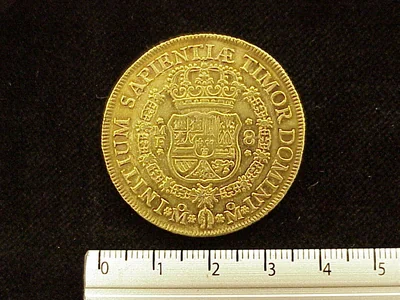
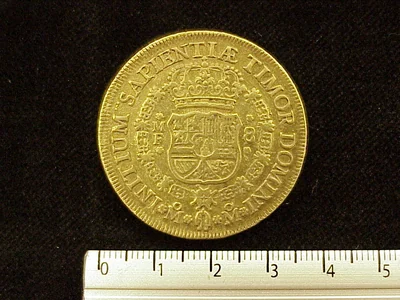
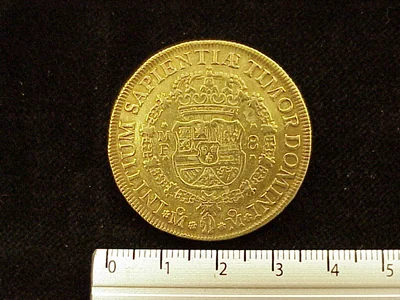
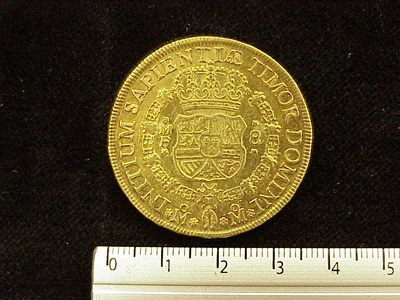
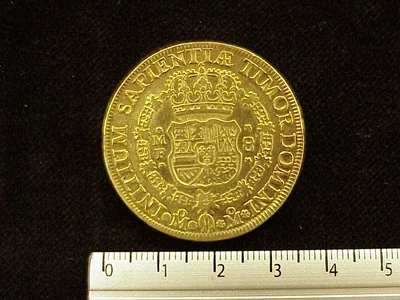
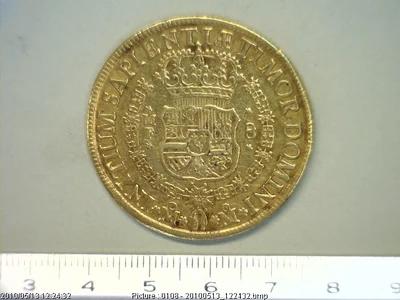
This is an 8 escudos coin, the largest gold denomination of Spain's colonial coinage. Collectors and old texts sometimes call these "doubloons." Yours was struck in 1739 during the first reign of King Felipe V of the Bourbon dynasty, at the Casa de Moneda in Mexico City (then part of the Viceroyalty of New Spain).
The hard specs, which you should verify on your own coin:
- Metal: gold, .875 fine (21 karat)
- Weight: 27.05 grams
- Diameter: 37 mm
- Edge: diagonally reeded
- Mint: Mexico City
- Assayer mark: MF
At .875 fineness and 27.05 grams, the coin contains roughly 23.7 grams of pure gold, close to 0.76 troy ounces. That gives it a hard floor tied to the international gold price. That floor alone is worth well over 1,800 USD at current gold levels, and it moves with the gold market.
What drives the price above melt
Gold content is the floor, not the ceiling. Three things push a colonial 8 escudos above its melt value:
- Authenticity. A confirmed genuine coin is worth far more than a suspicious one. Certification matters here more than almost any other factor.
- Condition (grade). A heavily worn, holed, or ex-jewelry example trades close to melt. A sharp, problem-free coin commands a real numismatic premium.
- Type and date desirability. Early Bourbon Mexico City gold has a steady collector base. This is a recognized, collectible series, not an obscure token.
Because colonial gold from this era was struck by hand and shipped worldwide, condition varies enormously. That is exactly why a certified grade changes the number so much.
Value ranges you can expect
| Condition | What it means | Approximate value (USD) |
|---|---|---|
| Damaged / ex-jewelry / holed | Bent, mounted, or scraped | Near melt, roughly 1,800 to 2,200 |
| Circulated, honest wear | Readable, no damage | Roughly 2,500 to 5,000 |
| Sharp, problem-free | Strong detail, no damage | Roughly 5,000 to 12,000+ |
| Certified high grade (NGC/PCGS) | Verified and encapsulated | Several thousand and up, driven by demand |
These are honest ranges, not fixed prices. The exact number depends on the specific coin in hand, and the only way to nail it down is authentication and grading. Colonial gold this old rarely trades without either damage questions or authenticity questions, so a clean, certified example carries a real premium.
The counterfeit problem (read this before you buy or sell)
Modern fakes of 8 escudos gold coins are common. Most come from China and cheat on the gold content, which means they almost never hit the correct weight. Your coin should weigh 27.05 grams and measure 37 mm. If your piece is off on weight, especially light, treat it as suspect.
Quick checks you can do at home:
- Weigh it on a jeweler's scale (0.01 g precision). It should read very close to 27.05 g.
- Measure the diameter (37 mm) and check for the diagonally reeded edge.
- Gold does not stick to a magnet. If it responds to a magnet, it is not solid gold.
None of these home tests are proof. For a coin worth this much, the definitive answer is certification by NGC or PCGS, the two major US grading services. They authenticate and grade the coin and seal it in a tamper-evident holder. If you plan to buy or sell above a few thousand dollars, that certification pays for itself.
How to check what yours is worth
- Weigh and measure it. Confirm 27.05 g and 37 mm first. This screens out the obvious fakes.
- Photograph both sides and the edge in good light. Serious buyers and appraisers will ask for exactly these images.
- Get it authenticated. For a coin in this value bracket, submit it to NGC or PCGS, or take it to a reputable dealer who will authenticate before quoting.
- Do not clean it. Cleaning colonial gold reduces its value. Leave it exactly as you found it.
Where to sell it
Because this is a precious-metal coin, you always have a buyer at some price, but where you sell decides how much of the premium you keep. Options that make sense:
- Established coin dealers and auction houses that handle world and colonial gold. They will authenticate, and reputable ones pay closer to full market for graded material.
- Verified numismatic shops rather than a generic pawn or scrap-gold buyer, who will likely offer melt only.
- Collector communities for private sales, where you can reach buyers who value the coin as more than metal.
Whatever route you take, sell only after you know whether the coin is genuine and roughly what grade it is. Selling an unauthenticated colonial 8 escudos to the first offer is how people leave thousands of dollars on the table, or unknowingly pass off a fake and create a dispute.
This coin belongs to the Colonial Escudos gold series, from the Colonial / Viceroyalty era. You can also compare other Mexican 8 escudos and other coins dated 1739.
Have one of these and not sure if it is real? Post clear photos of both sides and the edge, plus the exact weight, in the Pesoteca forum and let collectors help you check it before you sell.
Historical context
Eight escudos, Felipe V second period, 1739, Mexico City mint, assayer MF, Krause KM#148. Final year of the great matlazahuatl epidemic that devastated New Spain from 1736. It is also the year of the Royal Decree that created the Viceroyalty of New Granada as a territory separate from Peru, which reorganized the administrative map of the Americas. In Mexico, Vizarron y Eguiarreta continued as interim viceroy, a dual role held with the archbishop's miter. The onza weighs 27.06 grams with 0.916 fineness. Milled production had already been running for seven years at the Mexico City Mint with standardized weight and diameter. The pillar reverse remained without significant changes from the start of the series in 1732: crowned Pillars of Hercules, banners with PLVS VLTRA, crowned royal shield on the obverse. The MF signature is the shared mark of two assayers of the capital's workshop.
This piece belongs to the era
Colonial / Virreinato →Explore all the Mexican coins of this era, their historical context and how they connect to the monetary system of the period.
Value range of this piece
Market estimate: $51,441 - $86,638 MXN depending on the grade of preservation (typical range between a circulated and an uncirculated piece).
See the full breakdown by grade (VG, F, VF, EF, AU, MS-60, MS-63, MS-65) for the whole series →
Same denomination, other years
8 escudos Oro 0.875 (21k) · Escudos Coloniales (oro)
Frequently asked questions
How much is a 1739 Mexico 8 escudos gold coin worth?
It has a hard floor tied to its gold content: roughly 0.76 troy ounces of pure gold, worth well over 1,800 USD in melt alone at current gold prices. Above that, a circulated but undamaged coin typically brings 2,500 to 5,000 USD, and a sharp or certified example can reach several thousand and up. The exact number depends on authenticity and grade, so get it appraised or certified before selling.
Is the 1739 Felipe V 8 escudos rare?
It is a genuinely collectible colonial gold coin, not a common circulation piece, and it has a steady collector base. That said, its value is anchored by its gold content first and its condition second. Truly high value comes from a genuine, problem-free, certified example rather than the date alone.
How do I tell if my 8 escudos is genuine?
Start with the weight and size: it must weigh 27.05 grams and measure 37 mm, with a diagonally reeded edge. Most fakes, often made in China, come in light or off-weight because they skimp on gold, so the scale usually catches them. Gold is also non-magnetic. For a definitive answer on a coin worth this much, submit it to NGC or PCGS for certification.
Where can I sell a 1739 Mexico 8 escudos?
Use an established coin dealer or auction house that handles world and colonial gold, or a verified numismatic shop rather than a scrap-gold or pawn buyer who pays melt only. Authenticate the coin first, photograph both sides and the edge, and know your rough grade before accepting any offer. You can also get a second opinion from collectors in the Pesoteca forum.
Conversation
0 comments
Sources
Images for informational and educational purposes, attributed to their original source. Reference values; the real price depends on the grade, the specific variant and demand.
Loading comments…