
8 Escudos Carlos III 1763 Gold Coin: Value & How to Sell
The 8 Escudos Carlos III 1763 Gold Coin: Value & How to Sell is worth between $51,270 and $86,350 MXN depending on its grade of preservation.
Prices updated: August 2026
Viceroyalty · Mexico City Mint · Assayer MM
Viceroyalty · Mexico City Mint · Assayer MM
The 8 Escudos Carlos III 1763 Gold Coin: Value & How to Sell is worth between $51,270 and $86,350 MXN depending on its grade of preservation.
Prices updated: August 2026
How much is the 8 Escudos Carlos III 1763 Gold Coin: Value & How to Sell worth?
The estimated value of the 8 Escudos Carlos III 1763 Gold Coin: Value & How to Sell ranges from $51,270 (circulated, XF) up to $86,350 (official blister pack), with $73,594 as a reference for an uncirculated (UNC) piece. The estimate is based on the official mintage and the historical behavior of the family.
The real price depends on four factors: the grade of preservation (a circulated piece is worth the low end of the range; an uncirculated one, or one still in its official blister pack, the high end), the finish (satin vs mirror/proof), the rarity within the series based on the mintage, and the metal spot price on the day of the deal when the piece is silver or gold. Check the value-by-grade table above and compare with equivalent pieces before buying or selling.
Where to buy or sell this coin?
Browse the national directory of numismatic shops or the community forum to trade directly with other collectors.
Description
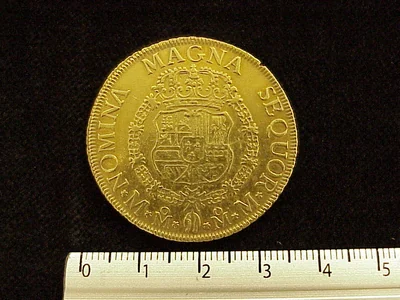
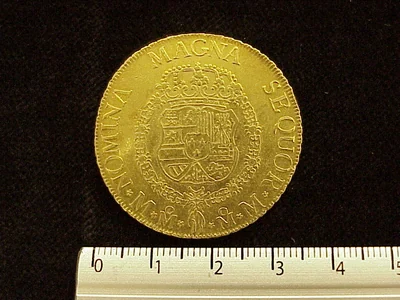
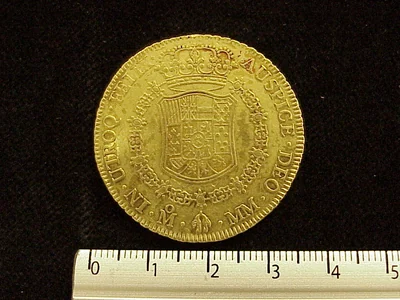
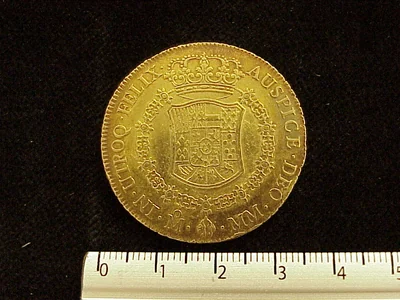
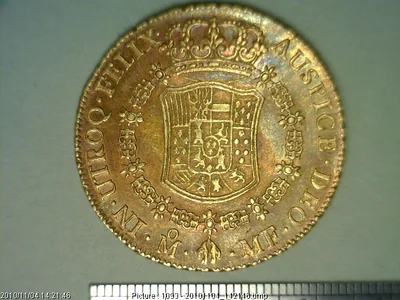
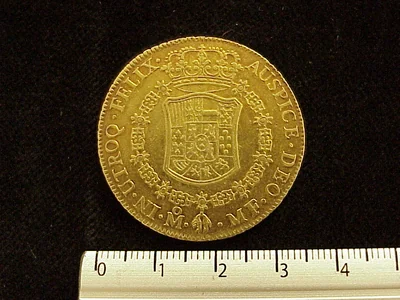
If you inherited an 8 Escudos gold coin dated 1763, you own real colonial gold, not a token. This piece contains 26.96 grams of 0.875 fine gold (about 0.71 troy ounces of pure gold), which sets a hard floor value near USD 1,600 based on the metal alone in 2026. From there, condition and eye appeal decide whether it is worth that floor or several times more.
What this coin actually is
The 8 Escudos was the largest gold denomination struck in the Spanish colonial system. This one was minted in 2026's reference year of 1763 at the Casa de Moneda de México (the Mexico City Mint), during the reign of Carlos III of Spain, while Mexico was still New Spain under the Spanish Crown. Collectors sometimes call these big gold pieces "doubloons," and yes, this is the coin type behind the pirate-treasure reputation.
Hard specs, which matter for spotting fakes:
- Metal: gold, 0.875 fine (21 karat)
- Weight: 26.96 grams
- Diameter: 35.57 mm
- Edge: chain pattern (segmented, not smooth)
- Mint: Mexico City
- Assayer mark: MM
The design is the "pillar and bust" or portrait type, with the bust of the Spanish king on the front and the crowned Spanish arms on the reverse. Note: the reign here is Carlos III, not Carlos II. Carlos II was a Habsburg who died in 1700, so a 1763 coin cannot bear his portrait. If a listing says "Carlos II, 1763," that is a red flag or a typo.
What it is worth
Two values apply, and you need to understand both.
Melt value (the floor). With roughly 0.71 troy ounces of pure gold, the coin is never worth less than its gold content. At recent gold prices that floor sits around USD 1,600. This is the number a bullion dealer will quote you if they do not care about the numismatics. Never sell a colonial gold coin at melt without checking the collector value first.
Collector value (the real prize). Early Mexican 8 Escudos in solid grades trade well above melt. Circulated but honest examples commonly bring USD 2,000 to USD 4,000. Sharp, problem-free coins with good detail run higher, and certified examples in high grade have crossed USD 8,000 to USD 15,000 or more at major auctions. Condition is everything here. A cleaned, scratched, or mount-damaged coin (jewelry-mounted 8 Escudos are common) can fall back toward melt.
| Item | Detail |
|---|---|
| Denomination | 8 Escudos (gold) |
| Year | 1763, Mexico City mint |
| Gold content | ~0.71 troy oz pure |
| Melt floor (2026) | ~USD 1,600 |
| Circulated collector value | USD 2,000 to USD 4,000 |
| High-grade certified | USD 8,000 to USD 15,000+ |
These are guide ranges. The exact number depends on grade, strike, and whether the coin has been damaged or cleaned.
The myth to kill: "any old gold doubloon is worth a fortune"
Age alone does not make this coin rare. The Mexico City Mint produced 8 Escudos across many years, and thousands survive. What separates a USD 2,000 coin from a USD 12,000 coin is condition and originality, not the date. A worn, ex-jewelry piece with a solder scar is still valuable for its gold, but it is not a five-figure coin no matter how old it looks.
Also ignore any claim of a documented mintage figure for this exact issue. Colonial mint records are incomplete, so no reliable official strike number exists. Anyone quoting a precise mintage for the 1763 8 Escudos is guessing.
How to tell if yours is genuine
Counterfeit colonial gold is common, and modern fakes (often from overseas) usually fail on the physical basics.
- Weigh it. A real coin is 26.96 grams. Use a scale that reads to 0.01 g. Fakes are frequently underweight or made of lower-fineness gold.
- Measure it. Diameter should be 35.57 mm.
- Check the edge. Genuine pieces have a chain-pattern edge, not a plain smooth one.
- Look for mount damage. Filed edges, solder blobs, or a drilled hole cut the value hard.
- Get it certified. For a coin in this price range, professional grading from NGC or PCGS is the safest confirmation. Certification both authenticates the coin and locks in a grade, which raises resale value.
If the weight is off, stop there. Correct weight in gold is very hard to fake because gold is so dense.
Where to sell it
Because this is a precious-metal coin worth four figures or more, sell where value is verified, not to the first buyer.
- Reputable coin dealers and auction houses (Heritage, Stack's Bowers) handle Mexican colonial gold regularly and reach serious buyers. Best for high-grade or certified pieces.
- Certified sale: send your best coin to NGC or PCGS first, then sell the graded coin. Buyers pay a premium for certainty.
- Collector communities: vetted numismatic forums and collector groups can get you a fair price, but only deal with buyers who ask for edge and weight photos.
Avoid dumping a colonial gold coin on a general marketplace at the first offer. That is where undervaluation and fraud both happen.
Related pages: browse the full Colonial Escudos (gold) series, the Colonial / Viceroyalty era, other Mexican 8 Escudos, and more coins from 1763.
Got one in a drawer and not sure what grade it is? Post clear photos of the front, back, and edge in the Pesoteca forum and let collectors help you pin down the value before you sell.
Historical context
Eight escudos Carlos III, 1763, Mexico mint, assayer MM, Krause KM#155. Year of the Treaty of Paris that ended the Seven Years' War: Spain returned Havana and Manila in exchange for ceding Florida to England and receiving Spanish Louisiana from France. It was a far-reaching territorial reorganization in North America. In New Spain the Marquis of Cruillas continued as viceroy. The ounce weighs a theoretical 27.06 grams at 0.916 fineness. Produced by mill press with a standardized round planchet. The pillar reverse was maintained with the crowned Pillars of Hercules and PLVS VLTRA, iconography that had been in use for thirty years since the reform of 1732. The MM signature appears in the field as the mark of the workshop's assayers. Pieces of 1763 are material testimony to the imperial turning point that marks the end of the pre-Westphalian Atlantic system.
This piece belongs to the era
Colonial / Virreinato →Explore all the Mexican coins of this era, their historical context and how they connect to the monetary system of the period.
Value range of this piece
Market estimate: $51,270 - $86,350 MXN depending on the grade of preservation (typical range between a circulated and an uncirculated piece).
See the full breakdown by grade (VG, F, VF, EF, AU, MS-60, MS-63, MS-65) for the whole series →
Same denomination, other years
8 escudos Oro 0.875 (21k) · Escudos Coloniales (oro)
Frequently asked questions
How much is a 1763 8 Escudos gold coin worth?
It never sells below its gold content, roughly USD 1,600 at recent prices. Honest circulated examples usually bring USD 2,000 to USD 4,000, and high-grade certified coins have reached USD 8,000 to USD 15,000 or more. Condition and originality drive the number, not the date.
Is the 1763 8 Escudos rare?
Not by age alone. The Mexico City Mint struck 8 Escudos across many years and thousands survive. No reliable official mintage figure exists for this specific issue because colonial records are incomplete. What makes one worth five figures is condition and an undamaged, original surface, not rarity of the date.
How do I tell if my 1763 8 Escudos is genuine?
Check the physical specs first: it must weigh 26.96 grams, measure 35.57 mm, and have a chain-pattern edge. Correct weight is hard to fake because gold is so dense, so an underweight coin is almost certainly counterfeit. For final confirmation on a coin worth this much, get it certified by NGC or PCGS.
Where can I sell a 1763 8 Escudos gold coin?
Sell to reputable coin dealers or auction houses like Heritage or Stack's Bowers that handle Mexican colonial gold, or sell it certified after grading through NGC or PCGS for the best price. You can also post photos in the Pesoteca forum to get a value estimate first. Never sell to the first buyer at melt without checking collector value.
Conversation
0 comments
Sources
Images for informational and educational purposes, attributed to their original source. Reference values; the real price depends on the grade, the specific variant and demand.
Loading comments…