
1762 Mexico 8 Reales Carlos III (Silver Colonial): Value Guide
The 1762 Mexico 8 Reales Carlos III : Value Guide is worth between $749 and $3,153 MXN depending on its grade of preservation.
Prices updated: August 2026
Viceroyalty · Mexico City Mint · Assayer MM
Viceroyalty · Mexico City Mint · Assayer MM
The 1762 Mexico 8 Reales Carlos III : Value Guide is worth between $749 and $3,153 MXN depending on its grade of preservation.
Prices updated: August 2026
How much is the 1762 Mexico 8 Reales Carlos III (Silver Colonial): Value Guide worth?
The estimated value of the 1762 Mexico 8 Reales Carlos III (Silver Colonial): Value Guide ranges from $749 (circulated, XF) up to $3,153 (official blister pack), with $2,279 as a reference for an uncirculated (UNC) piece. The estimate is based on the official mintage and the historical behavior of the family.
The real price depends on four factors: the grade of preservation (a circulated piece is worth the low end of the range; an uncirculated one, or one still in its official blister pack, the high end), the finish (satin vs mirror/proof), the rarity within the series based on the mintage, and the metal spot price on the day of the deal when the piece is silver or gold. Check the value-by-grade table above and compare with equivalent pieces before buying or selling.
Where to buy or sell this coin?
Browse the national directory of numismatic shops or the community forum to trade directly with other collectors.
Description
If you inherited a heavy silver coin marked "8 R" with a Spanish king's portrait and the date 1762, you have a Mexico City 8 Reales struck under Carlos III. In 2026, worn examples trade from roughly 150 to 600 USD, and high-grade or scarce assayer varieties can reach several thousand. Here is what actually drives that number.
What you actually have
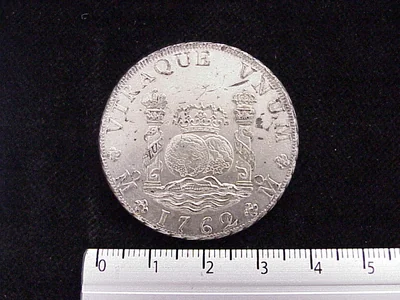
The 8 Reales was the original "Spanish dollar," the piece of eight that circulated worldwide for centuries and later inspired the US dollar itself. Yours was minted in Mexico City (the Mexico mint mark, an "oM" monogram) in 1762 under King Carlos III of Spain, during the colonial period when Mexico was the Viceroyalty of New Spain.
The 1762 date sits at the transition between two designs. Early Carlos III 8 Reales still use the older "pillar dollar" type (two globes between the Pillars of Hercules), while the later type shows the king's bust. Which design you have affects value, so check your coin against reference images before assuming a price.
Specifications (verify yours against these)
| Spec | Value |
|---|---|
| Denomination | 8 Reales |
| Metal | Silver, 0.900 fine (90% silver) |
| Weight | 27.21 grams |
| Diameter | 39 mm |
| Edge | Laureate (decorated, not smooth) |
| Mint | Mexico City |
| Assayer | MM |
| Date | 1762 |
If your coin does not weigh close to 27.21 grams or measure about 39 mm, treat it as suspect. These are two of the fastest authenticity checks you can run at home.
What it's worth in 2026
Value on colonial 8 Reales is driven by grade, eye appeal, the design type, and whether the coin shows the chopmarks or corrosion common on pieces that spent decades in trade. Here is a realistic range for a genuine 1762 example.
| Condition | Approx. value (USD) |
|---|---|
| Heavily worn / damaged / chopmarked | 100 to 250 |
| Circulated, honest wear (VF) | 250 to 600 |
| Lightly circulated (XF/AU) | 600 to 1,500 |
| Uncirculated / certified MS | 2,000 and up |
The silver alone gives every genuine example a floor. At 27.21 grams of 0.900 fine silver, the coin contains roughly 0.787 troy ounces of pure silver, so its melt value tracks the daily silver spot price. That means a badly worn piece is never worthless, it is worth at least its metal. Rare varieties and top-grade certified coins sell for a large multiple of that floor.
Genuine pillar-type Carlos III 8 Reales in strong grades have brought several thousand dollars at international auction, while common circulated bust-type pieces are affordable collector coins. The gap between those two outcomes is exactly why grade and type matter more than age here.
The myth: "it's from the 1700s, so it's worth a fortune"
Age alone does not make this coin rare. Mexico City struck 8 Reales in enormous numbers to supply global trade, and many survive. A worn, cleaned, or chopmarked example is a nice historical piece worth a couple hundred dollars, not a life-changing find. What commands real money is a sharp, original-surface coin with no cleaning, ideally certified. Anyone quoting you five figures for a heavily circulated common example is selling hype.
How to tell if yours is genuine
Counterfeits of Spanish colonial dollars exist, both old contemporary fakes and modern replicas. Run these checks before you buy or sell:
- Weight and size. Should be 27.21 grams and about 39 mm. Cast fakes are often off on both.
- Edge. A genuine piece has a laureate (patterned) edge, not a plain smooth one.
- Sound test. Real 0.900 silver rings with a clear, sustained tone when balanced on a fingertip and tapped gently. Base-metal fakes give a dull, short thud.
- Details. Look for mushy, soft lettering or seams, which point to a cast copy.
- Certification. For anything you believe is worth more than a few hundred dollars, send it to NGC or PCGS for grading and authentication. A certified holder is the difference between guessing and knowing.
Use our coin grading guide to match your coin's wear to a grade before you assume a value.
Where to sell it
Because this is a precious-metal coin, only deal with buyers who inspect the piece and confirm its weight in front of you.
- A verified numismatic dealer from the Pesoteca shop directory can appraise and buy it on the spot.
- Collector-to-collector through the Pesoteca buy/sell forum, where knowledgeable buyers will pay closer to full retail than a bulk dealer.
- For higher-grade or certified pieces, a major auction house (Heritage, Stack's Bowers) reaches the international buyers who pay top money for colonial silver.
Before listing, photograph the obverse, reverse, and edge in good light, note the weight, and identify whether yours is the pillar or bust type. Do not dump it on the first social-media offer.
Not sure whether you have the pillar type or the bust type, or what grade yours falls in? Post clear photos of both sides and the edge in the Pesoteca forum and the community will help you pin down the variety and a fair value.
Historical context
This piece belongs to the reign of Carlos III of Spain (1759-1788). An enlightened king, he promoted the so-called Bourbon Reforms that reorganized the administration and finances of New Spain.
The government of New Spain in 1762 was in the hands of Joaquin de Monserrat, Marquis of Cruillas, coordinating defenses against the British attack on Havana.
The numismatic type of the piece is pillar, officially introduced in New Spain in 1732. The reverse shows two crowned globes between the Pillars of Hercules with the motto PLVS VLTRA, and for the first time the coin was struck on a screw press with a laurel-patterned edge, which reduced the fraudulent clipping of silver and made the pillar real the most reliable trade coin of its era.
The Mexico Mint formally introduced the mechanized minting of pillar reales in 1732, and from then on the crowned Mo mark was accompanied by the assayer's initials. Production was enormous, exported as trade money to the Philippines, China, Protestant Europe and the 13 English colonies. The assayer's initials declared on the piece are MM, an official of the Royal Treasury charged with certifying the silver fineness (0.930 and later 0.903) according to the viceregal standard.
The Krause catalog references this piece under KM#105, useful for cross-checking the record against international auction listings.
Year of the British attack on Havana and Manila that forced the temporary cession of both strongholds.
This piece belongs to the era
Colonial / Virreinato →Explore all the Mexican coins of this era, their historical context and how they connect to the monetary system of the period.
Value range of this piece
Market estimate: $749 - $3,153 MXN depending on the grade of preservation (typical range between a circulated and an uncirculated piece).
See the full breakdown by grade (VG, F, VF, EF, AU, MS-60, MS-63, MS-65) for the whole series →
Other denominations from 1762
8 Reales Coloniales · Plata 0.900
Same denomination, other years
8 reales Plata 0.900 · 8 Reales Coloniales
Frequently asked questions
How much is a 1762 Mexico 8 Reales Carlos III worth?
It depends heavily on grade and design type. Worn, chopmarked, or cleaned examples run roughly 100 to 250 USD, honest circulated pieces 250 to 600 USD, and lightly circulated coins 600 to 1,500 USD. Uncirculated or certified examples can bring 2,000 USD and up. Every genuine coin has a floor at its silver melt value, about 0.79 troy ounces of pure silver.
Is the 1762 8 Reales Carlos III rare?
Not rare in worn, common form. Mexico City struck 8 Reales in huge quantities for global trade, so circulated examples are readily available. What is genuinely scarce is a high-grade, original-surface coin with no cleaning, and certain assayer or design varieties. Age alone does not make it valuable; condition and type do.
How can I tell if my 1762 8 Reales is genuine?
Start with weight and size: a real one is 27.21 grams and about 39 mm. Check for a laureate (patterned) edge, not a smooth one. Real 0.900 silver rings with a clear, sustained tone when tapped; fakes sound dull and short. For anything you think is worth more than a few hundred dollars, get it certified by NGC or PCGS.
Where can I sell a 1762 8 Reales Carlos III?
For a fast quote, use a verified dealer from the Pesoteca shop directory. For closer to full retail, sell collector-to-collector in the Pesoteca buy/sell forum. For high-grade or certified coins, a major auction house like Heritage or Stack's Bowers reaches international buyers who pay the most for colonial silver. Always let the buyer verify the weight before payment.
Conversation
0 comments
Sources
Images for informational and educational purposes, attributed to their original source. Reference values; the real price depends on the grade, the specific variant and demand.
Loading comments…