
8 Reales Carlos III 1761: Value of This Colonial Silver Coin
The 8 Reales Carlos III 1761: Value of This Colonial Silver Coin is worth between $742 and $3,123 MXN depending on its grade of preservation.
Prices updated: August 2026
The 8 Reales Carlos III 1761: Value of This Colonial Silver Coin is worth between $742 and $3,123 MXN depending on its grade of preservation.
Prices updated: August 2026
How much is the 8 Reales Carlos III 1761: Value of This Colonial Silver Coin worth?
The estimated value of the 8 Reales Carlos III 1761: Value of This Colonial Silver Coin ranges from $742 (circulated, XF) up to $3,123 (official blister pack), with $2,257 as a reference for an uncirculated (UNC) piece. The estimate is based on the official mintage and the historical behavior of the family.
The real price depends on four factors: the grade of preservation (a circulated piece is worth the low end of the range; an uncirculated one, or one still in its official blister pack, the high end), the finish (satin vs mirror/proof), the rarity within the series based on the mintage, and the metal spot price on the day of the deal when the piece is silver or gold. Check the value-by-grade table above and compare with equivalent pieces before buying or selling.
Where to buy or sell this coin?
Browse the national directory of numismatic shops or the community forum to trade directly with other collectors.
Description
If you inherited or found a large silver coin dated 1761 with the name CAROLUS III on it, you have a genuine piece of Mexican colonial history, not junk. A worn but authentic 1761 8 Reales from the Mexico City mint is worth roughly 60 to 150 USD for the silver and collector interest alone. Sharp, high-grade or scarce assayer examples climb into the hundreds or thousands.
This is the coin the world called the "Spanish dollar" or "piece of eight." It was legal tender in the United States until 1857, which is why so many turn up in American estates and collections today.
What you actually have
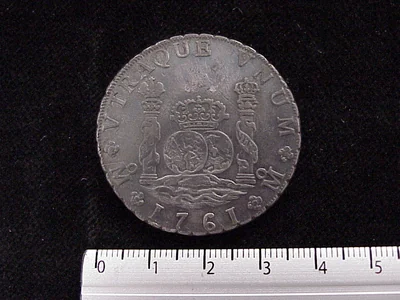
The 8 Reales was the standard large silver trade coin of the Spanish Empire. Yours was struck at the Mexico City mint (Casa de Moneda de México), the most prolific silver producer in the empire, during the reign of Carlos III (Charles III of Spain). The 1761 date puts it early in his reign.
The letters MM on the coin are the initials of the assayer, the mint official who certified the silver purity. Assayer marks matter for value because some combinations are scarcer than others.
Technical specs (check yours against these)
| Feature | Value |
|---|---|
| Metal | Silver, .900 fine (90% silver) |
| Weight | 26.95 g |
| Diameter | 38 mm |
| Edge | Laureate (decorated, not smooth) |
| Mint | Mexico City |
| Assayer | MM |
| Catalog reference | KM#105 |
The silver content alone gives this coin a floor value. At 26.95 grams of .900 fine silver, it contains about 0.78 troy ounces of pure silver. That means it can never be worth less than its melt value, which moves with the silver market, typically in the range of 20 to 30 USD depending on the spot price. A collector coin is always worth more than melt, so never sell one of these for scrap.
What drives the value
Age is not the reason this coin has value. Millions of 8 Reales were struck over centuries, so "old" does not mean rare. Four things move the price:
- Condition (grade). A coin worn nearly smooth is a common item. One with crisp detail, full legends, and original surfaces is a different animal. Grade is the single biggest factor.
- The specific date and assayer. 1761 is an early Carlos III year. Certain year and assayer pairings are scarcer and sell for premiums.
- Authenticity and eye appeal. Cleaned, holed, or damaged coins lose most of their premium.
- Chop marks and provenance. Some trade dollars carry Asian merchant "chop marks." These can add interest for specialist collectors.
Realistic value ranges
Without seeing your exact coin and grade, honest numbers look like this:
| Condition | Approximate value (USD) |
|---|---|
| Heavily worn, damaged, or cleaned | 30 to 60 |
| Circulated, clearly readable detail | 60 to 200 |
| Lightly circulated, strong detail | 200 to 600 |
| Uncirculated or near-mint | 800 to several thousand |
Early Carlos III pillar and bust 8 Reales in top certified grades have sold at Heritage Auctions and Stack's Bowers in the four- and low five-figure range over the past several years. Those are exceptional survivors, not the typical estate coin. Assume yours falls in the lower bands unless a professional grade proves otherwise.
The myth: "an old Spanish silver dollar is worth a fortune"
Most of these are worth tens of dollars, not thousands. The internet is full of listings claiming any "piece of eight" is a jackpot. The reality: condition and correct attribution decide everything, and the vast majority of surviving 8 Reales are well worn from real circulation. A worn 1761 is a nice conversation piece worth around 100 USD, not a retirement fund. Believe the melt-plus-modest-premium math before you believe the hype.
Watch out for fakes
Colonial silver is one of the most counterfeited categories in numismatics, both period contemporary counterfeits and modern replicas. Before you buy or trust a value:
- Weigh it. It should be very close to 26.95 g on a jewelry scale. A significant deviation is a red flag.
- Measure it. Diameter around 38 mm.
- Check the edge. It should be laureate (a decorated pattern), not plain or seamed.
- Look at the engraving style, mint mark, and assayer letters. Fakes often get the lettering slightly wrong.
- Be suspicious of any coin priced far below its silver value, or of "museum reproduction" pieces sold as originals.
For anything you plan to buy or sell above a couple hundred dollars, third-party certification from NGC or PCGS removes the guesswork and adds resale value.
How to check what yours is worth
- Photograph the front (obverse), back (reverse), and edge in good light.
- Weigh and measure it and compare to the specs table above.
- Note the date and assayer letters.
- Compare recent sold prices for the same date and grade, not asking prices.
- Get a professional opinion before selling anything that looks better than average.
Where to sell it
For the best price and the least risk, use a verified dealer or a collector marketplace, not a random social media buyer. Post clear photos and your weight and measurements. Never accept an offer below the silver value.
Have a 1761 8 Reales, or another colonial silver coin you can't identify? Post your photos and weight in the Pesoteca forum and the community will help you nail down the date, assayer, and a realistic price.
Historical context
This piece belongs to the reign of Carlos III of Spain (1759-1788). An enlightened king, he promoted the so-called Bourbon Reforms that reorganized the administration and treasury in New Spain.
The government of New Spain in 1761 was in the hands of Joaquin de Monserrat, Marquis of Cruillas, in the days of the Seven Years' War.
The numismatic type of the piece is pillar (columnario), officially introduced in New Spain in 1732. The reverse shows two crowned globes between the Pillars of Hercules with the motto PLVS VLTRA, and for the first time the coin was struck on a screw press with a laureate edge, which reduced the fraudulent clipping of silver and made the pillar real the most trusted trade coin of its time.
The Mexico City mint formally introduced the mechanized striking of pillar reales in 1732, and from then on the crowned Mo mark was accompanied by the assayer's initials. Production was enormous, exported as trade money to the Philippines, China, Protestant Europe, and the 13 English colonies. The dies were signed by the Mexico City mint assayer active in the period, an official charged by the Royal Treasury with certifying that the silver fineness met the viceregal standard.
The colonial catalogs trace this piece within the families of the Real de a ocho of Mexico, with prices that respond to rarity by year and assayer's signature.
It was the year Spain entered the Seven Years' War through the so-called Third Family Compact with France.
This piece belongs to the era
Colonial / Virreinato →Explore all the Mexican coins of this era, their historical context and how they connect to the monetary system of the period.
Value range of this piece
Market estimate: $742 - $3,123 MXN depending on the grade of preservation (typical range between a circulated and an uncirculated piece).
See the full breakdown by grade (VG, F, VF, EF, AU, MS-60, MS-63, MS-65) for the whole series →
Other denominations from 1761
8 Reales Coloniales · Plata 0.900
Same denomination, other years
8 reales Plata 0.900 · 8 Reales Coloniales
Frequently asked questions
How much is an 8 Reales Carlos III 1761 worth?
A worn but authentic 1761 Carlos III 8 Reales is typically worth 60 to 200 USD, driven by its silver content and collector interest. Its silver alone (about 0.78 troy ounces of .900 fine) sets a floor near 20 to 30 USD at melt. Sharp, lightly circulated examples reach several hundred, and certified uncirculated coins can bring thousands. Condition and the exact assayer decide the final number.
Is the 8 Reales Carlos III 1761 rare?
Not in average condition. Millions of 8 Reales were struck at the Mexico City mint over centuries, so most surviving worn examples are common and worth modest premiums over silver. What is scarce is a high-grade, uncirculated example, or a specific scarce assayer variety. Those command real premiums. Age alone does not make this coin rare.
Where can I sell my 8 Reales Carlos III 1761?
Sell through a verified numismatic dealer or a collector marketplace rather than a random social media buyer. Because it is a precious-metal coin, deal only with someone who will inspect and weigh it in front of you. Photograph the obverse, reverse, and edge, and check the value range in this listing before you sell. For coins that look better than average, get NGC or PCGS certification first, since it raises resale value.
How do I tell if my 8 Reales Carlos III 1761 is genuine?
Weigh it (should be close to 26.95 g) and measure it (about 38 mm) with a jewelry scale and calipers, then compare to the specs table above. Check that the edge is laureate, not plain. Examine the engraving style, mint mark, and MM assayer letters, since fakes often get the lettering wrong. Colonial silver is heavily counterfeited, so be suspicious of any coin priced far below its silver value, and use NGC or PCGS certification for high-value pieces.
Conversation
0 comments
Loading comments…