
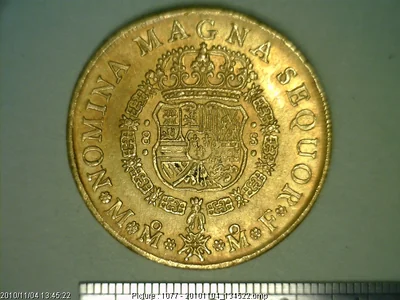
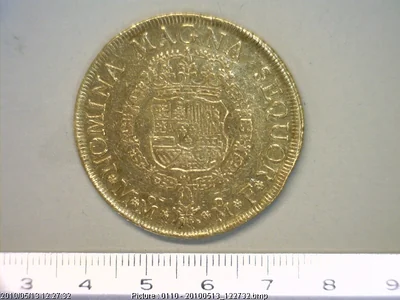
8 Escudos Fernando VI 1749: The Colonial Gold Onza
The 8 Escudos Fernando VI 1749: The Colonial Gold Onza is worth between $51,327 and $86,446 MXN depending on its grade of preservation.
Prices updated: August 2026
Viceroyalty · Mexico City Mint · Assayer MF
Viceroyalty · Mexico City Mint · Assayer MF
The 8 Escudos Fernando VI 1749: The Colonial Gold Onza is worth between $51,327 and $86,446 MXN depending on its grade of preservation.
Prices updated: August 2026
How much is the 8 Escudos Fernando VI 1749: The Colonial Gold Onza worth?
The estimated value of the 8 Escudos Fernando VI 1749: The Colonial Gold Onza ranges from $51,327 (circulated, XF) up to $86,446 (official blister pack), with $73,675 as a reference for an uncirculated (UNC) piece. The estimate is based on the official mintage and the historical behavior of the family.
The real price depends on four factors: the grade of preservation (a circulated piece is worth the low end of the range; an uncirculated one, or one still in its official blister pack, the high end), the finish (satin vs mirror/proof), the rarity within the series based on the mintage, and the metal spot price on the day of the deal when the piece is silver or gold. Check the value-by-grade table above and compare with equivalent pieces before buying or selling.
Where to buy or sell this coin?
Browse the national directory of numismatic shops or the community forum to trade directly with other collectors.
Description
If you inherited an 8 Escudos Fernando VI dated 1749, you are holding one of the classic gold coins of colonial Mexico, and it is worth real money. This is not a common piece worth a few dollars. Genuine examples in collectible condition trade from roughly 2,000 USD to well over 10,000 USD depending on grade, driven by both its gold content and its status as an early Bourbon-era gold onza struck in Mexico City.
Here is what you actually have, what it is worth, and how to make sure it is real before you sell.
What this coin is
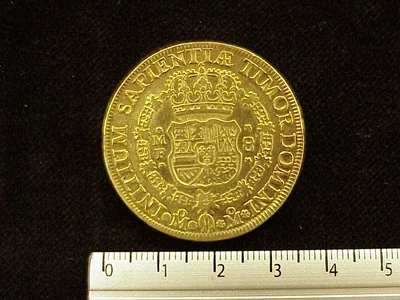
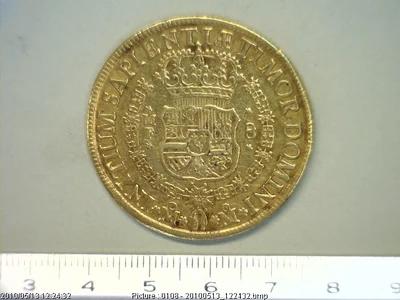
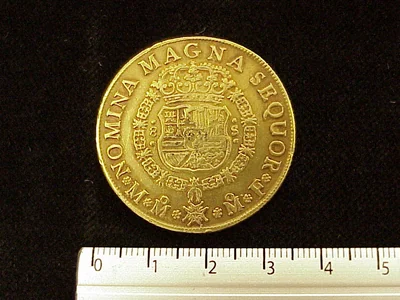
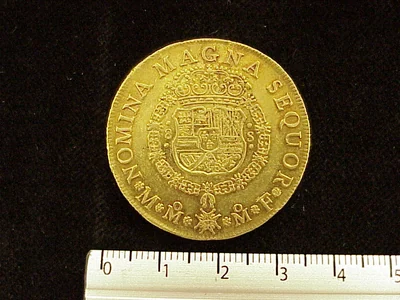
The 8 escudos was the largest gold coin of the Spanish colonial system, often called an "onza" (ounce). This one was struck in 1749 at the Casa de Moneda de México (the Mexico City Mint) during the reign of Fernando VI, one of the Bourbon kings of Spain. New Spain (colonial Mexico) supplied a huge share of the gold and silver that circulated across the Spanish empire, and Mexico City coins like this one traveled the world.
Key specs to verify against your coin:
- Metal: gold, .875 fine (21 karat)
- Weight: 26.99 grams
- Diameter: 36.22 mm
- Edge: reeded (milled)
- Mint: Mexico City (Casa de Moneda de México)
- Assayer mark: MF
- Year: 1749 (single year of this issue)
That weight matters. A genuine coin sits at 26.99 grams. Fakes almost always miss the mark on weight because they use lower-purity gold or base metal cores. If your coin is off by more than a fraction of a gram, be suspicious.
What it is worth in USD
There is no single number, because grade drives everything. Two 1749 8 escudos can differ by thousands of dollars depending on wear, surfaces, and whether the coin has been certified by NGC or PCGS.
A realistic framework:
| Condition | What it looks like | Approximate value (USD) |
|---|---|---|
| Heavily worn / damaged | Smooth, scratched, ex-jewelry | Around melt value of the gold |
| Circulated (Fine to VF) | Clear design, honest wear | 2,000 to 4,000 |
| High grade (XF to AU) | Sharp detail, little wear | 4,000 to 8,000 |
| Certified Mint State | Uncirculated, graded by NGC/PCGS | 8,000 to 15,000+ |
The floor under any genuine example is its gold content. At 26.99 grams of .875 fine gold, the coin contains about 0.76 troy ounces of pure gold. That means it can never be worth less than the daily gold spot price for that amount of metal, which is the number to check first before anyone quotes you a "deal." Anything above melt is the collector premium for its age, condition, and rarity.
Be careful with the melt floor: a heavily worn or mounted (ex-jewelry) coin often trades close to melt only, because its collector value is destroyed. A crisp, original coin carries a large premium over melt.
Is it rare?
Colonial 8 escudos were struck in far smaller numbers than the silver 8 reales, and they saw hard use. Exact mintage figures for the 1749 Mexico City issue are not cleanly documented, which is normal for coins of this era. Survival is what counts for value, and high-grade survivors are genuinely scarce. Circulated examples come up at auction with some regularity; problem-free Mint State pieces are the ones that command the top figures.
Because 1749 is the only year for this specific issue, there is no year-to-year variety to chase. There can be minor die varieties (letter positions, small striking differences) that specialists at NGC or PCGS distinguish, but for most sellers the coin is simply a 1749 8 escudos.
How to tell if yours is genuine
This coin is faked, precisely because it is valuable. Run these checks before you trust any offer:
- Weigh it. A real one is 26.99 grams. Use a scale accurate to 0.01 g. Underweight is a red flag; many counterfeits use lower-purity gold or a base-metal core.
- Measure it. 36.22 mm diameter. Check the edge is reeded, not smooth or seamed.
- Look for solder or mount marks. Many of these were worn as jewelry. Filed edges, a solder blob, or a smoothed rim cut the value hard.
- Get it certified for anything above a few thousand dollars. Grading by NGC or PCGS is the definitive proof of authenticity and grade, and a certified coin sells faster and higher. The fee is small next to what this coin is worth.
If you plan to buy or sell above the melt value, professional authentication is not optional. It is the difference between a confident sale and getting burned.
Where to sell it
For a coin at this value level, sell where buyers can verify what they are getting:
- Certified auction houses. For high-grade pieces, major numismatic auctions reach the buyers who pay top prices for colonial gold.
- A verified numismatic dealer from the Pesoteca directory, who can appraise it in person and pay based on grade and metal.
- The Pesoteca buy-and-sell forum, where collectors trade directly.
Whatever route you choose, photograph the obverse, reverse, and edge clearly, and get the weight on record. Do not dump a coin like this to the first offer on a general marketplace, where fakes are common and buyers lowball genuine pieces.
Want a second opinion on your 1749 8 escudos before you sell? Post clear photos and the weight in the Pesoteca forum and let collectors who handle these coins weigh in on grade and authenticity.
Historical context
Eight escudos, Fernando VI, 1749, Mexico mint, assayer MF, Krause KM#150. The first full year after the Treaty of Aix-la-Chapelle of 1748, which ended the War of the Austrian Succession. Fernando VI was consolidating his policy of neutrality, and his minister Ensenada was launching the Cadastre that would bear his name in peninsular Spain, a pioneering attempt at proportional taxation. In New Spain, the Count of Revillagigedo continued as viceroy. The ounce weighs 27.06 grams at .916 fineness. Produced by mill press on a round planchet, with a classic pillar reverse. Krause references KM#150 as the now-stabilized pillar type of Fernando VI in Mexico. The MF assayers' initials appear in the field. Pieces of this year bear witness to a decade of relative imperial peace that allowed New Spain to consolidate its role as the crown's leading supplier of precious metals.
This piece belongs to the era
Colonial / Virreinato →Explore all the Mexican coins of this era, their historical context and how they connect to the monetary system of the period.
Value range of this piece
Market estimate: $51,327 - $86,446 MXN depending on the grade of preservation (typical range between a circulated and an uncirculated piece).
See the full breakdown by grade (VG, F, VF, EF, AU, MS-60, MS-63, MS-65) for the whole series →
Same denomination, other years
8 escudos Oro 0.875 (21k) · Escudos Coloniales (oro)
Frequently asked questions
How much is an 8 Escudos Fernando VI 1749 worth?
It depends heavily on condition. A genuine circulated example typically runs from about 2,000 to 4,000 USD, higher grades reach 4,000 to 8,000 USD, and certified Mint State coins can bring 8,000 to over 15,000 USD. The floor is its gold content: about 0.76 troy ounces of pure gold, so it is never worth less than that day's melt value. For a firm figure on your exact coin, get it graded by NGC or PCGS.
How do I know if my 8 Escudos Fernando VI 1749 is genuine?
Check the specs first. A real one weighs 26.99 grams and measures 36.22 mm with a reeded edge. Counterfeits, often lower-purity gold, usually miss on weight, so a precise scale gives them away. Watch for solder marks or filed edges from jewelry use, which cut the value. For any coin worth more than a few thousand dollars, certification by NGC or PCGS is the definitive proof of authenticity.
Is the 8 Escudos Fernando VI 1749 rare?
Colonial 8 escudos were struck in far smaller numbers than silver coins and saw heavy circulation. Exact mintage for the 1749 Mexico City issue is not cleanly documented, which is normal for coins of this era. Circulated examples appear at auction with some regularity, but problem-free, high-grade survivors are genuinely scarce and command the strongest prices.
Where can I sell an 8 Escudos Fernando VI 1749?
For a coin this valuable, sell where buyers can verify it: a certified numismatic auction house for high grades, a verified dealer from the Pesoteca directory who can appraise it in person, or the Pesoteca buy-and-sell forum among collectors. Photograph the obverse, reverse, and edge, and have the weight documented. Avoid selling to the first offer on a general marketplace where fakes are common.
Conversation
0 comments
Sources
Images for informational and educational purposes, attributed to their original source. Reference values; the real price depends on the grade, the specific variant and demand.
Loading comments…