
En resumen
The only Mexican silver series where every coin reproduces another coin from the country's history: the Caballito, the Macuquina, the Columnario. Here is the full run, issue by issue, plus real values and how to avoid overpaying.
Most silver commemorative sets celebrate an event. This one celebrates coins themselves. The Herencia Numismática de México (Numismatic Heritage of Mexico) is a series of Mexican silver coins whose reverse reproduces another coin, one that already made history. If you inherited one or want to build the set, here is what each piece actually is, what it is made of, and what it is worth in 2026.
Twenty-four coins make up the complete series, each a 100-peso piece with a genuine Sterling silver center. The concept is simple and unusual: instead of honoring a person or a date, each coin depicts a landmark of Mexican coinage, from a hand-struck colonial cob to the Caballito, widely considered the most beautiful coin Mexico ever made.
What the Herencia Numismática de México actually is
This is a series of 100-peso coins struck by the Banco de México, all with a silver center mounted in a bronze-aluminum ring, so each coin is bimetallic, not solid silver. It launched in 2011 and rolled out in four issues: I in 2011, II in 2012, III in 2013, and IV in 2014. Each issue holds six pieces, 24 total. The decree that created the series was published in Mexico's official gazette (Diario Oficial de la Federación) on June 14, 2011.
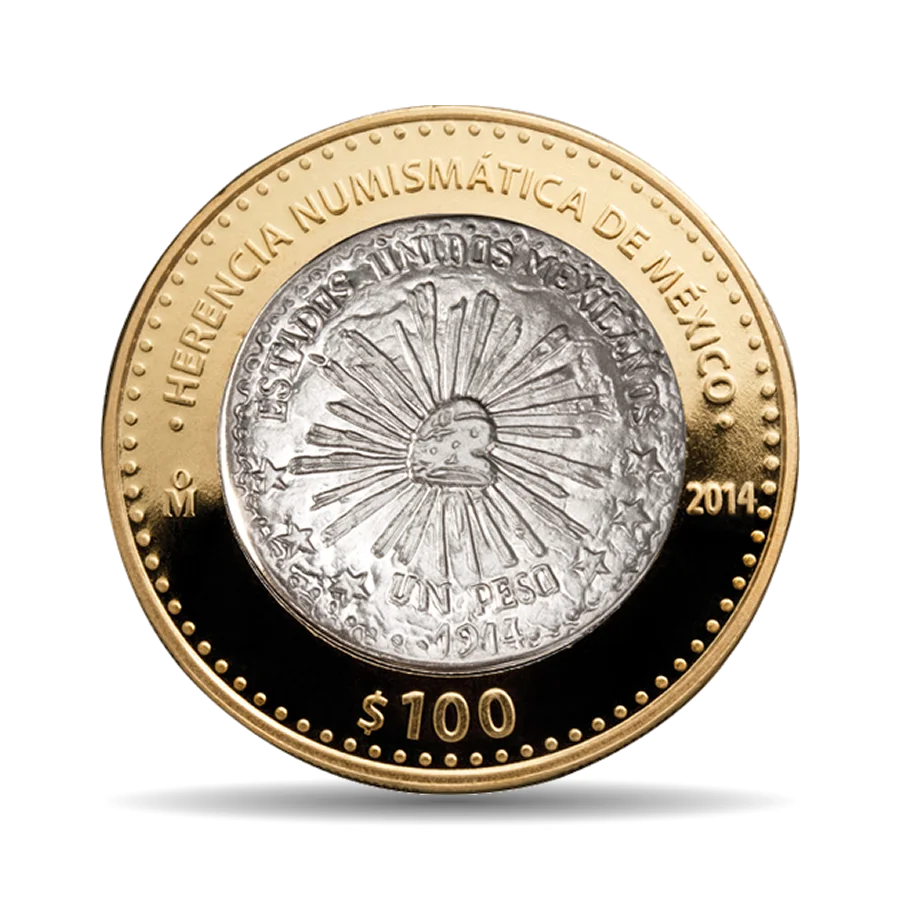
The obverse carries the National Coat of Arms with the legend Estados Unidos Mexicanos, as required by law. The reverse reproduces an emblematic piece of Mexican numismatics: a colonial cob, a Republic peso, a Pillar dollar, an independence-era coin. Alongside the image sits the legend HERENCIA NUMISMÁTICA DE MÉXICO, the Mo mint mark of the Casa de Moneda de México, the year, the 100-peso denomination, and a beaded border.
One point that trips up newcomers: the series is not arranged by the age of the original coin. Banxico mixed the eras. A single issue can pair a 1608 cob with a 1950 railroad coin. Building the set is like assembling five centuries of Mexican history with the pieces shuffled.
Official specifications from the decree
These are the hard numbers from the decree. Use them to weigh and measure anything offered to you. If a piece does not match, something is wrong.
| Spec | Official value |
|---|---|
| Face value | 100 pesos |
| Shape | Circular |
| Diameter | 39.0 mm |
| Edge | Discontinuous reeding |
| Center | Sterling silver, .925 fine, copper alloy |
| Center weight | 16.812 g |
| Pure silver content | 15.552 g, one-half troy ounce |
| Outer ring | Bronze-aluminum alloy |
| Obverse | National Coat of Arms, Estados Unidos Mexicanos |
| Reverse | Historic coin, Herencia Numismática legend, Mo mint, year, beaded border |
| Struck until | December 31, 2014 |
Three numbers matter most. The center is Sterling silver at .925 fineness, not pure silver and not low-grade silver. That center weighs 16.812 grams and holds 15.552 grams of pure silver, exactly one-half troy ounce. It sits in a bronze-aluminum ring. When someone sells you this as a full ounce of silver, it is not: it is half an ounce in the center, and the ring is a different metal. That silver content gives every coin in the series a floor at melt value, currently a few dollars per coin in bullion terms, before any collector premium.
Issue I (2011): the launch
The first batch came out loaded. This is where the Caballito appears.
- Caballito 2011: reproduces the reverse of the 1914 Caballito peso, the coin most collectors agree is the finest Mexico ever struck. It shows the winged Victory riding a galloping horse with a torch. The original in good condition is not cheap.
- Peso de Bolita 2011: the 1913 Villa peso struck in Hidalgo del Parral, Chihuahua, Bolita type. This is revolutionary money, the kind Villa ordered struck in the north during the armed struggle.
- Resplandor Republicano 2011: the classic Republic 8 reales cap-and-rays, dated 1824 by the decree, struck at the Durango mint with assayer R.L. This coin circulated worldwide as hard currency through the 19th century, accepted in Asia, Europe, and the United States. It was the dollar of its era.
- Columnario 2011: the reverse of the 1732 viceregal 8 reales, Pillar type, the first of its kind struck in Mexico. The two Pillars of Hercules with the PLVS VLTRA legend and the two globes of the old and new worlds. It is a direct ancestor of the peso sign.
- Morelos SUD 2011: the reverse of the Morelos insurgent 8 reales, in copper, SUD type. These were the coins of the South, struck by the insurgency during the War of Independence, with the SUD initials for the Army of the South. Emergency money, made mid-war in copper, not silver.
- Busto 2011: the obverse of the 1783 viceregal Carlos III 8 reales, Bust type, showing the king's profile. It marks the moment colonial coinage moved from the Pillar design to the monarch's portrait.
If you are starting the set, this is the issue that hooks most people, thanks to the Caballito and the Resplandor.
Issue II (2012): the colony and modern Mexico
The 2012 batch went further back in time, to the cobs, and also jumped forward to the railroad.
- Macuquina 2012: the obverse of the 1608 viceregal 8 reales, Mexico mint, initial F, cob type. This is the hand-cut, crude, irregular coin of the first silver struck in the Americas. Each one is unique because they were clipped from a silver bar and struck by hand. Dated 1608, it is the oldest piece in the whole series.
- Coin with Chops and Philippines Countermark 2012: the obverse of the 1804 viceregal Carlos IV 8 reales, with Philippines counterstamp and chops. Chops are the small marks Chinese merchants stamped to certify the silver was good. Mexican silver crossed the Pacific on the Manila Galleon and came back tattooed from travel.
- Peso de Manita 2012: note this one is not a silver peso. It is the reverse of the Republic 8 escudos gold coin, Manita type, 1828, assayer JM. Named for the arm with the Phrygian cap in its hand. A gold piece from the young Republic, among the first the independent country struck.
- Maximiliano 2012: the obverse of the 1866 Second Empire peso, struck in Mexico, with the profile of Maximilian of Habsburg. The emperor Napoleon III sent to Mexico, executed in 1867. A short, tragic chapter: an Austrian reigning in Mexico for a few years.
- Ferrocarril del Sureste 2012: a jump to the 20th century, the reverse of the 1950 5-peso coin for the inauguration of the Southeast Railroad. It breaks the colonial tone and brings the series to mid-century industrial Mexico.
- Zacatecas Type LVO 2012: the reverse of the 1811 royalist provisional 8 reales, struck in Zacatecas, L.V.O. type, first type. Emergency money from the royalist side during the War of Independence, from the rich silver-mining Zacatecas mint.
Issue III (2013): colonial silver and independence
The 2013 batch dug into colonial and War of Independence pieces. This is where the series gets serious for anyone studying monetary history.
- Carlos y Juana 3 Reales 2013: the reverse of the viceregal 3 reales, denomination marked in dots, Carlos y Juana type, first series, assayer R. It reproduces one of the very first coins struck at the Casa de Moneda de México, founded in 1535, only a few years after the Conquest. Among the oldest pieces any Mexican series can represent.
- 8 Reales Resplandor with Chops 2013: the reverse of the Republic cap-and-rays 8 reales, with chops. Another Resplandor marked by Asian merchants, a perfect companion to the Philippines-countermark coin from the previous issue.
- First Empire 8 Escudos 2013: the obverse of the First Empire 8 escudos of 1822, first type, the gold coin of Agustín de Iturbide. After independence was won in 1821, Iturbide crowned himself emperor and struck coins with his bust. It did not last long, but it was the first money of the country free from Spain.
- Junta de Zitácuaro 8 Reales 2013: the obverse of the insurgent coin of the Suprema Junta de América, 8 reales, 1811, in silver. The first attempt at an insurgent government during the fight for independence, made to finance the war against the viceroyalty.
- 1 Peso de Balanza 2013: the reverse of the Republic Balanza (scales) peso, struck in Zacatecas, assayer H. It carries the scales of justice, a symbol of the young Republic seeking order after so many wars.
- Suriana 2 Pesos 2013: the reverse of the 1915 Zapatista 2-peso coin, struck in Suriana. Money from the revolutionary south, made by Zapata's forces to pay troops during the civil war. With the Morelos SUD and Zitácuaro pieces, it forms the emergency-money block of the series.
If you like the colonial and independence periods, this is your favorite issue.
Issue IV (2014): the close, with rare pieces
The fourth and final batch went for the less common pieces, the ones only the dedicated collector knows by name.
- Pelucona 2014: the obverse of the viceregal 8 escudos Pelucona type, Fernando VI, 1748. The famous colonial gold 8 escudos, nicknamed for the abundant wig curls of the Bourbon king on the obverse. It is one of the most sought-after coins in all Spanish-American numismatics, and the original in gold is worth a fortune.
- Muera Huerta 2014: the reverse of the 1914 Villa 1-peso coin, struck in Cuencamé, Durango, six-star type. Revolutionary money of the north, from the issues Villa's División del Norte made to pay troops. Each Villa mint had its mark, and the six stars identify Cuencamé.
- 60 Pesos de Oaxaca 2014: the obverse of the revolutionary coin of the Free and Sovereign State of Oaxaca, 60 pesos, 1916. During the Revolution, with the country split and no strong central government, several states struck their own money to pay troops. Oaxaca was among the most active.
- Oaxaca León Grande 2014: the reverse of the Oaxaca royalist provisional coin, 8 reales, 1812, León Grande type. Note this one is royalist and colonial, not revolutionary: emergency money from the viceroy's side during the War of Independence, distinct from the 60-peso revolutionary coin. Oaxaca produced emergency coinage in two wars a century apart.
- Republican Copper Quarter 2014: the reverse of the Republic quarter-real coin, in copper, 1834, initial A. Not silver or gold, this was everyday small change, the money people used to buy bread. The series honors the humble coin that moved the real economy, not just fine silver.
- British Guiana Countermark 2014: the obverse of the 1806 viceregal Carlos IV 8 reales, Bust type, with a British Guiana counterstamp. The British countermarked Mexican silver so it would pass in their Caribbean colonies. Proof that Mexican coin was hard currency even in British territory.
The release calendar: how Banxico rolled them out
The order confuses newcomers. Here it is, clearly, in a table.
| Issue | Year | Pieces | Main focus |
|---|---|---|---|
| I | 2011 | 6 | Caballito, cap-and-rays, Pillar dollar, Morelos insurgency |
| II | 2012 | 6 | Cob, silver that traveled to Asia, Second Empire, railroad |
| III | 2013 | 6 | Early colonial, Iturbide gold, insurgency |
| IV | 2014 | 6 | Pelucona, Oaxaca revolutionary, countermarks, copper |
Banxico released one issue per year, from 2011 to 2014, six pieces each time. It did not follow the chronological order of the original coins. To build a display by historical era, you will mix pieces from all four issues. To build it by issue, you keep Banxico's release order. Both approaches work.
For completing the set, the 2011 coins have been on the market longest and show up most often. The 2014 coins are the newest and the hardest to find loose. If you are closing out the set, leave Issue IV for last.
How to tell a genuine Herencia coin
As with any silver series that trades at a premium, copies appear. Here is what to check before you pay.
First, material and weight. The center is Sterling silver at .925, not some plated metal, mounted in a bronze-aluminum ring. The center should weigh 16.812 grams per the decree, with half a troy ounce of pure silver inside. A piece that feels too light, or rings tinny, is telling you something. Weigh it and measure the 39.0 mm diameter against the official spec before buying.
Second, the edge. The decree calls for discontinuous reeding, not a smooth, crooked, or poorly finished rim. That discontinuous reeding is hard to replicate well, which makes it one of the fastest giveaways of a cheap copy.
Third, the relief. These coins were struck to modern quality. The reverse detail, the cob, the cap-and-rays, the Pelucona, should look clean and defined. A cheap copy loses sharpness and looks mushy. Compare against the official photo on Pesoteca before closing.
Fourth, the obverse. All of them carry the National Coat of Arms. Verify it is complete and correct, with no odd distortions.
Fifth, the price. If someone offers a silver piece from this series for almost nothing, be suspicious. The silver alone sets a floor, and nobody who knows what they hold will sell well below it. When something sounds too good, it usually is.
If you have doubts, post it to the forum with photos of obverse, reverse, and edge.
What these coins are actually worth
Value here rests on three legs, and each one matters.
The silver gives every coin a floor at melt value, roughly a few dollars per piece in bullion terms, something circulation commemoratives do not have. Beyond metal, the collector premium depends on condition and on which piece it is. The scarcer, more sought-after designs like the Pelucona and the Caballito, and any coin in uncirculated condition, command the strongest premiums. The most common mistake beginners make is paying uncirculated prices for a worn, handled coin. Condition drives the price every time, even for the same coin from the same issue.
Complete, high-grade sets sell for a meaningful multiple of the loose-coin total, because assembling all 24 takes patience and a full run in matched condition is uncommon. Do not rush it. Ask the community what a given issue and grade is selling for before you pay, and if a seller does not inspire confidence, walk away. Another one always shows up.
Herencia versus other Banxico silver series
Banxico has made several silver series over the years. Knowing where the Herencia fits helps you understand what you are buying.
There are the Onza Libertad silver ounces, pure silver made almost as an investment product, with the Angel of Independence. Those are collected by metal and by date, and priced close to the silver spot. The Herencia is not investment bullion, it is commemorative silver with a concept behind it.
There are event commemoratives, the many silver coins Banxico has issued for anniversaries and figures. Those honor a date or a person. The Herencia honors the coins themselves, and that twist makes it unique. No other Mexican series turns the historic coin into the star of the reverse.
And there are the circulating commemoratives, like the 20-peso coins people hunt for at the bank. Those are base metals, they enter circulation, and beginners collect them easily. The Herencia does not circulate. It is pure collector silver.
In one line: the Libertad you collect for metal, the circulating coins for the bank hunt, and the Herencia for the history.
Where to buy and sell the series
You will not find this series by asking for change at a bank. It is silver, limited-mintage, and the first batch is now over a decade old.
Collector groups on Facebook, especially Numismática Mexicana, are where loose pieces surface when someone sells or breaks up a collection. Shops and coin shows are the other route, though there you need a sharp eye. Overpricing is common on a silver series like this. Do not marry the first piece you see. Compare, ask the groups what is being paid, and pass if the deal is not right.
If you are starting the set or hunting a single piece, visit the Herencia Numismática de México series hub to see all 24 entries in one place. To search in person without overpaying, check the shop directory to find where to look.
Which of these do you already have in your case, and which one have you been chasing the longest? Post it to the forum and let's compare. Someone in the community probably has the one you still need.
Loading comments…