
8 Reales Fernando VI 1747 (Mexico City Mint)
The 8 Reales Fernando VI 1747 is worth between $742 and $3,125 MXN depending on its grade of preservation.
Prices updated: August 2026
Royal crowns.
Royal crowns.
The 8 Reales Fernando VI 1747 is worth between $742 and $3,125 MXN depending on its grade of preservation.
Prices updated: August 2026
How much is the 8 Reales Fernando VI 1747 (Mexico City Mint) worth?
The estimated value of the 8 Reales Fernando VI 1747 (Mexico City Mint) ranges from $742 (circulated, XF) up to $3,125 (official blister pack), with $2,258 as a reference for an uncirculated (UNC) piece. The estimate is based on the official mintage and the historical behavior of the family.
The real price depends on four factors: the grade of preservation (a circulated piece is worth the low end of the range; an uncirculated one, or one still in its official blister pack, the high end), the finish (satin vs mirror/proof), the rarity within the series based on the mintage, and the metal spot price on the day of the deal when the piece is silver or gold. Check the value-by-grade table above and compare with equivalent pieces before buying or selling.
Where to buy or sell this coin?
Browse the national directory of numismatic shops or the community forum to trade directly with other collectors.
Description
If you inherited a large, worn silver coin marked with two pillars and a Spanish king's name, you may be holding an 8 reales, the original "pieces of eight." A 1747 Fernando VI 8 reales from the Mexico City mint is genuine colonial silver, and depending on wear it runs from roughly 100 USD to several thousand USD in top grades. Here is what it is and how to check yours.
Quick answer: what it's worth
This is a silver coin with real intrinsic value, so it has a floor. It contains 0.900 fine silver and weighs 26.97 grams, which is close to 0.78 troy ounces of pure silver. That metal alone is worth around 20 to 25 USD at recent silver prices, and a worn but genuine example almost always sells for more than melt because collectors want the type.
- Heavily worn, damaged, or holed: about 50 to 150 USD
- Nice circulated (clear pillars, readable date): about 200 to 600 USD
- High grade, sharp detail, minimal wear: 1,000 USD and up
- Rare high-grade certified examples of early Fernando VI pillar dollars have brought several thousand USD at Heritage and Stack's Bowers auctions
Condition drives almost everything here. Two 1747 pieces can sell for 80 USD and 3,000 USD purely on grade.
What this coin actually is
The 8 reales was the international trade coin of its era, the silver piece that circulated worldwide and became the model for the US dollar. Mexico City was the most prolific mint producing it, which is why so many survive.
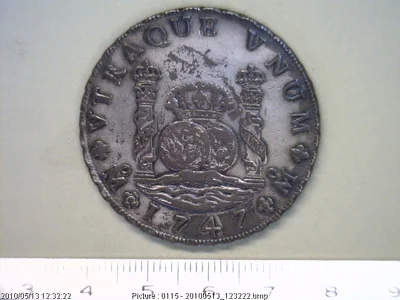
Your coin dates to the reign of Fernando VI (Ferdinand VI of Spain) and was struck in 1747 at the Mexico City mint ("ceca de México"). The letters MF are the assayer's initials, the mint official who certified the silver content. The catalog reference is KM#104.1.
Specifications
| Feature | Detail |
|---|---|
| Denomination | 8 reales |
| Ruler | Fernando VI |
| Date | 1747 |
| Mint | Mexico City |
| Assayer | MF |
| Metal | Silver, 0.900 fine |
| Weight | 26.97 g |
| Diameter | 40 mm |
| Edge | Laureate (decorated) |
| Catalog | KM#104.1 |
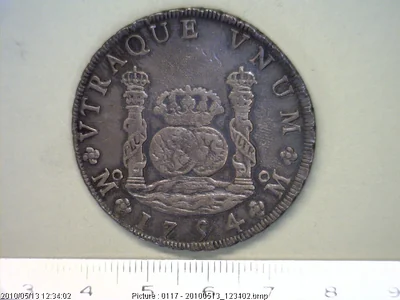
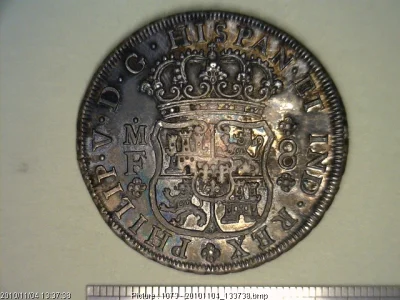
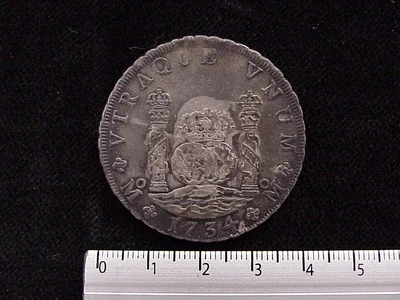
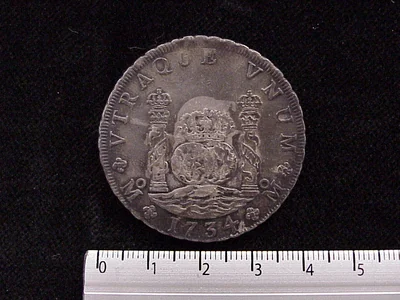
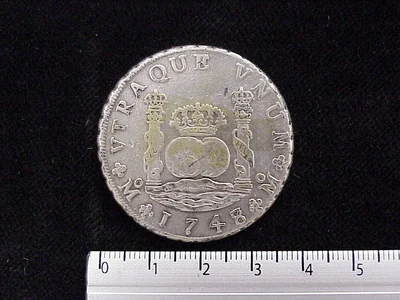
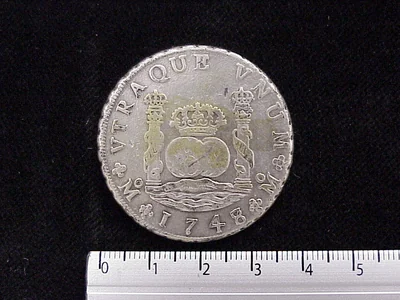
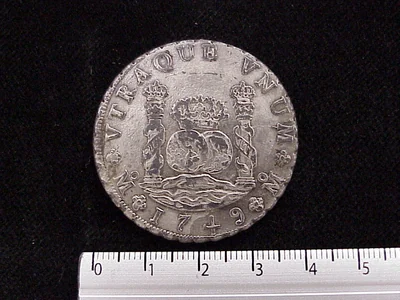
This is a "pillar dollar" type: the reverse shows two crowned columns (the Pillars of Hercules) flanking a pair of globes. That design is what collectors chase, and it is also the most faked.
The myth: "it's 270 years old so it's worth a fortune"
Age alone does not make this coin valuable. Millions of 8 reales were struck across the colonial period, so the type is common and a worn example is an affordable collectible, not a jackpot. What raises the price is grade (how little wear it has), eye appeal, and a specific scarce date or assayer combination.
Early Fernando VI issues from 1747, the first years of his reign, do carry a slight premium over later, more common dates. But a corroded, cleaned, or holed coin loses most of its collector value no matter how old it is.
How to tell if yours is genuine
Colonial pillar dollars are among the most counterfeited coins in the world, both period contemporary fakes and modern cast copies. Check these before you buy or sell:
- Weigh it. A genuine coin should be close to 26.97 g on a jewelry scale. Cast fakes are often lighter or made of the wrong alloy.
- Measure it. Diameter should be about 40 mm.
- Look at the edge. It should be laureate (a decorated pattern), not smooth or seam-lined. A visible casting seam is a red flag.
- Study the strike. Real dies produce crisp, slightly irregular hand-struck detail. Cast copies look soft, grainy, or too uniform.
- Silver test. Genuine 0.900 silver is non-magnetic and rings when tapped. If a magnet grabs it, it's fake.
Any offer far below the value of the silver content should make you suspicious. For a coin at this value level, professional certification by NGC or PCGS settles the question and boosts what a buyer will pay.
Errors and varieties
Genuine mint errors (off-center strikes, die rotation, doubled strikes) can multiply the value. Most "errors" people post online are post-mint damage: dings, corrosion, or environmental pitting, not factory errors. If you think you have a real one, post clear photos in the Pesoteca forum for the community to review.
Where to sell it
Because this is a precious-metal coin, deal only with buyers who will inspect the piece and its weight in person, and verify before you pay.
- A verified numismatic dealer from the Pesoteca directory can appraise it on the spot, sorted by city and without markup from middlemen.
- The Pesoteca buy-and-sell forum connects you directly with collectors who understand the type.
- For a high-grade example, sending it to NGC or PCGS first, then selling through a major auction house like Heritage or Stack's Bowers, usually gets the strongest price.
Photograph the obverse, reverse, and edge before you list it, and compare your measurements to the table above. Don't dump it to the first Facebook bidder.
Got a colonial 8 reales you can't date or read? Post the photos in the Pesoteca forum and let collectors help you pin down the mint, assayer, and value.
Historical context
This piece belongs to the reign of Fernando VI of Spain (1746-1759). Son of Felipe V. His reign was marked by neutrality in the European conflicts and by enlightened reforms in Spain and the Indies.
The government of New Spain in 1747 was in the hands of Juan Francisco de Güemes y Horcasitas, count of Revillagigedo, the Güemes family's first viceregal term.
The piece's numismatic type is the pillar (columnario), introduced officially in New Spain in 1732. The reverse shows two crowned globes between the Pillars of Hercules with the motto PLVS VLTRA, and for the first time the coin was struck in a screw press with a laurel edge, which reduced the fraudulent clipping of silver and made the pillar real the most trusted trade coin of its day.
The Mexico mint formally introduced the mechanized striking of pillar reales in 1732, and from then on the crowned Mo mark was accompanied by the assayer's initials. Production was enormous, exported as trade money to the Philippines, China, Protestant Europe, and the 13 English colonies. The dies were signed by the Mexico mint assayer active in the period, an official charged by the Royal Treasury with certifying that the silver fineness met the viceregal standard.
Colonial catalogs track this piece within the families of the Mexico Real de a ocho, with prices that respond to rarity by year and assayer signature.
A year after Fernando VI's accession, with the Mexico mint refining the pillar design under the new dynasty.
This piece belongs to the era
Colonial / Virreinato →Explore all the Mexican coins of this era, their historical context and how they connect to the monetary system of the period.
Value range of this piece
Market estimate: $742 - $3,125 MXN depending on the grade of preservation (typical range between a circulated and an uncirculated piece).
See the full breakdown by grade (VG, F, VF, EF, AU, MS-60, MS-63, MS-65) for the whole series →
Other denominations from 1747
8 Reales Coloniales · Plata 0.900
Same denomination, other years
8 reales Plata 0.900 · 8 Reales Coloniales
Frequently asked questions
How much is an 8 Reales Fernando VI 1747 worth?
It depends almost entirely on condition. A worn or damaged example runs about 50 to 150 USD, a solid circulated coin about 200 to 600 USD, and a high-grade certified piece can reach 1,000 USD and up, with the best early Fernando VI pillar dollars bringing several thousand USD at auction. The 0.900 silver content sets a floor of roughly 20 to 25 USD.
Is the 1747 Fernando VI 8 reales rare?
The type is common because Mexico City struck millions of 8 reales, so worn examples are affordable. Value comes from grade, not age. Early 1747 dates carry a modest premium, and genuinely high-grade certified coins are scarce and command strong prices.
Where can I sell an 8 Reales Fernando VI 1747?
Use a [verified numismatic dealer from the Pesoteca directory](/tiendas) for an on-the-spot appraisal, or the [Pesoteca buy-and-sell forum](/foro/compra-venta) to reach collectors directly. For a high-grade coin, certify it with NGC or PCGS and sell through a major auction house. Photograph the obverse, reverse, and edge first.
How do I tell if my 8 Reales Fernando VI 1747 is genuine?
Weigh it (should be about 26.97 g) and measure it (about 40 mm) with a jewelry scale and calipers, then compare to the specs above. Check that the edge is laureate with no casting seam, that the strike is crisp, and that it's non-magnetic. Pillar dollars are heavily faked, so any offer well below the silver value is a warning sign.
Conversation
0 comments
Loading comments…