
8 Reales Carlos IV 1789: Value & Prices
The 8 Reales Carlos IV 1789: Value & Prices is worth between $740 and $3,116 MXN depending on its grade of preservation.
Prices updated: August 2026
Viceroyalty · Mexico City Mint · Assayer FM
Viceroyalty · Mexico City Mint · Assayer FM
Design
Banxico
Reverse
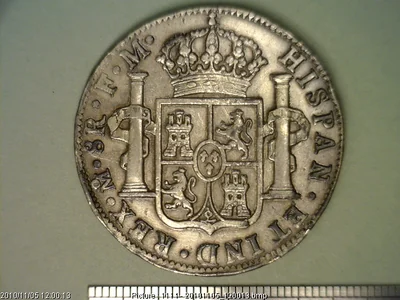
Crowned Spanish coat of arms flanked by the two Pillars of Hercules with the PLVS VLTRA banner. Around it, the legend HISPAN ET IND REX, the Mo mint mark (Mexico), the value 8R and the assayer's initials F M. It is the classic pillar reverse of the colonial bust 8 reales.
The 8 Reales Carlos IV 1789: Value & Prices is worth between $740 and $3,116 MXN depending on its grade of preservation.
Prices updated: August 2026
How much is the 8 Reales Carlos IV 1789: Value & Prices worth?
The estimated value of the 8 Reales Carlos IV 1789: Value & Prices ranges from $740 (circulated, XF) up to $3,116 (official blister pack), with $2,252 as a reference for an uncirculated (UNC) piece. The estimate is based on the official mintage and the historical behavior of the family.
The real price depends on four factors: the grade of preservation (a circulated piece is worth the low end of the range; an uncirculated one, or one still in its official blister pack, the high end), the finish (satin vs mirror/proof), the rarity within the series based on the mintage, and the metal spot price on the day of the deal when the piece is silver or gold. Check the value-by-grade table above and compare with equivalent pieces before buying or selling.
Where to buy or sell this coin?
Browse the national directory of numismatic shops or the community forum to trade directly with other collectors.
Description
If you inherited or found a 1789 Mexican 8 Reales with "CAROLVS IV" on it, here is the straight answer: in circulated condition it is worth roughly 200 to 250 USD, but a sharp uncirculated example has sold for around 3,200 USD. Most of that value comes from grade, not age, and this specific date has a quirk that collectors pay attention to.
What this coin is
The 8 Reales was the Spanish colonial silver dollar, struck at the Mexico City mint (marked Mo) when Mexico was part of the Spanish empire. It is a large silver piece, and the 1789 date sits at a transition moment.
Carlos III of Spain died on December 14, 1788. His son Carlos IV succeeded him, but the new dies took time to arrive from Spain. The result: this coin carries the name and numeral of the new king (the legend reads CAROLVS IV DEI GRATIA) while still showing the laureate bust of his father, Carlos III, on the front. That mismatch is what separates this piece from an ordinary colonial 8 Reales. Collectors call it a transitional or "imaginary bust" type, and it is the reason this date draws extra attention.
Is it silver? Yes.
This is a genuine silver coin, and that gives it a price floor no matter the condition.
| Spec | Value |
|---|---|
| Metal | Silver |
| Fineness | 0.900 (international catalogs cite about .903) |
| Weight | 26.89 g |
| Diameter | 39 mm |
| Pure silver | about 24 g (roughly 0.78 troy ounces) |
At silver prices in 2026, the metal alone is worth somewhere in the low tens of dollars per coin. But for this piece the melt value is almost never the number that matters. The coin as a collectible is worth much more.
What it is actually worth
Price is driven by grade (condition) and by how clearly the bust of Carlos III reads. Auction and catalog data show a wide spread:
| Grade | Approximate value | Source |
|---|---|---|
| Circulated (VF) | around 200 to 250 USD | Numista, April 2025 |
| Uncirculated (MS62) | around 3,000 to 3,200 USD | Numista, April 2025 |
So the difference between a worn example and a crisp uncirculated one is more than ten times the money. A coin where the bust, the shield, and the fine detail are still sharp sits at the top of that range. A coin that has been cleaned, scratched, or worn smooth sits at the bottom, or below it.
Watch the numeral variety
Not every 1789 8 Reales is the same coin. Some examples spell the numeral as IV and others as IIII. These are distinct varieties and they can trade at different prices. Look closely at how the numeral is engraved on your piece before you assume its value, because collectors do.
How to tell if yours is genuine
Colonial silver is faked, so run these checks before you buy or sell:
- Weight and size. It should weigh about 26.89 g and measure 39 mm across. A coin that is light or off-size is a red flag.
- The reverse. You want the crowned shield between two pillars, with the banner reading PLVS VLTRA, the Mo mint mark, the 8R denomination, and the assayer initials FM.
- The bust. Remember, the front shows Carlos III even though the legend names Carlos IV. That is correct for 1789, not an error.
- The ring. Real silver has a distinct high tone when tapped, though this test alone proves nothing.
If anything looks off, get it checked by a specialist before money changes hands.
What Mo and FM mean
Mo is the mint mark for Mexico City, where the coin was struck. FM are the initials of the assayers responsible for the silver fineness during that period. Both appear on the reverse next to the shield and pillars. They confirm the coin is a Mexico City product, which is what you want to see.
Where to sell
Because value on this coin swings so hard with grade, sell to someone who actually knows colonial silver rather than a general pawn shop that will pay you melt. Pesoteca keeps a directory of dealers who buy and sell colonial silver and can give you a grade-based valuation. If you want to see how this piece fits the wider series, browse the colonial 8 Reales series and the colonial era catalog.
Have a 1789 8 Reales in hand and not sure whether yours is the IV or the IIII variety? Post clear photos of both sides on the Pesoteca forum and let collectors weigh in before you sell.
Historical context
This piece belongs to the reign of Carlos IV of Spain (1788-1808). Son of Carlos III. His reign coincided with the French Revolution and with the Napoleonic wars that ended in the abdications of Bayonne.
The government of New Spain in 1789 was led by Manuel Antonio Florez, the close of his viceroyalty in New Spain.
The numismatic type of the piece is bust, introduced in 1772 under Carlos III. The obverse shows the king's portrait in the neoclassical fashion and the reverse the royal shield crowned with the Golden Fleece. The edge is laureate or corded, and every example was struck on a screw press, with Latin legends spelling out the monarch's titles and dignities.
The Mexico mint had migrated to the bust pattern in 1772. Under Carlos III and Carlos IV the highest annual output of struck silver in the viceroyalty was recorded, fueling trade with the Philippines via the Manila Galleon and the payment of the situado to the Antilles. The assayer's initials declared on the piece are FM, an official of the Royal Treasury charged with certifying the silver fineness (0.930 and later 0.903) per viceregal standard.
The Krause catalog references this piece under KM#106, useful for cross-checking the listing against international auction records.
The year of Carlos IV's accession and of the French Revolution, two events that would mark the rest of the reign.
This piece belongs to the era
Colonial / Virreinato →Explore all the Mexican coins of this era, their historical context and how they connect to the monetary system of the period.
Value range of this piece
Market estimate: $740 - $3,116 MXN depending on the grade of preservation (typical range between a circulated and an uncirculated piece).
See the full breakdown by grade (VG, F, VF, EF, AU, MS-60, MS-63, MS-65) for the whole series →
Other denominations from 1789
8 Reales Coloniales · Plata 0.900
Same denomination, other years
8 reales Plata 0.900 · 8 Reales Coloniales
Frequently asked questions
How much is an 1789 Carlos IV 8 Reales worth?
It depends on condition. A circulated (VF) example sells for around 200 to 250 USD, while a well-preserved uncirculated coin (MS62) has reached about 3,000 to 3,200 USD (Numista, April 2025). Grade, and how clearly the bust reads, drive the price far more than the silver content does.
Why does it show Carlos III's face if it says Carlos IV?
Carlos III died on December 14, 1788 and Carlos IV succeeded him, but the new dies were delayed coming from Spain. So the coin already carries the name and numeral of Carlos IV while keeping the laureate bust of his father, Carlos III. It is a transitional type, and that detail is what makes it desirable.
Is it real silver, and how much does it contain?
Yes, it is silver, recorded at 0.900 fineness (international catalogs cite about .903). It weighs 26.89 g and measures 39 mm, giving it roughly 24 g of pure silver, about 0.78 troy ounces. The collector value normally beats the metal value by a wide margin.
Where can I sell this coin?
Sell to a specialist who understands colonial silver, not a general shop that only pays melt. The Pesoteca [directory of dealers](/tiendas) lists numismatists who buy and sell colonial silver and can give you a grade-based valuation, which is what truly sets the price on this coin.
Conversation
0 comments
Sources
Images for informational and educational purposes, attributed to their original source. Reference values; the real price depends on the grade, the specific variant and demand.
Loading comments…