
1733 Mexico 8 Escudos Gold Coin (Felipe V): Value & Price Guide
The 1733 Mexico 8 Escudos Gold Coin : Value & Price Guide is worth between $51,194 and $86,222 MXN depending on its grade of preservation.
Prices updated: August 2026
Rare.
Rare.
The 1733 Mexico 8 Escudos Gold Coin : Value & Price Guide is worth between $51,194 and $86,222 MXN depending on its grade of preservation.
Prices updated: August 2026
How much is the 1733 Mexico 8 Escudos Gold Coin (Felipe V): Value & Price Guide worth?
The estimated value of the 1733 Mexico 8 Escudos Gold Coin (Felipe V): Value & Price Guide ranges from $51,194 (circulated, XF) up to $86,222 (official blister pack), with $73,485 as a reference for an uncirculated (UNC) piece. The estimate is based on the official mintage and the historical behavior of the family.
The real price depends on four factors: the grade of preservation (a circulated piece is worth the low end of the range; an uncirculated one, or one still in its official blister pack, the high end), the finish (satin vs mirror/proof), the rarity within the series based on the mintage, and the metal spot price on the day of the deal when the piece is silver or gold. Check the value-by-grade table above and compare with equivalent pieces before buying or selling.
Where to buy or sell this coin?
Browse the national directory of numismatic shops or the community forum to trade directly with other collectors.
Description
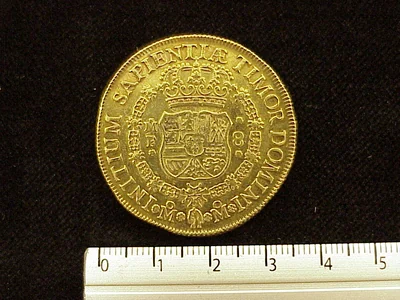
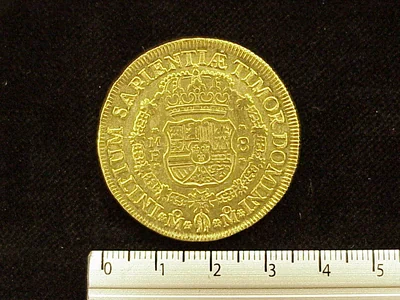
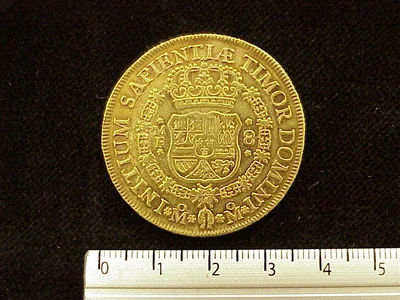
If you inherited a 1733 Mexican 8 escudos, you are holding one of the most valuable colonial gold coins ever struck in the Americas. This is not a coin worth a few dollars. Even a heavily worn, cleaned example carries thousands of dollars in gold and collector value, and top early Mexican 8 escudos have crossed six figures at auction.
What you actually have
The 8 escudos was the largest gold denomination in the Spanish colonial system, popularly called an "onza" (ounce). Yours was struck at the Mexico City Mint under Felipe V (Philip V of Spain), dated 1733, with the assayer initial F (the mint official who certified the metal's fineness).
Here are the specs that matter for value. Confirm them before you do anything else:
- Metal: gold
- Weight: 26.92 g
- Fineness: .875 (87.5% pure gold)
- Diameter: 37 mm
- Edge: diagonal reeded
- Catalog reference: KM#148
At .875 fine, this coin contains roughly 23.5 g of pure gold, which is about 0.76 troy ounces. That gives it a hard melt floor that moves with the gold market: today that alone is well over 1,500 USD in metal, regardless of condition. No genuine example of this coin is "worth nothing."
What it's worth
Value for early Mexican 8 escudos comes down to three things: the exact type, the date and mint combination, and the grade (state of preservation). The 1733 date is significant because it sits at the transition of Mexico's minting styles.
| Coin | Year | Condition | Approximate value (USD) |
|---|---|---|---|
| 8 Escudos Felipe V, Mexico | 1733 | Worn, damaged, or cleaned | 1,800 to 3,500 |
| 8 Escudos Felipe V, Mexico | 1733 | Solid collectible grade | 4,000 to 15,000 |
| 8 Escudos Felipe V, Mexico | 1733 | Choice / high grade, certified | 20,000 and up |
| Early Mexico 8 escudos (rare types/dates) | 1700s | Top rarities | 100,000+ at auction |
The wide spread is real, not a hedge. A coin that has been mounted in jewelry, polished, or holed drops toward the melt floor. A sharp, original-surface piece certified by NGC or PCGS commands the top of the range and, for the scarcest early dates and types, far more. Records for the very rarest 18th-century Mexican gold 8 escudos have reached into the hundreds of thousands of dollars at Heritage and Stack's Bowers.
Cob vs. milled: this matters for your coin
Early 1730s is the changeover era at the Mexico Mint. Older colonial gold was hand-struck ("cob" coinage), irregular and crude. Around this period the mint moved to machine-struck (milled) coins with round, even planchets. The style of your 1733 piece affects both its identification and its price, so photograph it exactly as it is and let a specialist confirm the type. Do not assume; the difference can be thousands of dollars.
The myth to ignore
A common belief is that any old Spanish colonial coin is automatically a life-changing fortune. Most colonial silver is worth modest sums. Gold 8 escudos are the exception because of their size, gold content, and low survival rate, but even here the price is driven by grade and rarity, not age alone. A damaged 1733 onza is still valuable, just not record-breaking. Anyone quoting you "millions" for an average example is not being honest.
How to tell if yours is genuine
Colonial gold is heavily forged, so verification comes first:
- Weigh it on a jewelry scale. Genuine examples are close to 26.92 g. A coin that weighs noticeably light is a red flag.
- Measure the diameter with calipers against 37 mm.
- Check the edge for diagonal reeding.
- Study the engraving, mintmark, and assayer initial (F). Forgeries often get the style, letters, or portrait wrong.
- Be suspicious of any offer far below the gold value. Real 1733 onzas do not sell for a few hundred dollars.
For a coin at this value level, professional grading and authentication by NGC or PCGS is worth the fee. Certification protects the price and makes selling far easier.
Where to sell it
Because this is high-value precious metal, sell through channels that let you verify before money changes hands:
- A verified numismatic dealer who will appraise the coin in person and quote you on the spot.
- The Pesoteca buy-and-sell forum, where collectors trade directly and can flag issues before you commit.
For a piece in this range, seriously consider a formal auction house (Heritage, Stack's Bowers) rather than a quick local sale. The right auction can add thousands over a walk-in offer. Photograph the obverse, reverse, and edge in good light, and never accept a lowball from the first buyer online.
Think you have a 1733 onza? Post clear photos of both sides and the edge in the Pesoteca forum and let collectors help you pin down the exact type before you sell.
Historical context
Eight escudos, Felipe V second period, 1733, Mexico mint. A pivotal year for the Mint: in 1732 mill striking with a round planchet was introduced, abandoning the cob technique that had been used without interruption since 1535. The 1733 ounce is from the first full years of the new system, with a pillar reverse showing the crowned Pillars of Hercules over the sea and the bands with the legend PLVS VLTRA, declarative iconography of the Spanish overseas empire. Felipe V reassumed the throne in 1724 after the death of his son Luis I, and his second period spans 1724 to 1746. In New Spain, Juan de Acuña, Marquis of Casafuerte, governed as viceroy from 1722 until his death in 1734. The piece theoretically weighs 27.06 grams with a fineness of 0.916. The technical change allowed uniformity of weight and shape, a hallmark of the Bourbon reform of the mint. The edge was marked with a mechanical collar or inscription that hindered clipping, the main fraud that had affected colonial gold until then. The listing records this piece as rare, a sign of the scarce survival of the first full year of the Mexican pillar coinage.
This piece belongs to the era
Colonial / Virreinato →Explore all the Mexican coins of this era, their historical context and how they connect to the monetary system of the period.
Value range of this piece
Market estimate: $51,194 - $86,222 MXN depending on the grade of preservation (typical range between a circulated and an uncirculated piece).
See the full breakdown by grade (VG, F, VF, EF, AU, MS-60, MS-63, MS-65) for the whole series →
Same denomination, other years
8 escudos Oro 0.875 (21k) · 8 Escudos Felipe V Segunda Epoca
Frequently asked questions
How much is a 1733 Mexico 8 escudos Felipe V gold coin worth?
It depends heavily on condition. Even a worn or cleaned example is worth roughly 1,800 to 3,500 USD, driven partly by its gold content (26.92 g at .875 fine, about 0.76 troy ounces of gold). Solid collectible grades run 4,000 to 15,000 USD, and choice certified pieces or the scarcest early types can reach 20,000 USD and well beyond at major auctions.
Is the 1733 Felipe V 8 escudos rare?
Yes. Gold 8 escudos, the largest denomination in the Spanish colonial system, had low mintages and low survival rates. The 1733 date sits at the transition between hand-struck cob coinage and machine-struck milled coinage at the Mexico City Mint, which makes exact type identification important. Genuine examples in original, high grade are genuinely scarce.
Where can I sell a 1733 Mexican 8 escudos gold coin?
Because it is high-value gold, sell where you can verify before paying: a [verified numismatic dealer](/tiendas) who appraises in person, or the [Pesoteca buy-and-sell forum](/foro/compra-venta). For a coin at this value, a formal auction house like Heritage or Stack's Bowers often nets thousands more than a local walk-in offer. Photograph the obverse, reverse, and edge first, and never sell to the first lowball bidder online.
How do I tell if my 1733 8 escudos is genuine?
Weigh it (should be near 26.92 g), measure the diameter (37 mm), and check for a diagonal reeded edge. Examine the engraving style, the Mexico mintmark, and the assayer initial F; forgeries commonly get these wrong. Be very suspicious of any coin selling far below its gold value. For a piece this valuable, professional certification by NGC or PCGS is strongly recommended.
Conversation
0 comments
Loading comments…