
5 Pesos Ignacio Allende 2010: What It's Worth
The 5 Pesos Ignacio Allende 2010: What It's Worth is worth between $40 and $100 MXN depending on its grade of preservation.
Prices updated: August 2026
Bicentennial of Independence. Military man who launched the movement alongside Hidalgo.
Bicentennial of Independence. Military man who launched the movement alongside Hidalgo.
The 5 Pesos Ignacio Allende 2010: What It's Worth is worth between $40 and $100 MXN depending on its grade of preservation.
Prices updated: August 2026
How much is the 5 Pesos Ignacio Allende 2010: What It's Worth worth?
The estimated value of the 5 Pesos Ignacio Allende 2010: What It's Worth ranges from $40 (circulated, XF) up to $100 (official blister pack), with $78 as a reference for an uncirculated (UNC) piece. The estimate is based on the official mintage and the historical behavior of the family.
The real price depends on four factors: the grade of preservation (a circulated piece is worth the low end of the range; an uncirculated one, or one still in its official blister pack, the high end), the finish (satin vs mirror/proof), the rarity within the series based on the mintage, and the metal spot price on the day of the deal when the piece is silver or gold. Check the value-by-grade table above and compare with equivalent pieces before buying or selling.
Where to buy or sell this coin?
Browse the national directory of numismatic shops or the community forum to trade directly with other collectors.
Description
If you found a Mexican 5 Pesos coin with Ignacio Allende on it dated 2010, here is the honest answer: the everyday circulated version is worth about its face value, roughly 25 to 30 US cents. The version that carries real money is the encapsulated proof with a silver center, which trades in the tens of dollars, not thousands. In 2026, that distinction is the whole story.
Two very different coins with the same design
Mexico's central bank, Banco de México (Banxico), issued this piece in 2010 as part of the "Bicentenario de la Independencia" (Bicentennial of Independence) series honoring Ignacio Allende, a military leader of the 1810 independence movement. What matters for value is that two versions exist, and they are worth wildly different amounts.
The circulation version is a bimetallic coin you could get in pocket change. Aluminum-bronze ring, base-metal center. This is the one most people inherit or find. Value: face value. Around 25 to 30 US cents depending on the peso exchange rate. It is not rare and it is not silver.
The proof version is where the collector premium lives. Same design, but the center is struck in .925 sterling silver, given a mirror-like proof finish, and sold sealed in an official Banxico case. This is a made-for-collectors product, produced in a limited run. If your coin came in a hard capsule inside a presentation case, you likely have this one.
Specifications (both versions)
- Weight: 9.76 g
- Diameter: 30.52 mm
- Edge: Plain (smooth)
- Composition: aluminum-bronze outer ring, center in .925 silver (proof version) or base metal (circulation version)
- Finish: Proof (encapsulated) and standard circulation
What it actually sells for
| Version | Condition | Typical value (USD) |
|---|---|---|
| Circulation, worn | Circulated | Face value, about 0.25 to 0.30 |
| Circulation, uncirculated | BU | 1 to 3 |
| Proof silver center, in Banxico case | Proof, complete | Tens of dollars, higher as part of the full set |
The proof coins were often sold as part of a larger commemorative set. A single proof coin loose is worth less than one still sealed with its original case and certificate. Completeness and packaging drive the number here more than the coin alone.
The myth to ignore
Social media posts will tell you a 2010 bicentennial 5 pesos is "worth thousands" or "a collector's fortune." For the ordinary circulation coin, that is false. It was minted for general use and millions of people handled these. Age is not the driver, and 2010 is recent. The only version with a genuine premium is the silver proof, and even that is a modest collector item, not a jackpot.
Most "error" coins people post online are post-mint damage: scratches, corrosion, and dings from years in a drawer. Genuine mint errors (off-center strikes, die rotation, doubling) can raise value if verified, but they are uncommon and easy to confuse with plain wear.
How to tell which one you have
- Look at the case. A proof came sealed in an official Banxico capsule inside a presentation box. A loose coin from change is the circulation version.
- Check the center metal. The proof center is bright silver with a mirror finish. The circulation center is a duller base metal.
- Weigh and measure it. Use a jewelry scale and calipers. It should weigh 9.76 g and measure 30.52 mm. Wrong weight or diameter, flat relief, or smeared color are red flags for a fake.
For authentication of proof or higher-value pieces, third-party grading from services like NGC or PCGS gives a verifiable grade and confirms the coin is genuine.
Where to sell it
If you have the plain circulation coin, there is no real market beyond spending it. If you have the silver proof in its case, sell through a verified numismatic dealer or a collector marketplace rather than dumping it to the first Facebook buyer.
- Browse the Pesoteca dealer directory to find a shop that can appraise it in person.
- Post it in the Pesoteca buy-and-sell forum to reach collectors directly.
- Compare with other pieces in the same bicentennial commemorative series before you set a price.
Photograph the obverse, reverse, and edge in good light, and note whether you still have the original case and certificate.
Have a 2010 bicentennial 5 pesos and not sure if it's the silver proof or just change? Post clear photos in the Pesoteca forum and the community will help you identify exactly which version you're holding.
Historical context
Ignacio José de Allende y Unzaga: captain of the Queen's Dragoon Regiment and insurgent captain general
Ignacio José de Allende y Unzaga (1769-1811) was captain of the Queen's Dragoon Regiment and insurgent captain general during the War of Independence.
A career soldier, Allende took part in the conspiracies of Valladolid (1809) and Querétaro (1810). When the conspiracy was discovered in September 1810, he accelerated the uprising together with Hidalgo. He commanded the insurgent cavalry at the battle of Monte de las Cruces and at Aculco. He was executed by firing squad in Chihuahua on June 26, 1811, following the betrayal at Acatita de Baján.
Context of the year. The piece corresponds to 2010, the bicentennial year of the start of the struggle. Allende embodies the shift of Creole officers of the colonial army to the insurgent cause.
The reverse of the coin. The reverse of this 5-peso piece shows the portrait of Ignacio José de Allende y Unzaga, his engraved signature, and the year 2010, in accordance with the official catalog of the Bank of Mexico for the commemorative series of the Bicentennial of the start of Independence (1810-2010).
Legacy. San Miguel el Grande was renamed San Miguel de Allende in 1826 and is today a UNESCO World Heritage Site. His head remained on display in a cage at the Alhóndiga de Granaditas until 1821.
This piece belongs to the era
Nuevos Pesos y actualidad →Explore all the Mexican coins of this era, their historical context and how they connect to the monetary system of the period.
Value range of this piece
Market estimate: $40 - $100 MXN depending on the grade of preservation (typical range between a circulated and an uncirculated piece).
See the full breakdown by grade (VG, F, VF, EF, AU, MS-60, MS-63, MS-65) for the whole series →
Other denominations from 2010
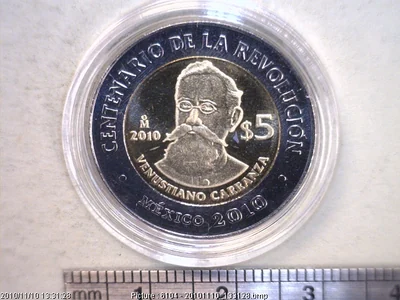
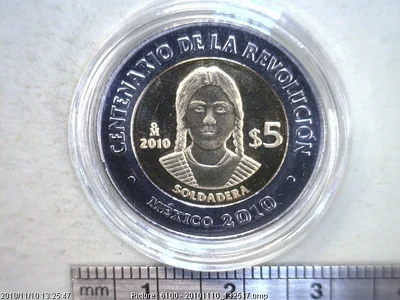
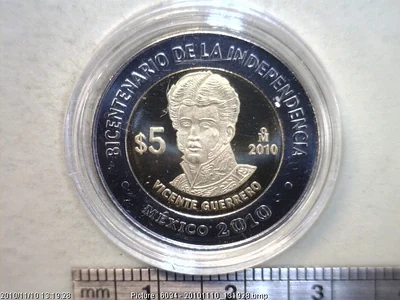
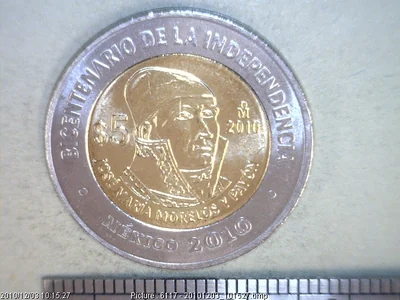
5 Pesos Bicentenario Independencia y Centenario Revolución · Bimetálica
Same denomination, other years
5 pesos Bimetálica · 5 Pesos Bicentenario Independencia y Centenario Revolución
Official sources
Frequently asked questions
How much is the Mexico 5 Pesos Ignacio Allende 2010 worth?
The circulation version is worth about face value, roughly 25 to 30 US cents, and up to a few dollars if uncirculated. The proof version with a .925 silver center, sealed in its official Banxico case, is worth tens of dollars, more when kept with its full original set and certificate.
Is the 5 Pesos Allende 2010 rare or made of silver?
The everyday circulation coin is not rare and is not silver, its center is base metal. Only the limited proof version has a .925 sterling silver center and a mirror finish. If yours came loose from pocket change, it is the common version.
Where can I sell my 5 Pesos Allende 2010?
For the silver proof, use a verified numismatic dealer from the [Pesoteca directory](/tiendas) who can value it on the spot, or list it in the [Pesoteca buy-and-sell forum](/foro/compra-venta). Photograph the obverse, reverse, and edge and keep the original case. The plain circulation coin has no market beyond face value.
How can I tell if my 5 Pesos Allende 2010 is genuine?
Weigh it (9.76 g) and measure it (30.52 mm) with a jewelry scale and calipers, then compare to the specs above. Fakes usually have wrong weight or diameter, flat relief, or poorly applied color. For higher-value proof pieces, third-party grading from NGC or PCGS confirms authenticity.
Conversation
0 comments
Loading comments…