
5 Pesos José María Morelos 2010 (Bicentennial): What It's Worth
Prices updated: August 2026
Bicentennial of Mexican Independence: José María Morelos y Pavón, proof.
Bicentennial of Mexican Independence: José María Morelos y Pavón, proof.
Design
Banxico
Obverse
Bicentennial of the Independence of Mexico: José María Morelos y Pavón, proof.
How much is the 5 Pesos José María Morelos 2010 (Bicentennial): What It's Worth worth?
The market value of the 5 Pesos José María Morelos 2010 (Bicentennial): What It's Worth is not yet documented with enough data to give a firm range. Weigh and measure your piece, compare it against the specifications, and check the forum for a second opinion.
The real price depends on four factors: the grade of preservation (a circulated piece is worth the low end of the range; an uncirculated one, or one still in its official blister pack, the high end), the finish (satin vs mirror/proof), the rarity within the series based on the mintage, and the metal spot price on the day of the deal when the piece is silver or gold. Check the value-by-grade table above and compare with equivalent pieces before buying or selling.
Where to buy or sell this coin?
Browse the national directory of numismatic shops or the community forum to trade directly with other collectors.
Description
If you inherited or found a 2010 five-peso coin with a man's face on it, here is the honest answer: most examples are worth a few dollars at most. This is a circulation coin, not a rarity. In top uncirculated grade or certified, it climbs, but not to hundreds of dollars. Here is exactly what drives the value and how to check yours in 2026.
What this coin actually is
The 5 Pesos José María Morelos (2010) is part of Mexico's Bicentennial series, a large set of five-peso coins the central bank (Banxico) released to mark 200 years of Mexican independence. Instead of one commemorative coin, Banxico issued a whole collection, each five-peso piece showing a different independence leader. Morelos was one of the movement's key figures after Miguel Hidalgo, which is why he got his own coin.
It is a bimetallic coin, meaning it has two metals: a lighter-colored outer ring around a darker center (similar in build to a US bicentennial-style dollar or a euro coin). It weighs 9.78 grams, measures 30.54 mm across, and has a smooth (plain) edge. Important for value: there is no silver or gold in it. The metal is base alloy, so there is no melt value to fall back on. Whatever it is worth comes purely from collector demand.
How much is it worth?
Be realistic. This coin circulated as everyday money, so millions of people handled it and worn examples are common.
- Worn / circulated: roughly face value up to a couple of US dollars. A worn Morelos five-peso is spending money, not a payday.
- Uncirculated (UNC / BU): a clean coin with no wear or spotting on either metal is where collectors pay a small premium, often a few dollars to low double digits depending on eye appeal.
- Certified high grade (MS-65 and up from NGC or PCGS): the best examples can reach higher, but we are still talking modest sums, not a fortune.
The honest range for a single coin is a few dollars up to low double digits, with certified top-grade pieces the exception. Anyone telling you a common 2010 five-peso is worth hundreds is selling hype.
| Coin | Year | Typical value (circulated) | Value (UNC/certified) |
|---|---|---|---|
| 5 Pesos Morelos (Bicentennial) | 2010 | Face value to ~2 USD | A few to low double-digit USD |
Is it rare?
No, not on its own. The exact mintage for this specific issue is not published by Banxico, but it entered general circulation, so survivors are plentiful. Where it gets interesting is the full set: the Bicentennial series has many different faces, and collectors chase the complete run. A single Morelos is easy to find. A complete, matched, uncirculated set is worth more as a group than the sum of loose coins.
2010 is the only year this design was struck, so there are no date varieties to hunt. Any real value differences come from grade, not year.
The ones people think are worth a fortune (but aren't)
Mexican commemoratives from the 2000s and 2010s get talked up online as "rare" because they look different from ordinary coins. They are not rare. They were mass-produced for circulation. The genuinely valuable Mexican coins are older gold pieces like the Centenario (a 50-peso gold coin) or early silver, not a 2010 bimetallic five-peso. If you have a box of inherited coins, this Morelos piece is likely one of the more common items in it.
Mint errors: worth checking, rarely real
Genuine mint errors (off-center strikes, die rotation, double strikes) can multiply a coin's value if they are verifiable. But most "errors" people post online are post-mint damage: dings, scratches, corrosion from being in a drawer for years. That damage lowers value, it does not raise it. If you think yours has a real error, get a second opinion before you get excited.
How to tell if yours is genuine
- Weigh it. A real one is 9.78 grams. Measure it. Diameter should be 30.54 mm. If your coin is off on either, that is a red flag.
- Check the relief. Compare the detail against official Banxico images. Fakes tend to have flatter, softer detail.
- For anything you plan to pay or ask real money for, certified grading from NGC or PCGS is the definitive proof of both authenticity and grade.
Where to sell it (US and online)
For a common circulated example, this is not worth shipping to a big auction house. Your realistic options:
- Coin shops and dealers for a quick over-the-counter offer.
- Serious collector groups and marketplaces where Mexican coin collectors trade.
- The Pesoteca buy-and-sell forum to reach collectors directly.
- The Pesoteca verified shop directory to find a dealer who will appraise it fairly, without a middleman markup.
Photograph both sides and the edge before you sell, and know the value range above so you do not accept a lowball offer. If you are unsure whether yours is common or a better grade, post it in the Pesoteca forum and let collectors weigh in.
Got a full Bicentennial set instead of a single coin, or think yours might be certified quality? Bring photos of the front, back, and edge to the Pesoteca community and we will help you figure out what it is really worth.
Historical context
José María Teclo Morelos Pérez y Pavón: priest, generalissimo, and strategist of the insurgent movement
José María Teclo Morelos Pérez y Pavón (1765-1815) was a priest, generalissimo, and strategist of the insurgent movement during the War of Independence.
This listing corresponds to the variant with the abbreviated MÉXICO legend on the reverse of José María Morelos. Morelos relieved Hidalgo in military command and led four campaigns in the country's south. In 1813 he installed the Congress of Anáhuac in Chilpancingo, where he promulgated the Sentiments of the Nation.
Context of the year. The piece is from 2010 and is part of the die variants of the series that Banxico recorded in its official catalog. The difference from the standard Morelos listing lies in engraving details of the reverse.
The reverse of the coin. The reverse of this 5-pesos piece shows the portrait of José María Teclo Morelos Pérez y Pavón, his engraved signature, and the year 2010, per the official Banco de México catalog for the commemorative series of the Bicentennial of the start of Independence (1810-2010).
Legacy. The state of Morelos, the city of Morelia, and Mexico City's international airport bear his name. For the collector, this variant adds typological value within the complete set.
This piece belongs to the era
Nuevos Pesos y actualidad →Explore all the Mexican coins of this era, their historical context and how they connect to the monetary system of the period.
Value range of this piece
Value range without enough data for this piece.
See the full breakdown by grade (VG, F, VF, EF, AU, MS-60, MS-63, MS-65) for the whole series →
Other denominations from 2010
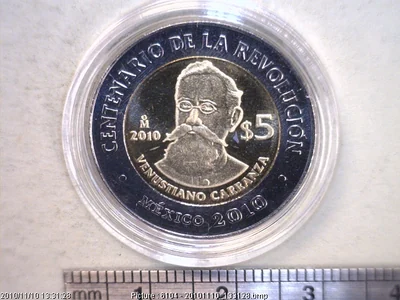
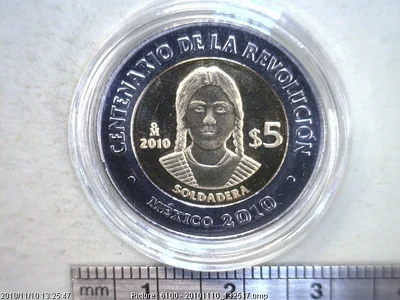
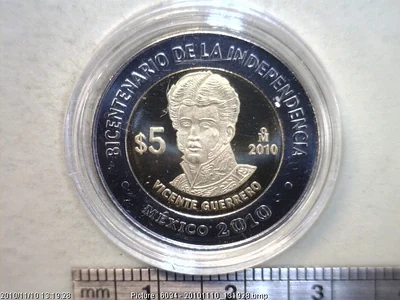
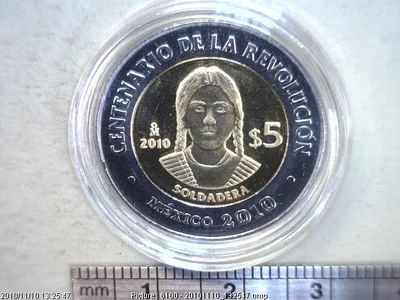
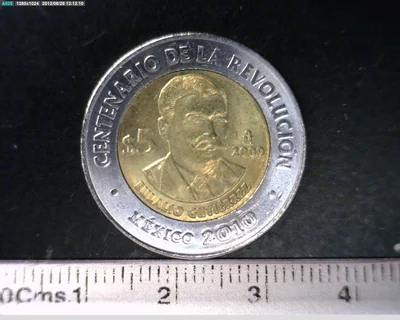
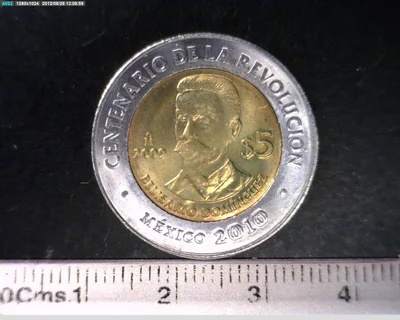
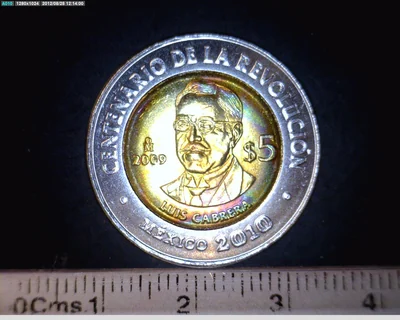
5 Pesos Bicentenario Independencia y Centenario Revolución · Bimetálica
Same denomination, other years
5 pesos Bimetálica · 5 Pesos Bicentenario Independencia y Centenario Revolución
Official sources
Frequently asked questions
How much is a 2010 5 Pesos José María Morelos worth?
Circulated examples are worth roughly face value up to a couple of US dollars, since it was an everyday circulation coin. A clean uncirculated (UNC/BU) piece brings a few dollars to low double digits, and certified high-grade coins (MS-65 and up from NGC or PCGS) can reach a bit more. It is not a coin worth hundreds.
Is the 2010 Morelos 5 peso rare or valuable?
No, a single coin is not rare. It circulated widely, so survivors are common. Value comes from grade, not scarcity. Where it gets more interesting is completing the full Bicentennial set of five-peso coins, which is worth more as a matched, uncirculated group than as loose pieces.
How do I tell if my Morelos 5 peso is genuine?
A real one weighs 9.78 grams and measures 30.54 mm. If yours is off on weight or diameter, be suspicious. Compare the relief detail to official Banxico images, since fakes look flatter. For anything you plan to buy or sell for real money, NGC or PCGS certification is the definitive check.
Where can I sell a 2010 5 Pesos Morelos coin?
For a common example, use coin dealers, serious collector groups, the [Pesoteca buy-and-sell forum](/foro/compra-venta), or the [verified shop directory](/tiendas) to find a dealer who appraises fairly. Photograph both sides and the edge, and check the value range before accepting any offer so you avoid a lowball.
Conversation
0 comments
Loading comments…