
1713 Mexico 4 Escudos Gold Coin (Felipe V): Value Guide
The 1713 Mexico 4 Escudos Gold Coin : Value Guide is worth between $25,806 and $43,463 MXN depending on its grade of preservation.
Prices updated: August 2026
Viceroyalty · Mexico City Mint
Viceroyalty · Mexico City Mint
The 1713 Mexico 4 Escudos Gold Coin : Value Guide is worth between $25,806 and $43,463 MXN depending on its grade of preservation.
Prices updated: August 2026
How much is the 1713 Mexico 4 Escudos Gold Coin (Felipe V): Value Guide worth?
The estimated value of the 1713 Mexico 4 Escudos Gold Coin (Felipe V): Value Guide ranges from $25,806 (circulated, XF) up to $43,463 (official blister pack), with $37,042 as a reference for an uncirculated (UNC) piece. The estimate is based on the official mintage and the historical behavior of the family.
The real price depends on four factors: the grade of preservation (a circulated piece is worth the low end of the range; an uncirculated one, or one still in its official blister pack, the high end), the finish (satin vs mirror/proof), the rarity within the series based on the mintage, and the metal spot price on the day of the deal when the piece is silver or gold. Check the value-by-grade table above and compare with equivalent pieces before buying or selling.
Where to buy or sell this coin?
Browse the national directory of numismatic shops or the community forum to trade directly with other collectors.
Description
If you found a small gold coin with a Spanish king's portrait and "1713" on it, you have a Mexican colonial 4 Escudos struck under Felipe V. The short answer: even worn examples carry real value because they are gold, and certified high-grade pieces can bring several thousand dollars at auction. Here is what actually drives the number.
What you have
The 4 Escudos was a gold coin minted in Mexico City during Spanish colonial rule (the Virreinato). "Escudo" was the Spanish gold denomination, and 4 escudos was a mid-size gold piece, worth half of the famous 8 escudos (the coin later called the "doubloon"). Yours was struck in 1713 under King Felipe V.
The hard specs, which you should verify before trusting anything:
- Metal: gold, .875 fine (21 karat)
- Weight: 13.57 grams
- Diameter: 17 mm
- Edge: plain (unmilled)
- Era: Colonial / Virreinato of New Spain
At roughly 13.57 grams of .875 gold, the coin contains close to 11.9 grams (about 0.38 troy ounces) of pure gold. That gives it a hard floor: whatever the collector market does, the metal alone is worth several hundred US dollars at current gold prices. A colonial gold coin from 1713 is never "worth nothing."
What it is actually worth in 2026
Early colonial gold from Mexico is genuinely sought after, and 1713 is an early date. Value swings hard on two things: the type of strike and the grade.
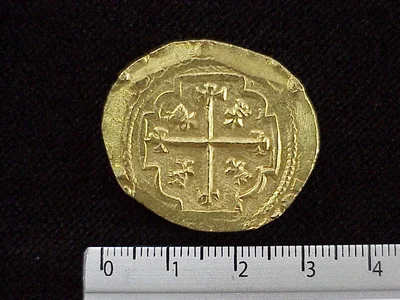
Colonial gold from this period comes in two very different forms. Early pieces were often cobs (called macuquinas in Spanish), hand-struck on irregular, roughly cut planchets. Later royal issues were round and better centered. The form and how much detail survives on the shield and cross matters more than almost anything else.
| Condition | What it looks like | Approximate value (USD) |
|---|---|---|
| Heavily worn / damaged | Design mostly flat, gold intact | 350 to 600 (near melt) |
| Circulated, identifiable | King's arms and legends readable | 700 to 2,000 |
| Strong strike, minimal wear | Sharp detail, good centering | 2,500 to 6,000+ |
| Certified high grade (NGC / PCGS) | Slabbed, top examples | 6,000 to five figures |
These are ranges, not a quote on your specific coin. Early Mexican colonial gold in choice condition regularly clears several thousand dollars at Heritage Auctions and Stack's Bowers, while a worn, damaged, or repaired piece sits much closer to its melt value. Do not assume the high end until a grader confirms it.
The myth to kill first
A 300-year-old gold coin sounds like it should be worth a fortune. Sometimes it is. But "old" and "gold" alone do not create five-figure prices. What does: sharp original detail, an undamaged surface, a scarce mint year or variety, and third-party certification. A cleaned, holed, bent, or heavily worn 1713 4 Escudos is still a nice piece of history, but it trades close to its gold content, not for a fantasy number.
Also be realistic about condition language. Colonial cobs were crude by design. A slightly off-center strike is normal for the era and is not a rare "error" that multiplies value. True mint errors on hammered coinage are hard to prove and require expert eyes.
How to tell if yours is genuine
Counterfeits of Spanish colonial gold exist, and the weight test catches most of them fast.
- Weigh it. A genuine 4 Escudos weighs about 13.57 grams. Fakes are frequently struck in lower-purity gold or base metal and come out lighter or heavier. A jeweler's scale settles it in seconds.
- Check the diameter. Should be near 17 mm.
- Look at the gold color and wear. Real .875 gold has a specific warm tone. Modern cast copies often show soft, mushy detail and casting seams on the edge.
- Get it certified. For any coin you believe is worth more than a few hundred dollars, send it to NGC or PCGS. A slab from either is the definitive answer on authenticity and grade, and it raises resale value on its own.
If you plan to buy or sell one for a meaningful sum, treat professional authentication as non-negotiable. Colonial gold is exactly the segment where sophisticated fakes appear.
Where to sell it
Because this is a precious-metal collectible, you have a real market either way.
- US auction houses (Heritage, Stack's Bowers) are the right venue for a certified, high-grade example. They reach the collectors who pay top dollar for colonial gold.
- Verified coin dealers give you an immediate offer. Expect a small discount versus auction, but you get paid now. Compare offers.
- Collector marketplaces and forums work well for identifiable, photographed coins. Always show the edge, both faces, and the weight to a buyer, and verify a buyer the same way before you ship.
Avoid dumping it into a general online listing at the first offer, and be wary of buyers who will not let you confirm weight and authenticity first. For a piece with a gold floor, patience pays.
Before you sell, photograph the obverse, reverse, and edge, weigh it, and match your coin against the grade ranges above. If you want a second opinion on grade or authenticity, post clear photos in the Pesoteca forum and let the community weigh in. You can also check current colonial gold Escudos in the series guide and read the Mexican coin grading guide to place your coin before anyone quotes you a price.
Sitting on a box of inherited coins and not sure which ones are the gold? Post a photo in the Pesoteca buy-and-sell forum and find out which pieces are the ones that actually matter.
Historical context
Four escudos cob of Felipe V, first period, dated 1713, Mexico City mint, with no explicit assayer mark in the recorded subtitle. Krause references the type as KM#55.1. That year the treaties of Utrecht were signed, closing the War of the Spanish Succession: Felipe V is recognized as king of Spain on condition of renouncing his rights to the French crown. In New Spain, Fernando de Alencastre Noroña y Silva, Duke of Linares, governed, having taken office as viceroy in 1711 and remaining until 1716. Half ounce of gold with a theoretical weight near 13.53 grams and 0.916 fineness. The piece was still produced under the cob technique that dominated the capital's mint before the milled-coinage reform of 1732. The planchet was cut with shears from a bar of cast gold, heated, and hammered between fixed dies. The result is a characteristic irregular edge and frequently partial legends. The combination of 1713 with New Spain symbolically carries the closing of the first Bourbon dynastic crisis.
This piece belongs to the era
Colonial / Virreinato →Explore all the Mexican coins of this era, their historical context and how they connect to the monetary system of the period.
Value range of this piece
Market estimate: $25,806 - $43,463 MXN depending on the grade of preservation (typical range between a circulated and an uncirculated piece).
See the full breakdown by grade (VG, F, VF, EF, AU, MS-60, MS-63, MS-65) for the whole series →
Other denominations from 1713
Escudos Coloniales (oro) · Oro 0.875 (21k)
Frequently asked questions
How much is a 1713 Mexico 4 Escudos gold coin worth?
It depends heavily on condition. Because it contains about 0.38 troy ounces of .875 gold, even a worn or damaged example is worth roughly 350 to 600 USD as metal. Identifiable circulated coins run 700 to 2,000 USD, and sharp or certified high-grade examples reach several thousand dollars at auction. Get it graded by NGC or PCGS before accepting any offer.
Is the 1713 4 Escudos rare?
It is an early Mexican colonial gold coin, and early dates are genuinely sought after by collectors. Survival is what matters most: many pieces are worn, cleaned, or damaged, so choice, well-struck examples are the scarce ones and command the highest prices. Age alone does not make it rare; condition and originality do.
How do I tell if my 4 Escudos is genuine?
Start with the weight: a real one is about 13.57 grams and 17 mm across. Fakes are often struck in lower-purity gold and come out off-weight, which a jeweler's scale reveals in seconds. Cast copies show soft detail and seams on the edge. For any coin you think is worth more than a few hundred dollars, submit it to NGC or PCGS for certification.
Where can I sell a 1713 4 Escudos gold coin?
For a certified high-grade piece, US auction houses like Heritage or Stack's Bowers reach the collectors who pay the most. Verified dealers give you a fast offer at a small discount. Collector forums work for identifiable, well-photographed coins. Always confirm weight and authenticity, on your coin and the buyer's, before money changes hands.
Conversation
0 comments
Sources
Images for informational and educational purposes, attributed to their original source. Reference values; the real price depends on the grade, the specific variant and demand.
Loading comments…