
1000 Old Pesos Sor Juana (1991): Value & Worth
Prices updated: August 2026
Old peso era · Sor Juana Inés de la Cruz · Aluminum bronze
Old peso era · Sor Juana Inés de la Cruz · Aluminum bronze
Design
Banxico
Reverse
Effigy of Sor Juana Inés de la Cruz accompanied by the face value "$1000". Year of minting "1991" and mint mark "Mo" of the Mexican Mint.
Obverse
Mexican National Coat of Arms with the inscription "ESTADOS UNIDOS MEXICANOS".
How much is the 1000 Old Pesos Sor Juana (1991): Value & Worth worth?
The market value of the 1000 Old Pesos Sor Juana (1991): Value & Worth is not yet documented with enough data to give a firm range. Weigh and measure your piece, compare it against the specifications, and check the forum for a second opinion.
The real price depends on four factors: the grade of preservation (a circulated piece is worth the low end of the range; an uncirculated one, or one still in its official blister pack, the high end), the finish (satin vs mirror/proof), the rarity within the series based on the mintage, and the metal spot price on the day of the deal when the piece is silver or gold. Check the value-by-grade table above and compare with equivalent pieces before buying or selling.
Where to buy or sell this coin?
Browse the national directory of numismatic shops or the community forum to trade directly with other collectors.
Description
If you inherited or found a Mexican 1000 Pesos coin dated 1991 with Sor Juana Inés de la Cruz on it, here is the honest answer up front: in circulated condition it is worth a few US cents to about 1 USD. This is a common circulation coin, not a rarity. Only pristine, uncirculated examples pull a small premium, and even those top out at a few dollars.
The number 1000 confuses a lot of people. This is an old peso coin from before Mexico's 1993 currency reform, when the country dropped three zeros. So 1000 old pesos became 1 new peso. It is no longer legal tender and cannot be spent or exchanged at a bank. Its value today is purely collectible.
What this coin actually is
Sor Juana Inés de la Cruz was a 17th-century Mexican poet and scholar, and her portrait appears on the reverse of this coin. It was struck at the Casa de Moneda de México (the Mexican Mint), marked with the small "Mo" mint mark. It belongs to the pre-1992 modern peso era.
Specifications (verify yours against these):
| Feature | Detail |
|---|---|
| Face value | 1000 old pesos |
| Year | 1991 |
| Metal | Aluminum-bronze |
| Weight | 0.76 grams |
| Diameter | 17.04 mm |
| Edge | Reeded |
| Mint | Casa de Moneda de México (Mo) |
Obverse: The Mexican coat of arms (an eagle on a cactus devouring a snake) with the inscription "ESTADOS UNIDOS MEXICANOS."
Reverse: The portrait of Sor Juana Inés de la Cruz with the face value "$1000," the year "1991," and the "Mo" mint mark.
What it's worth in 2026
Be realistic. This coin was produced for everyday circulation and survives in large numbers, so scarcity is not on your side. The metal is aluminum-bronze, which carries no meaningful bullion value (there is no silver or gold here, so no melt floor to protect the price).
| Condition | Approximate value (USD) |
|---|---|
| Circulated (worn) | Under 1 USD |
| Uncirculated (no wear) | 1 to 3 USD |
| Mint state, certified/graded | A few dollars, occasionally more for top grades |
The coin gains value in two situations only: it is in genuine uncirculated condition with full luster and sharp detail, or it comes sealed in an original Banco de México presentation package. Everyday worn examples from a coin jar are common and inexpensive. Check the grading and condition guide to place your piece.
Is it silver? No
A lot of people ask this because the coin has a bright, brassy tone. It is not silver and not gold. It is aluminum-bronze, an alloy used for low-denomination circulation coins. If you are looking for Mexican silver, that is a different category (see our guides on the Onza Libertad silver bullion coin and older silver pesos).
How to check what yours is worth
- Weigh and measure it. Use a jewelry scale and a caliper. A genuine coin weighs 0.76 grams and measures 17.04 mm across. Wrong weight or diameter is a red flag.
- Grade the wear. Look at the high points of the coat of arms and Sor Juana's portrait. Sharp, unworn detail with original shine means uncirculated. Smooth, flat, or scratched surfaces mean circulated.
- Check for original packaging. A sealed Banco de México blister or presentation set is worth more than a loose coin.
- Consider certification only if it grades high. Sending a common coin to NGC or PCGS costs more than the coin is worth unless it is a genuine top-grade example.
About "error" coins
Mint errors (off-center strikes, die rotation, double strikes) can multiply value when they are genuine and verifiable. Most "errors" people spot on social media are post-mint damage: dings, corrosion, or wear, not factory mistakes. If you think you have a real error, post clear photos on the Pesoteca forum and let the community weigh in before you get your hopes up.
Have a 1991 Sor Juana coin sitting in a drawer? Post front and back photos in the Pesoteca buy-and-sell forum and we'll help you figure out if it's a common example or something worth grading.
Historical context
The circulating Mexican peso coins of the second half of the 20th century were struck in alloys that changed according to the cost of metals and inflationary processes: .720 silver in the $1, $5, $10, $25 denominations during the 1940s-50s; cupronickel from the 1970s on; aluminum bronze and stainless steel in the 1980s; pieces with historical figures (Hidalgo, Cuauhtémoc, Juárez, Madero, Carranza, Sor Juana) in the late 1980s just before the transition to Nuevos Pesos in 1992. 1991 corresponds to the period when this variant was in circulation. Sor Juana Inés de la Cruz, a New Spain poet, appears on the circulating $1000 denomination of the 1980s, the first Mexican woman to appear on current coinage.
This piece belongs to the era
México Moderno (pre-1992) →Explore all the Mexican coins of this era, their historical context and how they connect to the monetary system of the period.
Value range of this piece
Value range without enough data for this piece.
See the full breakdown by grade (VG, F, VF, EF, AU, MS-60, MS-63, MS-65) for the whole series →
Other denominations from 1991
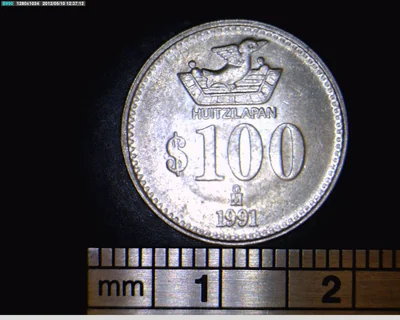
100 Pesos Bronce Aluminio · Aluminio-bronce
Same denomination, other years
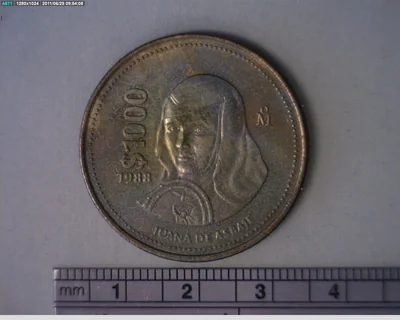
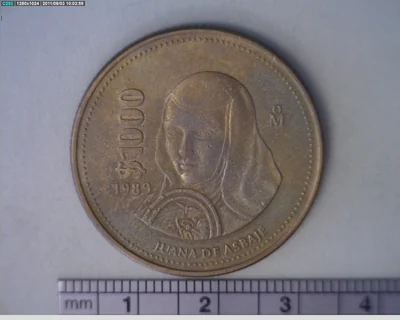
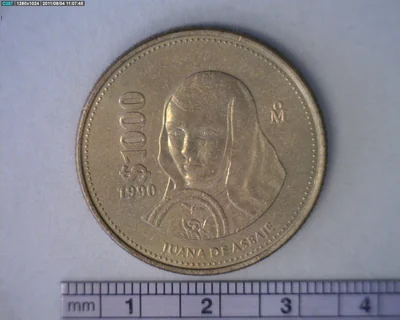
1000 pesos Aluminio-bronce · 100 Pesos Bronce Aluminio
Official sources
Frequently asked questions
How much is the 1991 1000 Pesos Sor Juana coin worth?
In circulated condition it is worth under 1 USD. A genuine uncirculated example runs about 1 to 3 USD, and top-grade certified coins or ones in original Banco de México packaging can reach a few dollars. This is a common circulation coin, not a rarity, and it contains no silver or gold.
Is the 1991 1000 Pesos Sor Juana coin rare?
No. It was struck for everyday circulation and survives in large numbers. Only pristine uncirculated pieces carry any premium, and even those stay modest. Worn examples from a coin jar are common and inexpensive.
Where can I sell a 1991 1000 Pesos Sor Juana coin?
Your best options are a verified numismatic shop from the [Pesoteca directory](/tiendas), which can appraise it on the spot, or the [Pesoteca buy-and-sell forum](/foro/compra-venta) among collectors. Photograph the obverse, reverse, and edge, and check the value ranges on this page before selling. Avoid dumping it to the first bidder on social media.
How can I tell if my 1991 Sor Juana coin is genuine?
Weigh and measure it with a jewelry scale and caliper. A genuine coin weighs 0.76 grams and measures 17.04 mm in diameter, struck in aluminum-bronze with a reeded edge. Fakes usually have the wrong weight or diameter, flat relief, or uneven color.
Conversation
0 comments
Sources
Images for informational and educational purposes, attributed to their original source. Reference values; the real price depends on the grade, the specific variant and demand.
Loading comments…