
1000 Pesos Sor Juana (1988): What It's Really Worth
Prices updated: August 2026
Old peso era · Sor Juana Inés de la Cruz · Aluminum bronze
Old peso era · Sor Juana Inés de la Cruz · Aluminum bronze
Design
Banxico
Reverse
Effigy of Sor Juana Ines de la Cruz in profile, with the legend "JUANA DE ASBAJE" (her birth name). On the left the value "1000" (with no peso symbol in the design, though catalogs note it as 1000), on the right the mint mark "Mo" of the Mexican Mint, and the year "1988".
Obverse
Mexican National Coat of Arms with the inscription "ESTADOS UNIDOS MEXICANOS".
How much is the 1000 Pesos Sor Juana (1988): What It's Really Worth worth?
The market value of the 1000 Pesos Sor Juana (1988): What It's Really Worth is not yet documented with enough data to give a firm range. Weigh and measure your piece, compare it against the specifications, and check the forum for a second opinion.
The real price depends on four factors: the grade of preservation (a circulated piece is worth the low end of the range; an uncirculated one, or one still in its official blister pack, the high end), the finish (satin vs mirror/proof), the rarity within the series based on the mintage, and the metal spot price on the day of the deal when the piece is silver or gold. Check the value-by-grade table above and compare with equivalent pieces before buying or selling.
Where to buy or sell this coin?
Browse the national directory of numismatic shops or the community forum to trade directly with other collectors.
Description
If you inherited or found a 1988 Mexican 1000 pesos coin with a woman's face on the back, here is the honest answer: a normal circulated one is worth roughly 50 cents to 1 USD. This is one of the most common Mexican coins ever struck, with 229.3 million minted in 1988 alone. The exception is a rare proof version that can bring around 550 USD.
That woman is Sor Juana Inés de la Cruz, a famous 17th-century Mexican poet and nun known as the "Tenth Muse." You will also see her on old Mexican banknotes from the same era. The coin is not silver or gold, so there is no melt value to fall back on. Everything here is about condition and, in a few cases, that special proof finish.
Quick answer: is it worth money?
For most people reading this, no, not much. In 2026 a worn, everyday example trades between collectors for the equivalent of about 9 to 12 Mexican pesos, roughly 50 cents to 1 USD. An uncirculated coin with full original luster climbs to around 6 USD (about 115 pesos). The big numbers you may have seen online, thousands of dollars, almost always refer to the proof version or are simply asking prices on marketplaces that nobody actually paid.
The coin itself
The 1000 pesos Sor Juana is made of aluminum bronze, an alloy of copper with aluminum and a little nickel. It has that pale golden color and is fairly large and heavy for pocket change.
| Feature | Detail |
|---|---|
| Denomination | 1000 pesos (old peso) |
| Metal | Aluminum bronze (no precious metal) |
| Weight | 15.04 g |
| Diameter | 31.02 mm |
| Edge | Reeded |
| Mint | Casa de Moneda de México (mint mark Mo) |
| Years struck | 1988 to 1992 |
| Mintage (1988) | 229,300,000 |
| Total mintage (1988 to 1992) | Over 613 million |
The front carries the Mexican national coat of arms. The back shows Sor Juana's portrait with the legend JUANA DE ASBAJE (her birth name), the year, and the value 1000.
Value by condition (USD)
| Condition | Approximate value |
|---|---|
| Circulated (worn) | 0.50 to 1 USD |
| Uncirculated, full luster | around 6 USD |
| Proof (mirror finish) | around 550 USD |
Aluminum bronze scratches and marks easily, so the coins that actually gain value are the ones with original shine and no rubbing on Sor Juana's face. If your coin is scuffed and dull, it is a common circulated piece.
The proof version: the only one worth real money
The proof is a special collector strike with a mirror-like reflective surface, made from polished dies. According to the Coins & Prices guide, a proof example is valued at around 550 USD. Mintage records for the proof are unclear, which is part of why collectors chase it. If your coin has deep, glossy mirror fields and frosted design elements and looks like it never touched circulation, have it checked. That is the version behind the high prices.
The prices people repeat that aren't real
Search this coin and you will find listings quoting the equivalent of 30,000, 80,000 pesos or thousands of dollars. Two things are going on:
- Those figures usually describe the proof version or a top-graded example, not the ordinary circulated coin.
- They are asking prices on marketplaces like MercadoLibre, not confirmed sales. Anyone can list a common coin at a fantasy price. That does not mean it sold.
The everyday circulated coin does not come close to those numbers. With over 613 million struck across the series, it is one of the most common Mexican coins of its time, the opposite of a rarity.
Why this coin exists
Mexico had heavy inflation in the 1980s, and by then 1000 pesos was ordinary spending money, not a big note. This was one of the last high-denomination coins before Mexico's 1993 monetary reform, which cut three zeros and introduced the Nuevo Peso. That makes it a clean marker of the "old peso" era, still cheap in worn grades but a natural fit for a collection built around modern Mexican circulation coins before the reform.
How to tell if yours is genuine
Genuine reproductions of a common coin like this are rare because there is no profit in faking a coin worth a dollar. Still, check these points:
- The reverse legend should read JUANA DE ASBAJE.
- Look for the Mo mint mark, the year, and the value 1000.
- Weight should be about 15 g, diameter about 31 mm.
- The pale golden aluminum bronze color and a clean reeded edge.
If you believe you have the proof version, the value jump justifies professional authentication and grading through a service like NGC or PCGS before you sell.
Where to sell it
A circulated example is worth so little that selling it individually rarely makes sense. Better options: bundle it with other coins, sell to a dealer as part of a lot, or hold it if you are building a set. To compare real prices and reach numismatic shops and collectors, check the Pesoteca shop directory at /tiendas.
Have you gone through your inherited coins yet? Post a photo of yours in the Pesoteca forum and we will help you tell a common piece from the proof that actually pays.
Historical context
Mexican circulating peso coins from the second half of the 20th century were struck in alloys that changed according to the cost of metals and inflationary processes: .720 silver in the $1, $5, $10, $25 denominations during the 1940s-50s; cupronickel from the 1970s; aluminum bronze and stainless steel in the 1980s; pieces with historical figures (Hidalgo, Cuauhtémoc, Juárez, Madero, Carranza, Sor Juana) in the late 1980s just before the transition to Nuevos Pesos in 1992. 1988 corresponds to the period in which this variant circulated. Sor Juana Inés de la Cruz, poet of New Spain, appears on the circulating $1000 denomination of the 1980s, the first Mexican woman to appear on current coinage.
This piece belongs to the era
México Moderno (pre-1992) →Explore all the Mexican coins of this era, their historical context and how they connect to the monetary system of the period.
Value range of this piece
Value range without enough data for this piece.
See the full breakdown by grade (VG, F, VF, EF, AU, MS-60, MS-63, MS-65) for the whole series →
Other denominations from 1988
100 Pesos Bronce Aluminio · Aluminio-bronce
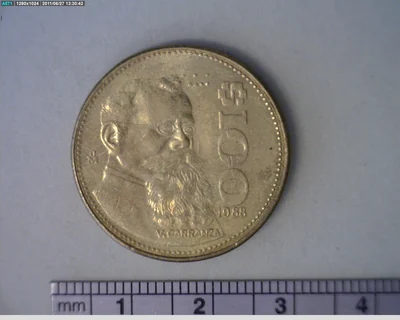
Same denomination, other years
1000 pesos Aluminio-bronce · 100 Pesos Bronce Aluminio
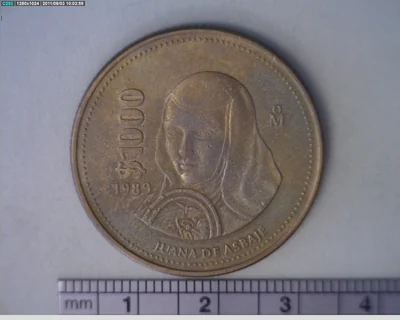
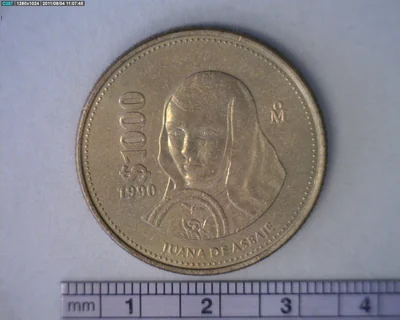
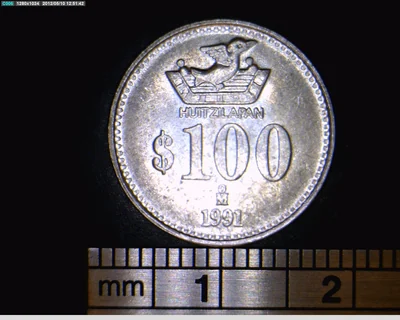
Official sources
Frequently asked questions
How much is the 1988 Sor Juana 1000 pesos coin worth?
A normal circulated example is worth about 0.50 to 1 USD (9 to 12 Mexican pesos) between collectors. Uncirculated with full luster runs around 6 USD. The rare proof version is valued near 550 USD. Prices of thousands of dollars online are almost always asking prices or refer to the proof, not the common coin.
Is this coin rare or valuable?
No. It is one of the most common Mexican coins of its era, with 229.3 million struck in 1988 and over 613 million across the 1988 to 1992 series. Only the proof (mirror finish) version is genuinely scarce and valuable.
Is the coin made of silver or gold?
Neither. It is aluminum bronze, an alloy of copper with aluminum and a little nickel. There is no precious metal and no melt value. Any worth is purely numismatic and depends on condition.
Where can I sell or buy this coin?
Since a circulated coin is worth only about a dollar, selling it alone rarely pays. Sell it as part of a lot to a dealer, or use the Pesoteca shop directory at /tiendas to compare real prices and reach coin shops and collectors. For the proof version, get it graded first through NGC or PCGS.
Conversation
0 comments
Sources
Images for informational and educational purposes, attributed to their original source. Reference values; the real price depends on the grade, the specific variant and demand.
Loading comments…