
1939 Mexican 10 Centavos (Cuproníquel): Value & Facts
Prices updated: August 2026
Centavos cupronickel 1939.
Centavos cupronickel 1939.
Design
Banxico
Reverse
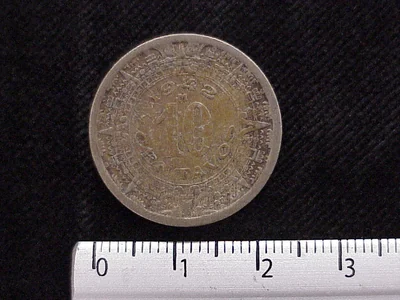
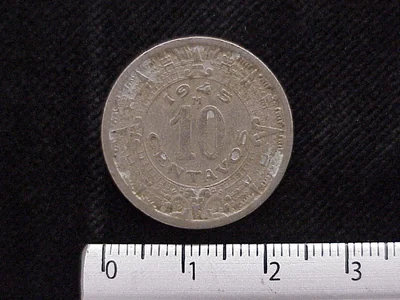
Outer ring of the Sun Stone (Aztec Calendar) surrounding the field of the coin, with the denomination "10 centavos", the minting year and the mint mark "M" of Mexico at the center. Design by Manuel Luna Negrete.
Obverse
Obverse with the Mexican National Coat of Arms and the legend "ESTADOS UNIDOS MEXICANOS" per official convention. Struck by the Mexican Mint under Banxico decree.
How much is the 1939 Mexican 10 Centavos (Cuproníquel): Value & Facts worth?
The market value of the 1939 Mexican 10 Centavos (Cuproníquel): Value & Facts is not yet documented with enough data to give a firm range. Weigh and measure your piece, compare it against the specifications, and check the forum for a second opinion.
The real price depends on four factors: the grade of preservation (a circulated piece is worth the low end of the range; an uncirculated one, or one still in its official blister pack, the high end), the finish (satin vs mirror/proof), the rarity within the series based on the mintage, and the metal spot price on the day of the deal when the piece is silver or gold. Check the value-by-grade table above and compare with equivalent pieces before buying or selling.
Where to buy or sell this coin?
Browse the national directory of numismatic shops or the community forum to trade directly with other collectors.
Description
Most 1939 Mexican 10 centavos coins are worth a few cents to about a dollar. They are not rare: nearly 7 million were struck. The value comes almost entirely from condition, and only a sharp, uncirculated example climbs into the 25 to 30 USD range in 2026.
If you inherited a jar of old Mexican change, this is one of the coins you will see most often. Here is what it actually is, what it sells for, and how to check whether yours is worth setting aside.
What you actually have
The 1939 10 centavos belongs to the Calendario Azteca series (Aztec Calendar), struck in cuproníquel from 1936 to 1946. "Centavos" are the fractional coins of the Mexican peso, the equivalent of cents. This one has no silver in it, so it has no melt value. Everything it is worth is numismatic, based on how well it survived.
The coin is easy to identify:
- Weight: 5.5 grams
- Diameter: 23.5 mm
- Edge: plain (smooth)
- Metal: cuproníquel, 80% copper and 20% nickel
- Obverse: the Mexican national coat of arms (eagle on a cactus with a serpent) and the legend Estados Unidos Mexicanos
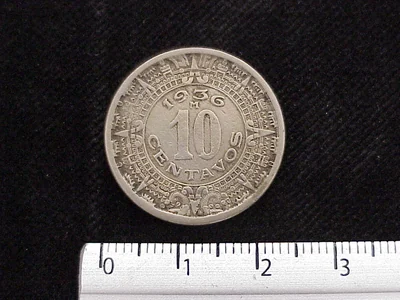
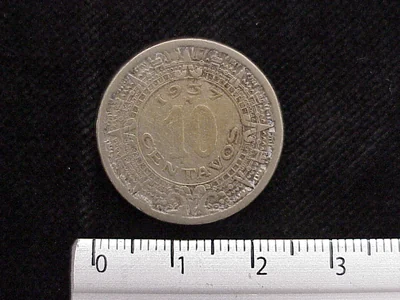
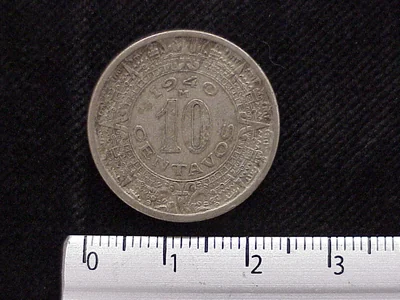
- Reverse: the outer ring of the Piedra del Sol (the Aztec Sun Stone, often called the Aztec Calendar), with the denomination "10 centavos," the year, and the mint mark M in the center
That mint mark M stands for the Casa de Moneda de México, the Mexico City Mint.
A note on size (this trips people up)
There is a much smaller Mexican 10 centavos, only about 15 mm across and roughly 1.5 grams, but that is a different coin struck between 1974 and 1980. If your coin is tiny, thin, and weighs about a gram and a half, you do not have the 1939 piece. The genuine 1939 issue is a solid coin: 23.5 mm and 5.5 grams.
How much is a 1939 10 centavos worth?
The date is common, so grade is the only thing that moves the price. A worn coin from a dealer bin is pocket change. An uncirculated example with full detail and original luster is where the real money sits, and even then we are talking tens of dollars, not hundreds.
| Grade | What it looks like | Value (USD, approx.) |
|---|---|---|
| Circulated, worn | Flat details, no shine | Under 1 USD |
| Very Fine (VF) | Clear design, moderate wear | 1 to 2 USD |
| Extremely Fine (XF) | Sharp detail, light wear | 3 to 5 USD |
| Uncirculated (MS) | Full detail, original luster | 7 to 30 USD |
These are reference ranges (Numista and general market data). Certified high-grade examples from NGC or PCGS in top Mint State grades can sell above these figures, but that requires a genuinely pristine coin, which is exactly what is hard to find in a series that circulated heavily.
Is it rare?
No. Mexico struck 6,920,000 of these in 1939 alone. They show up constantly in lots, dealer inventories, and inherited coin jars. Being from before World War II does not make it valuable; plenty of survivors exist. What is genuinely scarce is a 1939 coin that never wore down, because these were spent every day.
The whole series ran across eight dates: 1936, 1937, 1938, 1939, 1940, 1942, 1945, and 1946. Collectors who chase the set know that finding each year in high grade is the actual challenge, not finding the coins at all.
The coins people think are worth a fortune (and this isn't one)
A common belief is that any pre-war coin is a windfall. For most Mexican fractional coins of this era, including the 1939 10 centavos, that is not true. High mintage plus heavy circulation equals low value in worn grades. If a listing claims a common 1939 10 centavos is worth hundreds of dollars in average condition, it is either wildly overpriced or describing a certified top-grade example that is nothing like a typical find.
The Mexican coins that actually break records are silver and gold pieces with tiny mintages or historic significance, not fractional cuproníquel from the 1930s. If you want to know which Mexican coins genuinely command high prices, that is a separate list worth reading.
How to tell if yours is genuine
Counterfeits of a low-value common coin are rare, but it is still worth a quick check:
- Weigh it. It should be about 5.5 grams. A digital kitchen scale will do.
- Measure it. Diameter should be 23.5 mm.
- Check the reverse. You should see the outer ring of the Aztec Sun Stone with the mint mark M in the center and the year clearly struck.
- Check the obverse. The national coat of arms with the legend Estados Unidos Mexicanos.
If the weight or diameter is far off, you may have a different coin or a fake. When a coin looks unusually sharp and you think it might be a valuable Mint State example, professional grading by NGC or PCGS settles both authenticity and grade at once.
Where to sell it
Because the coin is common, you sell it the same way you would any circulated foreign coin: to collectors and dealers who buy in bulk or by date. For a worn example, expect very little. For a genuine uncirculated piece, a specialist buyer is worth the effort. You can use the Pesoteca store directory to find collectors and shops that buy and sell Mexican coins.
Got a jar of old Mexican centavos and not sure which ones are keepers? Post clear photos of the best-looking coins in the Pesoteca forum and we will help you sort the common ones from anything actually worth grading.
Historical context
Centavo coins form the base of the Mexican monetary system. Banxico has modified their diameters, materials and alloys several times over the last decades to optimize minting costs. The 10 centavos Cupronickel piece struck in 1939 belongs to the Banxico Numismatic Collection catalog documented on its official site.
For Mexican collectors, centavo pieces have value when they capture a material change, a die error or an atypically low mintage. Banxico publishes the annual mintages in CM10 starting from the year 2000. For earlier pieces the data may not be available. This entry follows the convention of the PSM System, one ID per distinct physical piece, not per shared design.
This piece belongs to the era
México Moderno (pre-1992) →Explore all the Mexican coins of this era, their historical context and how they connect to the monetary system of the period.
Value range of this piece
Value range without enough data for this piece.
See the full breakdown by grade (VG, F, VF, EF, AU, MS-60, MS-63, MS-65) for the whole series →
Same denomination, other years
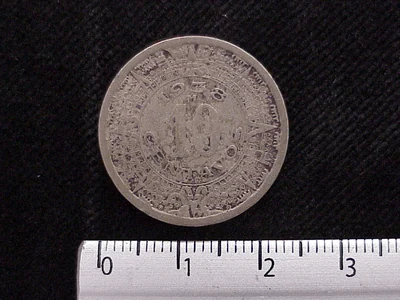
10 centavos Cuproníquel · Centavos Mexicanos
Frequently asked questions
How much is a 1939 Mexican 10 centavos worth?
It depends entirely on condition. A worn, circulated example is worth under 1 USD. In Very Fine it runs about 1 to 2 USD, Extremely Fine around 3 to 5 USD, and a genuine uncirculated coin with full luster can reach 7 to 30 USD. It is not rare, so grade is what drives the price.
Is the 1939 10 centavos rare?
No. Mexico struck 6,920,000 of them in 1939, so they turn up often in coin lots and inherited collections. The date is not scarce. What is genuinely hard to find is a well-preserved uncirculated example, since these coins circulated heavily.
What metal is the 1939 10 centavos made of, and does it contain silver?
It is cuproníquel: 80% copper and 20% nickel. There is no silver, so it has no melt value. Any worth it carries is purely numismatic, based on its grade and eye appeal.
How can I tell if my 1939 10 centavos is genuine?
Weigh it (about 5.5 grams) and measure it (23.5 mm diameter, plain edge). The reverse should show the outer ring of the Aztec Sun Stone with the mint mark M and the year; the obverse shows the national coat of arms with the legend Estados Unidos Mexicanos. If the weight or size is very different, you may have another coin, such as the smaller 1974-1980 issue, or a fake.
Conversation
0 comments
Sources
- Ejemplar de la Coleccion Numismatica Banco de Mexico . inv. 12228
- Ejemplar de la Coleccion Numismatica Banco de Mexico . inv. 12229
- Ejemplar de la Coleccion Numismatica Banco de Mexico . inv. 12230
Images for informational and educational purposes, attributed to their original source. Reference values; the real price depends on the grade, the specific variant and demand.
Loading comments…