
En resumen
Mexico had 13 official mints, from one that has run for nearly 500 years to others that lasted weeks. Learn to read every mint mark and spot the rare ones worth 20 to 80 times more.
The mint mark is the single most important signature on a Mexican coin, and almost no beginner looks at it. Two small letters near the shield or the portrait tell you where a piece was struck, under which government, and sometimes expose a seller passing off something misdated or fake. In 2026, learning to read these marks is the fastest way to buy a better coin at a fairer price.
Mexico had 13 official mints. One has run for nearly 500 years; another operated for weeks. Some produced millions of pieces; others struck fewer than 10,000 before closing, and a coin bearing one of those marks can be worth 20 to 80 times more than the same-year Mexico City equivalent. This guide covers all thirteen.
How to read the mint mark
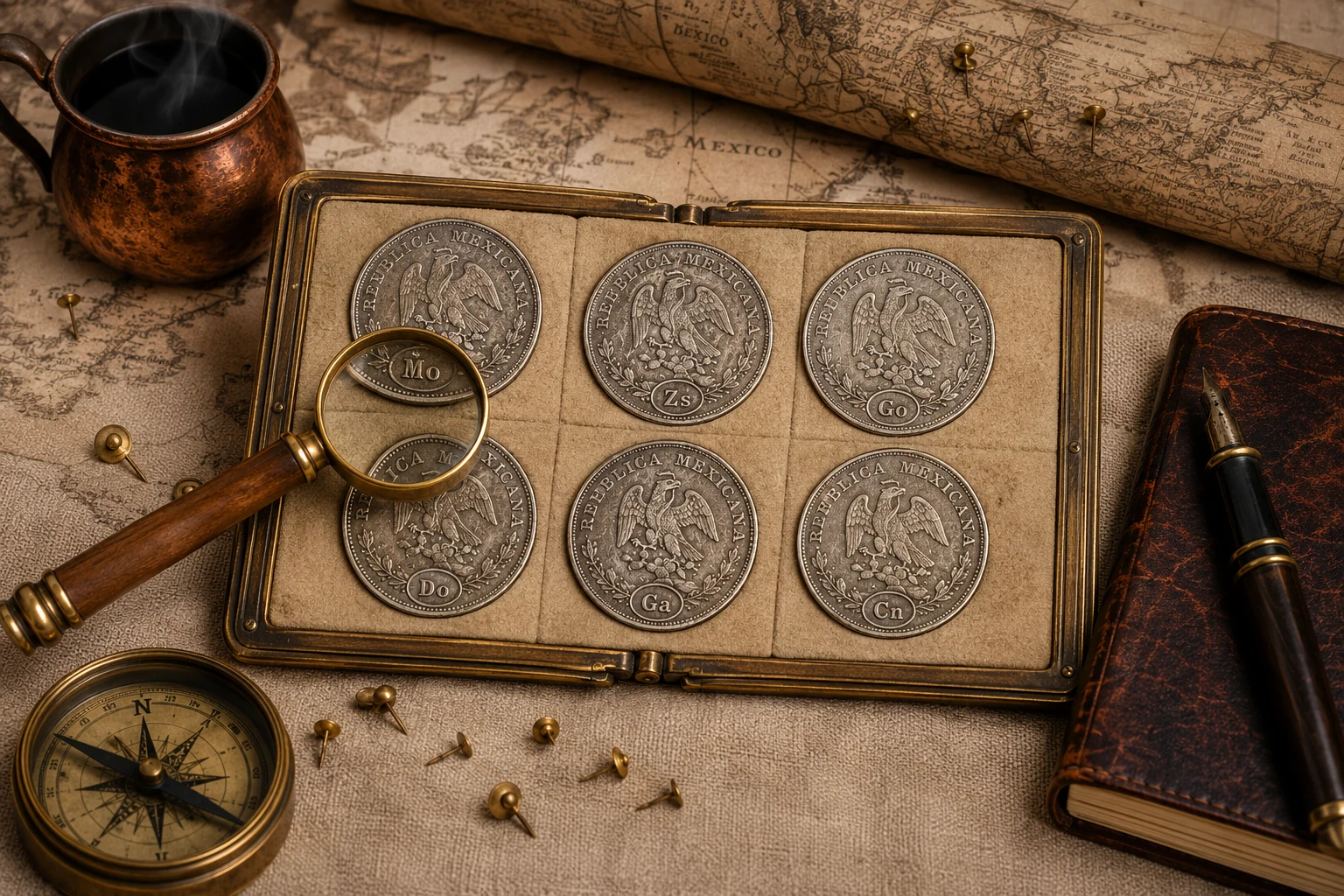
The mint mark is a code of one to four letters stamped into the field of the coin. On colonial and early republican coinage it appears on the obverse, near the bust or the crown. On decimal coinage (from 1863) and modern issues it settles on the reverse, below the shield or next to the denomination.
The official Mexican marks: Mo (México), Zs (Zacatecas), Go (Guanajuato), Cn (Culiacán), Ca (Chihuahua), Ho (Hermosillo), Do (Durango), Pi (San Luis Potosí), A or As (Álamos), Ce (Real de Catorce), Ga (Guadalajara), EoMo (Estado de México), Oa (Oaxaca). If you see any other set of letters on something sold as "colonial Mexican," it is either fake or from another Spanish Empire mint (Lima, Potosí in Bolivia, Guatemala, Bogotá).
The mint mark is not the same as the assayer's mark. The assayer certified the metal fineness and signed separately with initials, also stamped into the coin. On an 8 Reales Resplandor from Guanajuato dated 1885 you will see "Go" (mint), "R S" or similar (assayer), and sometimes the engraver's initials. Mint mark in three seconds, assayer in ten, engraver requires checking Krause or the catalog by era. A single-letter mark (A for Álamos) almost always comes with a companion mark. A two-letter mark with a raised second letter (Mo, Cn, Do) is a colonial typographic convention that lasted into the late 19th century.

The 13 historic mints spread across Mexican territory. Each mark identifies where a piece came from and is the first clue to valuing it.
Mexico City Mint (Mo)
Mark: Mo (M with a raised o). Location: Mexico City, current site on San Luis Potosí 152, Colonia Guerrero. Historic sites include the Real Palacio (today the National Palace) from 1535, the Apartado building (late 18th century), Legaria, and the current site since 1992. Active: 1535 to today, the oldest continuously operating mint in the Americas.
Founded by royal decree of Charles I of Spain on May 11, 1535, just 14 years after the fall of Tenochtitlan. First assayer: Francisco del Rincón. The earliest pieces were the "Carlos y Juana." In the 18th century alone it struck more silver than all European mints combined. The 8 Reales Columnario was a global reference coin between 1732 and 1772, accepted in China, the Philippines, India, and Europe.
Notable pieces: 8 Escudos Felipe V 1713, 8 Escudos Octaval 1831, 1 Onza Libertad Silver 2006, 100 Pesos Herencia Numismática III Primer Imperio 2013, 20 Centavos Copper 1952. The Onza Libertad, by the way, is Mexico's modern one-ounce silver bullion coin, and low-mintage proofs of it are actively chased at auction. Assayers: Francisco del Rincón (1535-1552), Antonio Forcada (1810-1823), Manuel Ochoa (1855-1870). Denominations: all of them, from the colonial 4 maravedís to the modern kilo of silver.
Rarity: the early colonial pieces (Carlos y Juana before 1572, 17th-century cob coinage) are the scarcest because so many were melted down. Certain Columnario dates (1732, 1734) run into the tens of thousands of dollars even when circulated. In modern issues, low-mintage Onza Libertad proofs (1985, 1995 old-type) are sought at auction. Five centuries without closing: it survived the viceroyalty, three empires, two foreign interventions, the Revolution, and bank nationalization.
Zacatecas Mint (Zs)
Mark: Zs. Location: Zacatecas city, final site in the historic center, today a heritage building. Active: 1810-1905 with interruptions. It was born during the war of independence, when moving silver to Mexico City became impossible on roads full of insurgents; it closed for good under Porfirian centralization. Zacatecas was the silver heart of New Spain and independent Mexico, with millions of 8 Reales Resplandor struck between 1825 and 1897. The first pieces from 1810-1811 were struck with improvised dies and are known as "necessity coins," crude and highly prized today.
Notable pieces: 8 Reales Realista 1814, 8 Reales Resplandor Zacatecas 1879, 8 Reales Resplandor Zacatecas 1891. Assayers: F.P. (Fermín Pérez, 1811-1815), Zs.O.M. (Ochoa y Moctezuma, 1820s), J.S., R.L. (mid-19th century), F.Z., Z.S. (late). Denominations: reales from half to eight, pesos from 1869, copper centavos; almost no gold.
Rarity: the 1810-1811 necessity coins are the absolute prizes. Common Zacatecas Resplandor (1880-1895) is affordable, roughly 150 to 600 dollars depending on grade. Rare dates: 1873 (decimal transition) and certain low-mintage 1900-1905 issues. It is the classic choice for building a complete set by mint. Collect one Resplandor per decade and you will have 20 pieces in the album before you notice.
Guanajuato Mint (Go)
Mark: Go. Location: Guanajuato city, facilities next to the Alhóndiga de Granaditas. Active: 1812-1900. Established by the royalist junta on the same silver-decentralization logic as Zacatecas. Its proximity to the Valenciana, Rayas, and Cata mines made it the second mint by volume after Mexico City. At several points in the 19th century it was the country's leading silver producer.
Notable pieces: 8 Reales Resplandor Guanajuato 1878, 8 Reales Resplandor Guanajuato 1884, 8 Reales Resplandor Guanajuato 1897. Assayers: J.J. (early republican period), P.J. (1830s), Y.F., R.S. (Rafael Sánchez, 1870-1880), R.R. (Rafael Reyes, 1890s). Denominations: reales, pesos, gold escudos (lower volume), decimal centavos.
Rarity: royalist years 1812-1821 are scarce and in high demand. The 1870-1897 Resplandor issues are among the most common on the market. The 1898-1900 dates are nearly impossible because of tiny closing mintages. If you want an 8 Reales Resplandor in reasonable quality, start with Go or Zs, the most abundant and the best price range.
Culiacán Mint (Cn)
Mark: Cn (C with a raised n). Location: Culiacán, Sinaloa, historic center, now demolished. Active: 1846-1905. Founded during the Mexican-American War to strike Sinaloa silver without depending on the capital. The Cosalá and El Rosario mines fed it for nearly 60 years. It never reached the volumes of Mexico City or Zacatecas but produced respectably.
Notable pieces: 8 Reales Resplandor Culiacán 1880, 8 Reales Resplandor Culiacán 1893, 10 Centavos Decimal 1873 Culiacán. Assayers: C.E., P (Pedro Sánchez, 1870s), A.M. (Antonio Moreno, 1880s), M.P. (late). Denominations: reales, pesos, decimal centavos; a silver specialist.
Rarity: intermediate, roughly 250 to 1,000 dollars in reasonable grades. Rare decimal-transition years (1869-1873) command higher prices. It is a mint the average collector forgets, which means opportunity. Good-grade Cn pieces are cheaper than their Mo equivalents, a gap that narrows as more people learn to read the marks.
Chihuahua Mint (Ca)
Mark: Ca (some catalogs use CH). Location: Chihuahua city, near today's Government Palace; the original building no longer exists. Active: 1810-1895 with interruptions. Established to strike northern silver without shipping it to the capital. The Batopilas and Santa Eulalia mines fed it through most of the 19th century. It had low-activity periods (1830-1846 and 1863-1867 during the French intervention) that cut its output.
Notable pieces: 8 Reales Resplandor Chihuahua 1889, 8 Reales Realista 1812 Chihuahua, 8 Reales Silver Independencia 1813 Chihuahua, 8 Reales Countermarked 1821. Assayers: R.P. (Rodrigo Prieto, 1810s), M.M. (Manuel Miranda, 1830s), M.P. (mid-century), R.G.C., M.R. (late). Denominations: reales, pesos, some gold escudos.
Rarity: early royalist coinage (1810-1815) is scarce due to low initial mintages and melting. The 1880-1895 Resplandor issues are accessible. French-intervention years 1863-1867 bearing the Ca mark are rare and sought. The 1821 countermarks are pure historical document: a coin that circulated with royalist symbols was re-stamped with independence symbols when the country broke free.
Hermosillo Mint (Ho)
Mark: Ho. Location: Hermosillo, Sonora, historic center; original building demolished in the early 20th century. Active: 1835-1895. Established in the early federal republic to serve the Sonoran mines of Álamos, La Aduana, and early Cananea. Output ran below Zacatecas or Guanajuato, with some very low-mintage years.
Notable pieces: 8 Reales Resplandor Hermosillo 1893, 8 Reales Resplandor Hermosillo 1885, 8 Reales Resplandor Hermosillo 1891. Assayers: P.P. (1840s), J.A. (1860s), F.M. (Francisco Molina, 1880s), G. (late). Denominations: reales, decimal pesos, some centavos; no significant gold.
Rarity: among the most prized because of relative scarcity. Common Ho Resplandor sells for 20 to 40 percent more than the same-year Mo. The 1840s-1850s pieces are nearly impossible outside specialized auctions. If someone offers you a "cheap" Ho Resplandor, check the mark and assayer twice. Many circulating "Ho" coins are actually mis-struck "Mo" pieces or modern casts.
Durango Mint (Do)
Mark: Do. Location: Durango city, attached to the old Government Palace, now administrative offices. Active: 1811-1895. Founded by royalist order on the same silver-decentralization logic. Nearly 85 years of continuous production with ups and downs. An intermediate producer.
Notable pieces: 8 Reales Resplandor Durango 1879, 1/8 Reales Copper Independencia 1816 Durango, 8 Reales Resplandor Durango 1894, 1 Centavo Lead 1914 Estado de Durango. Assayers: R.M. (1810s), C.G. (1830s), R.P.C. (mid-century), M.C., J.M.R. (late). Denominations: reales, pesos, occasional escudos, centavos.
Rarity: medium; common pieces run roughly 200 to 750 dollars. The revolutionary years 1913-1915 with the Do mark belong more to the revolutionary series. Durango is an ideal second axis after Mo: accessible prices and enough date variety to build a 20 to 30 piece album without breaking the bank.
San Luis Potosí Mint (Pi)
Mark: Pi. Location: San Luis Potosí city, the old Consulado building near the Plaza de Armas, now state property. Active: 1827-1893, with no major interruptions. Established in the first federal republic to serve the north-central mining region. The Cerro de San Pedro, Charcas, and Catorce mines fed it, with respectable volumes especially in 1860-1890.
Notable pieces: 8 Reales Resplandor San Luis Potosí 1880, 8 Reales Resplandor San Luis Potosí 1888, 8 Reales Resplandor San Luis Potosí 1892. Assayers: J.S. (1830s), P.S., M.C. (mid-century), R.O., M.R. (late). Denominations: reales, pesos, decimal centavos, occasional gold escudos.
Rarity: accessible, comparable to Durango. Rare dates: 1827-1830 (startup, low mintage) and 1893 (closing, minimal run). One warning: do not confuse the San Luis Potosí mint (Pi) with the Real de Catorce mint (Ce). Both sit in the state of San Luis Potosí, but they are entirely different mints with wildly different volumes.
Álamos Mint (A / As)
Mark: A or As. Location: Álamos, Sonora, a mining town that in the mid-19th century was one of the richest in the region. Active: 1862-1895. Founded during the Juárez era to exploit local silver. Álamos hit its economic peak in the years the mint operated, in some decades with a larger population than Hermosillo. One of the lowest total-output mints, with modest annual mintages.
Notable pieces: 8 Reales Resplandor Álamos 1885, 8 Reales Resplandor Álamos 1895, 8 Reales Resplandor Álamos 1890. Assayers: D.L. (1860s), P.G., L. (mid-century), M.L. (late). Denominations: almost exclusively silver 8 Reales Resplandor; other denominations are exceptional.
Rarity: among the scarcest and most prized. An 8 Reales Resplandor As in XF grade can fetch roughly 750 to 2,000 dollars. The 1863-1870 dates are nearly impossible without an international auction. It is a candidate for a high-end thematic collection. You cannot build the full series without spending 10,000 to 20,000 dollars, but each As piece documents a mining town that has nearly vanished economically.
Real de Catorce Mint (Ce)
Mark: Ce. Location: Real de Catorce, San Luis Potosí, at 2,743 meters altitude; today a tourist "pueblo mágico." Active: 1863-1864, less than one effective year. The classic phantom mint of the Mexican catalog. Established during the Second French Intervention by the Juárez government to decentralize coinage while the capital was under military occupation. Real de Catorce offered proximity to mines such as La Purísima, La Concepción, and La Descubridora. It closed in 1864 when control of the routes was regained. Total output is estimated at fewer than 5,000 pieces, almost all 8 Reales Resplandor of 1863. Fewer than 100 examples are known worldwide. Assayer: M.L. Denominations: exclusively 8 Reales Resplandor.
Rarity: extreme. An 8 Reales Ce 1863 in any grade brings at least 4,000 dollars and easily above 15,000 in AU grades. Heritage has recorded pieces above 25,000 dollars. The operation was so brief that many Mexican collectors do not even know it existed. If someone offers you a "Ce" at a reasonable price, it is almost certainly a modern counterfeit. NGC or PCGS authentication is mandatory.
Guadalajara Mint (Ga)
Mark: Ga. Location: Guadalajara, Jalisco; the Casa de Moneda building is now a museum and cultural space in the historic center. Active: 1812-1895 with interruptions during the first republic. Established in the context of the war of independence. Guadalajara was already the second city of the viceroyalty after Mexico City, connected to western mines and to trade routes toward Manila via San Blas. It struck consistently for eight decades, peaking between 1820-1830 and 1870-1890.
Notable pieces: 8 Reales Resplandor Guadalajara 1879, 8 Reales Resplandor Guadalajara 1894, 8 Escudos Realista 1813 Guadalajara, 8 Escudos Realista 1821 Guadalajara. Assayers: M.R. (1812-1820), J.M. (1830s), F.S. (mid-century), J.A., A.H. (late). Denominations: reales, pesos, gold escudos (relatively frequent), decimal centavos.
Rarity: common-year Ga Resplandor is accessible, comparable to Zs or Go. The royalist Ga 8 Escudos (1812-1821) are high-end and much sought, above 3,000 dollars. If you are into late colonial gold, Guadalajara is the natural candidate after Mexico City. Its escudo volume lets you build a representative selection without needing museum-unique pieces.
Estado de México Mint (EoMo)
Mark: EoMo. Location: Tlalpan, then capital of the State of Mexico (before the Federal District was created in 1824). Active: 1828-1830, two years. The second phantom mint of the Mexican catalog. Established during the first federal republic, when the State of Mexico still included territory that today corresponds to the Federal District, Morelos, Hidalgo, Tlaxcala, and parts of the present State of Mexico. It answered the federalist project of giving each state the power to issue coin. The experiment failed quickly under pressure from the central government. Total output is estimated at fewer than 10,000 pieces, almost all 8 Reales Resplandor of 1828, 1829, and 1830. Assayer: L.F. Denominations: almost exclusively 8 Reales; smaller fractions are very rare.
Rarity: extreme. An 8 Reales EoMo in any grade brings above 2,500 dollars, and high grades can pass 12,000. Fewer than 200 examples are known worldwide across the three dates. EoMo documents a failed federalist project; Ce documents the war against the French intervention. Two phantoms with opposite political genealogies.
Oaxaca Mint (Oa)
Mark: Oa. Location: Oaxaca de Juárez, historic center. Active: 1858-1893. Founded during the War of the Reform to strike southern silver from the Ixtlán and Taviche mines. Economic and strategic justification in the face of conservative occupation of the capital. It produced consistently for 35 years, with special concentration in the final years before closing.
Notable pieces: 8 Reales Resplandor Oaxaca 1879, 8 Reales Resplandor Oaxaca 1885, 20 Pesos Decimal 1870 Oaxaca, 1 Peso Estado Libre y Soberano de Oaxaca 1915, 2 Pesos Silver Oaxaca 1915. Assayers: E (Enrique Villegas, 1860s-1870s), A.E. (Antonio Espino, 1880s), N (late). Denominations: reales, pesos, decimal centavos; the 20 Pesos gold Oa 1870 is notably rare.
Rarity: medium-high due to relative scarcity. The 1858-1870 years are scarce and pricey; 1880-1893 are more affordable but always above their Mo equivalents. The 1915 revolutionary issues marked "Estado Libre y Soberano de Oaxaca" are a category of their own. They are not from the original Oaxaca mint (closed in 1893) but emergency issues during the Carrancista occupation.
Ranking the mints
By founding date
Mexico City (1535), Chihuahua and Zacatecas (1810, mid war of independence), Durango (1811), Guanajuato and Guadalajara (1812), San Luis Potosí (1827), Estado de México (1828, closed 1830), Hermosillo (1835), Culiacán (1846), Oaxaca (1858), Álamos (1862), Real de Catorce (1863, closed 1864).
By total historic output
Mexico City (hundreds of millions over five centuries), Zacatecas (the 19th-century silver heart), Guanajuato (second producer in several periods), Guadalajara (83 consistent years), Durango-Chihuahua-San Luis Potosí (medium-high), Culiacán-Oaxaca-Hermosillo (medium), Álamos (low), Real de Catorce and Estado de México (phantom mints with minimal mintages).
By rarity and collectibility
- Phantom: Real de Catorce (Ce) and Estado de México (EoMo). Any genuine piece is a collecting event.
- Scarce with high demand: Álamos, Hermosillo, Oaxaca. Prices consistently above the Mo equivalents.
- Intermediate with a good market: Culiacán, Chihuahua, San Luis Potosí, Durango. Accessible prices with reasonable availability.
- Common: Mexico City, Zacatecas, Guanajuato, Guadalajara. High volumes let you build a collection without excessive cost.
Quick reference table
| Mint (mark) | Active | Output | Rarity | Typical Resplandor range (USD) |
|---|---|---|---|---|
| Mexico City (Mo) | 1535-today | Very high | Common | 100 to 500 |
| Zacatecas (Zs) | 1810-1905 | Very high | Common | 150 to 600 |
| Guanajuato (Go) | 1812-1900 | High | Common | 150 to 600 |
| Guadalajara (Ga) | 1812-1895 | High | Common | 150 to 700 |
| Durango (Do) | 1811-1895 | Medium-high | Medium | 200 to 750 |
| San Luis Potosí (Pi) | 1827-1893 | Medium-high | Medium | 200 to 750 |
| Chihuahua (Ca) | 1810-1895 | Medium-high | Medium | 250 to 1,000 |
| Culiacán (Cn) | 1846-1905 | Medium | Medium | 250 to 1,000 |
| Oaxaca (Oa) | 1858-1893 | Medium | Medium-high | 300 to 1,500 |
| Hermosillo (Ho) | 1835-1895 | Low-medium | Scarce | 300 to 1,500 |
| Álamos (A / As) | 1862-1895 | Low | Scarce | 750 to 2,000 |
| Estado de México (EoMo) | 1828-1830 | Minimal | Phantom | 2,500 and up |
| Real de Catorce (Ce) | 1863-1864 | Minimal | Phantom | 4,000 and up |
Ranges are for silver 8 Reales Resplandor in reasonable collector grades; rare dates, gold, and top grades go well beyond these figures.
Phantom mints: watch for counterfeits
Real de Catorce (Ce) and Estado de México (EoMo) have the fewest known pieces worldwide. Any offer outside a certified NGC or PCGS holder needs authentication. Twentieth-century forgers concentrated on these because of the high margin. Rule of thumb: any "Ce" or "EoMo" offered below 3,000 dollars is suspect, and below 1,500 dollars it is almost certainly fake.
How to check what yours is worth
Reading the mint mark is step one, but three things decide the actual dollar figure:
- Grade. A coin's condition, from heavily worn to mint state, can swing the value by a factor of ten or more. A worn common Resplandor is worth close to its silver content; the same date in AU can be several hundred dollars.
- Authenticity. For anything scarce (Ho, As, and especially Ce and EoMo), send it to NGC or PCGS. Certified pieces sell for more and, more importantly, sell at all. Raw phantom-mint coins are assumed fake until proven otherwise.
- Metal floor. The 8 Reales Resplandor is roughly 90 percent silver at about 27 grams. That sets a floor near current melt value, so even a common worn example is not worthless.
To sell or appraise: photograph both faces with the mark in focus, get a certified opinion for anything you think is scarce, and check recent Heritage Auctions and Stack's Bowers results for the same date and grade before accepting any offer.
Where to start
If you are starting from zero: begin with a Mo selection from any era. With 20 to 30 Mo pieces you can start bringing in provincial mints. Zacatecas and Guanajuato are the most affordable after Mexico City. Álamos and Hermosillo come in when you want to step up. Leave the phantoms (Ce and EoMo) for last, or for never, depending on your budget.
Explore the full Pesoteca catalog by era, denomination, and mint. If you have a coin you think you have identified but are not sure, post it in the Pesoteca forum with focused photos of the obverse and reverse showing the mark. Which mint mark is on the coin sitting in your drawer right now?

Loading comments…