
En resumen
Some Mexican banknotes are worth far more than their face value: the Diego Rivera and Frida Kahlo 500, private-bank notes from the Porfiriato era, Revolution-era scrip, and any note with a printing error or rare serial. No made-up prices, just what actually drives value.
Every so often a story goes viral claiming a Mexican banknote "sold for half a million pesos." Almost always that is an asking price on a listing, not a real sale. But behind the clickbait there is a real point: some Mexican banknotes are worth far more than their face value, and it pays to know which ones and why, especially before you spend or exchange one without realizing what you have.
Here is the honest list, with no invented prices. Instead of telling you "it's worth X" (which depends entirely on condition and buyer), we explain what makes each group valuable and how to identify it. If you want to locate a specific note, use the how much is my banknote worth search tool.
First, what actually drives the price up
No banknote is valuable for a single reason. These are the levers, from most to least important:
- Condition. An uncirculated note (UNC), with no folds or stains, can be worth several times what the same note is worth in worn shape. This factor outweighs everything else.
- Real rarity. Low print run, an uncommon issuing bank, or few surviving examples.
- Special serial number. Low serials, palindromes (a serial that reads the same backward, like 1234321), or repeated digits.
- Printing errors. Misaligned cuts, ink smears, shifted printing.
- Current demand. A note that is trending (because it left circulation or went viral) rises in price while the interest lasts.
With that in mind, these are the most sought-after Mexican banknotes in 2026.
1. The 500-peso Diego Rivera and Frida Kahlo note
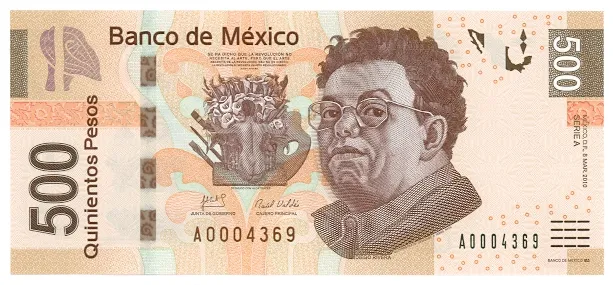
The most famous case. The 500-peso Diego Rivera and Frida Kahlo note, from the Banco de México "F" series, is beloved for its design: in 2017 the International Bank Note Society recognized it worldwide. It has since left circulation (replaced by the Benito Juárez note with the gray whale), which pushed up collector demand.
This is the king of clickbait, listed online at wild figures. The reality is more grounded, but an example that is uncirculated, has a low serial, or carries a printing error does hold real collector value well above face. A worn, common example is worth much less than the internet claims.
2. Private-bank notes from the Porfiriato era
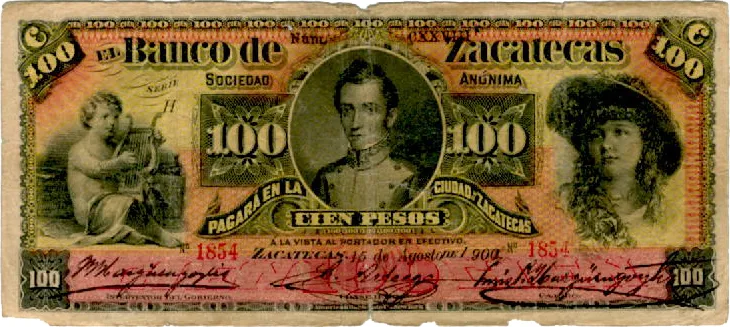
Before 1925, dozens of state-chartered banks printed their own paper money (the Porfiriato refers to the long rule of president Porfirio Díaz). Notes from the Banco de Zacatecas, the Banco Yucateco, the Banco Mercantil de Yucatán, and the Banco de Jalisco are historic pieces with beautiful allegorical engravings.
Value here varies enormously: some are relatively common, others extremely scarce, depending on the bank, the denomination, and how many survived. High denominations (100, 500 pesos) in good condition are the most coveted. This is the category where an "old" note genuinely can be worth a lot, but also where people get confused most: not every Porfiriato-era note is a fortune. You can browse them sorted in the banknote catalog.
3. Revolution-era scrip and notes
During the Mexican Revolution, each faction printed its own money: scrip from Carranza's Constitutionalist Government, obligations of the Federal Treasury, even Bank of Montreal checks in Pachuca. Many were low-denomination, printed on cardstock, and spent so quickly that today they are hard to find complete and in good shape.
That scarcity is exactly the appeal: survival is rare. A well-preserved revolutionary note from an uncommon issue has its own market among collectors of Mexican history.
4. Modern commemorative notes
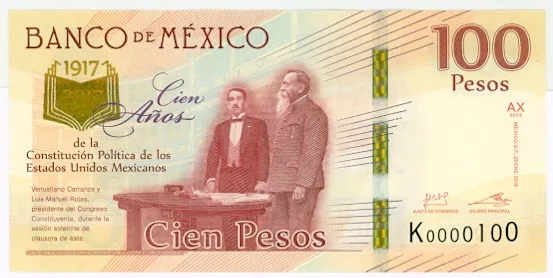
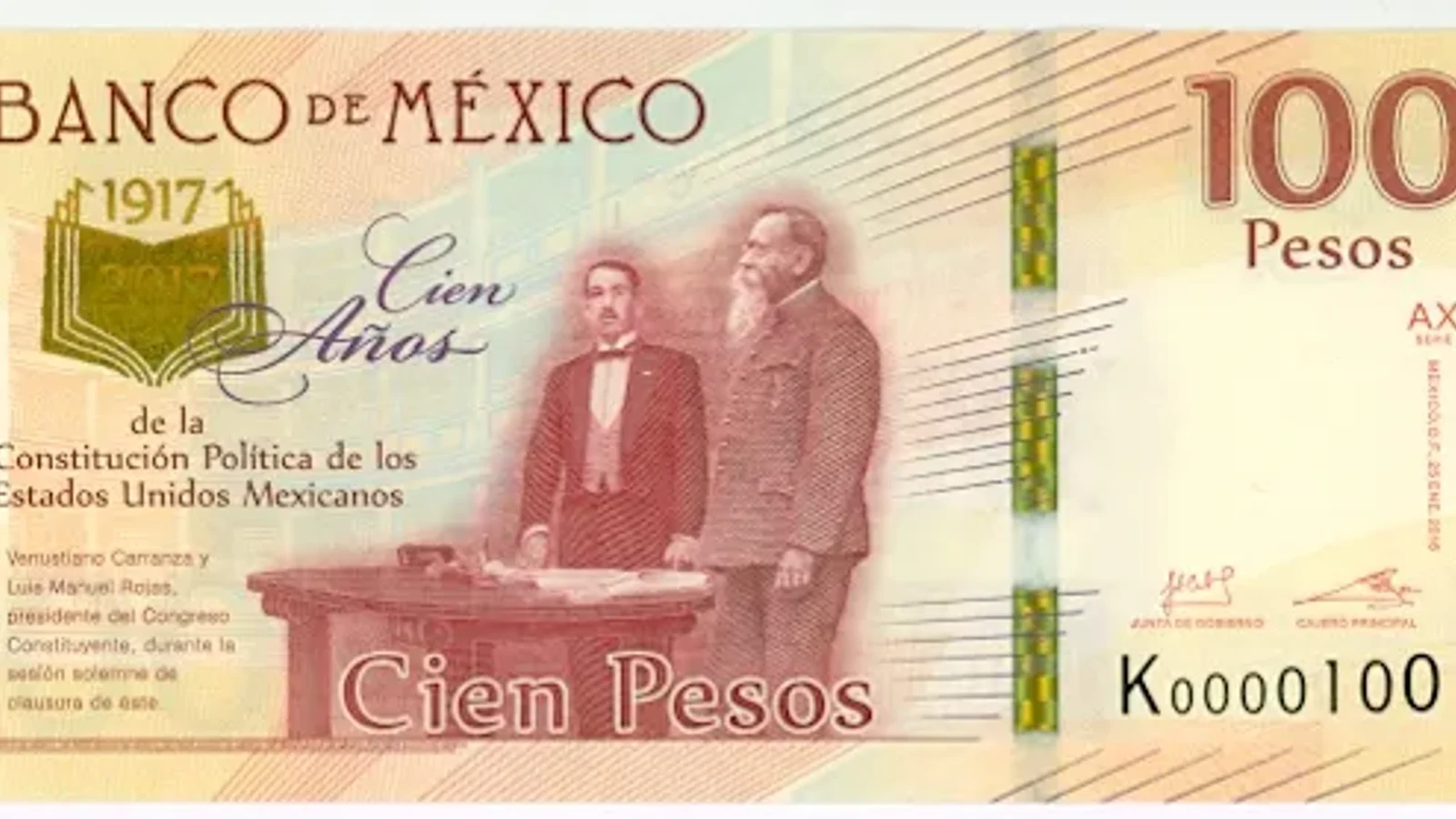
Not everything valuable is antique. The 100-peso note for the Centennial of the Constitution (2016-2017) and the 200-peso note for the Bicentennial of Independence (2008-2010) are commemoratives with limited print runs, which values them differently from a common note of the same denomination.
The key with these is not to confuse them: the commemorative 100 is the red Carranza note, distinct from the common Nezahualcóyotl one. Check carefully before assuming yours is the special version.
5. Any note with a printing error or special serial
This is the wildcard category, and it applies to any denomination, even the modern notes in your wallet right now. A factory error (misaligned cut, ink smear, shifted printing) or an eye-catching serial (0000001, a palindrome like 1234321, or repeated digits) can turn a common current note into a piece collectors fight over.
That is why it pays to check before you spend: that 50-peso axolotl note or 20-peso commemorative you are carrying could have a serial or an error worth keeping.
How to find out what yours is really worth
We will repeat the golden rule, because it is what protects you: the asking price is not the selling price. If someone lists a note at half a million pesos, that does not mean it is worth that; it means they want to sell it for that. A banknote is worth what someone actually pays, and that depends on condition and current demand.
Three honest steps to place yours:
- Identify it. Denomination, series, year, and figure. Use the how much is my banknote worth search to reach its data page.
- Grade the condition with a critical eye. Any folds? Stains? Worn corners? Be tough on yourself: notes are almost always more circulated than their owners think.
- Compare against the real market. Ask in the forum or with a serious coin and currency dealer from the directory. Never trust the first price you see online.
And if you are catching the collecting bug, read our guide to Mexican notaphily to start off right. Have a note you think is valuable? Post it in the forum and the community will help you figure out what you are holding.

Loading comments…