
Mexico 50 Pesos Fuertes (1914), Banco de Jalisco
Familia PRIV · algodón
Period: Bancos privados de emisión
Design
Banxico
Obverse
Banco de Jalisco
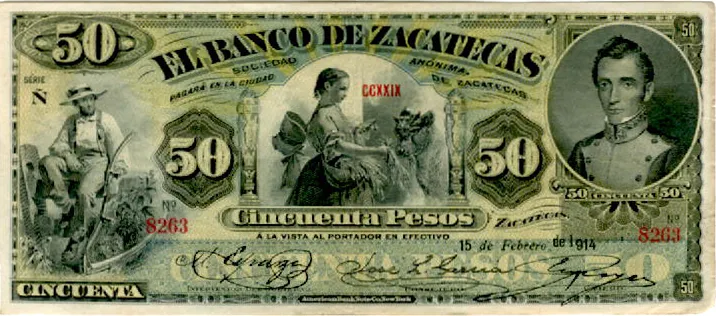
A female allegory in the center and two portraits in ovals on the sides
Reverse
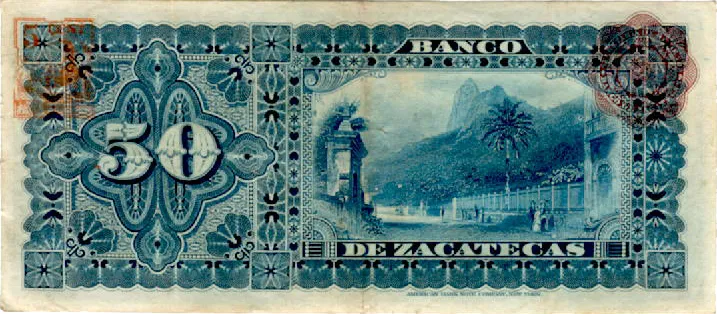
Engraved ornamental design with the denomination
About this banknote
If you inherited a 1914 Mexican 50 Pesos note from the Banco de Jalisco, here is the honest answer: most surviving examples trade in the tens of dollars, but scarce signatures, high grades, and unissued remainders can reach a few hundred USD. This is a private bank note from the late Porfiriato era, not government legal tender you can spend today, and its value is 100 percent collector-driven.
What this note actually is
The Banco de Jalisco was one of several regional issuing banks authorized to print their own paper money before Mexico centralized banking under the Banco de México in 1925. It was based in Guadalajara, already a major economic hub in western Mexico. The note is denominated in "Pesos Fuertes" (literally "strong pesos"), which in that period meant a full-weight silver peso, distinguishing it from lighter or foreign coinage in circulation.
The face (obverse) carries a central female allegory with two oval portraits on either side. The back (reverse) shows an engraved ornamental design with the denomination repeated. These were produced by professional security printers of the era (many Mexican private bank notes of this period were printed by the American Bank Note Company), which is why the engraving quality is high.
How much is it worth in USD
Because this is over a century old and no longer redeemable, the value is purely notaphilic (paper-money collecting). What we see in the world paper money market:
- Circulated, well-worn examples: roughly 15 to 50 USD.
- Clean, problem-free examples with good color: often 50 to 150 USD.
- Uncirculated or unissued "remainder" notes (printed but never put into circulation, often with no serial or a specimen overprint): these can run 100 to 400 USD or more, depending on the type.
- Rare signature combinations, low serials, or genuine printing errors: can push well above those ranges.
Condition and true scarcity drive everything. Many Porfiriato private bank notes and Revolution-era scrip exist as remainders, meaning they were printed but the bank collapsed or centralization killed the issue before they circulated. That is why some "old" notes are surprisingly affordable in crisp condition: they never saw a wallet.
| Note | Bank / Era | Typical value (USD) | Where sold |
|---|---|---|---|
| 50 Pesos Fuertes, circulated | Banco de Jalisco, 1914 | 15 to 50 | Dealer / collector forum |
| 50 Pesos Fuertes, clean VF-XF | Banco de Jalisco, 1914 | 50 to 150 | Auction / dealer |
| 50 Pesos Fuertes, unissued remainder | Banco de Jalisco | 100 to 400+ | Heritage, Stack's Bowers |
For firm auction records on Mexican regional bank notes, Heritage Auctions and Stack's Bowers regularly sell graded examples (PMG holders), and their archives are the best public reference for exact hammer prices.
The myth: "it's over 100 years old, so it's a fortune"
Age alone means almost nothing in paper money. What actually drives value is survival rate, demand for that specific bank, grade, and any error or special serial. A common Banco de Jalisco note in worn condition is worth pocket money to a collector. The same note, crisp and uncirculated, can be worth ten times more. Do not assume a century-old note is rare just because it is old.
How to check what yours is worth
- Grade it honestly. Is it crisp with no folds (uncirculated), or soft, creased, and worn? Folds, tears, tape, and staining crush the value.
- Look for a serial or overprint. No serial number often means an unissued remainder, which can be desirable. Low serials or repeating/palindrome serials add a premium.
- Check for genuine printing errors. Misaligned cuts, ink smears, or factory folds are real errors that raise value. Normal use damage is not an error.
- Get it graded. For anything you think is above 100 USD, third-party grading (PMG is the standard for world paper money) protects both authenticity and price.
Is it genuine?
Originals from this era were printed by professional security printers on quality banknote paper with sharp intaglio engraving. Watch for:
- Paper feel: genuine notes have textured, rag-content paper, not smooth modern print stock.
- Engraving depth: real intaglio has slight relief you can feel; reproductions look flat with dull, even color.
- Design comparison: match the portraits, allegory, and signatures against confirmed images from catalogs and past auction listings.
Reproductions and "museum copies" of Mexican revolutionary and Porfiriato notes do exist, so compare before you pay. When in doubt, post clear photos of both sides in the Pesoteca forum for a second opinion.
Where to sell it
- A verified dealer from the Pesoteca shop directory, who can appraise it on the spot.
- The Pesoteca buy-and-sell forum, directly between collectors.
- For higher-grade or scarce examples, a specialist world paper money auction (Heritage, Stack's Bowers) reaches the international bidders who pay the most.
Photograph both sides in good, even light, note any low or palindrome serial and any error, and do not dump it to the first Facebook buyer. If you also collect coins from this period, the Revolution and Porfiriato produced some genuinely valuable silver as well, worth checking alongside the paper.
Got a 1914 Banco de Jalisco note in hand? Post the front and back in the Pesoteca forum and let the community tell you if you're holding a common remainder or something a collector will chase.
Historical context
The Banco de Jalisco, founded in Guadalajara in 1898, was one of the institutions that exercised the right of issue during the period when Mexico had no single central bank. Under the Law of 1897, each state could have one bank authorized to put its own notes into circulation; the one in Jalisco covered much of the country's northwest, though its bills were slow to be accepted outside its zone owing to competition from the banks of the capital.
The 50-peso note of 1914 was a high denomination for the time, meant more for substantial commercial transactions than for everyday spending. It shares the aesthetic of the series: a central allegorical female figure and two oval portraits on the sides, with an ornamental engraved reverse. The year 1914 marked the bank's decline; it closed in June amid revolutionary turmoil and pressures from the government of Victoriano Huerta. High-value pieces like this one circulated little and survived even less, which makes them scarce testimonies to the end of the private banks of issue.
Frequently asked questions
How much is a 1914 Mexico 50 Pesos (Banco de Jalisco) note worth?
It has no spendable face value today, only collector value. Worn examples trade for roughly 15 to 50 USD, clean examples 50 to 150 USD, and uncirculated or unissued remainder notes can reach 100 to 400 USD or more. Condition and scarcity of the exact type decide the price.
Is the 1914 Banco de Jalisco 50 Pesos note rare?
Some are, some are not. Many Porfiriato private bank notes survive as unissued remainders (printed but never circulated), so crisp examples are more available than you'd expect. Genuine rarity comes from scarce signatures, low or palindrome serials, and printing errors, which push the value well above the common range.
Where can I sell a 1914 Mexican 50 Pesos note?
Use a verified dealer from the [Pesoteca shop directory](/tiendas) for an on-the-spot appraisal, or the [Pesoteca buy-and-sell forum](/foro/compra-venta) between collectors. For high-grade or scarce examples, a specialist world paper money auction such as Heritage or Stack's Bowers reaches international bidders. Always photograph both sides first.
How can I tell if my 1914 Banco de Jalisco note is genuine?
Check the paper (genuine notes use textured rag-content banknote paper, not smooth print stock), the engraving depth (real intaglio has slight relief you can feel), and compare the portraits and signatures against confirmed catalog images. Reproductions look flat with dull, even color. When unsure, post clear photos in the [Pesoteca forum](/foro).
Familia PRIV
This banknote belongs to the BIL-PRIV family within the Sistema PSM . Explore all the banknotes that share origin, era and design with this piece.
Ver todos los billetes de la familia PRIV →