
8 Reales Resplandor Mexico 1896: Value & Silver Content
The 8 Reales Resplandor Mexico 1896: Value & Silver Content is worth between $745 and $1,961 MXN depending on its grade of preservation.
Prices updated: August 2026
Strong silver peso .9028, Mexico City Mint, struck in 1896.
Strong silver peso .9028, Mexico City Mint, struck in 1896.
Design
Banxico
Reverse
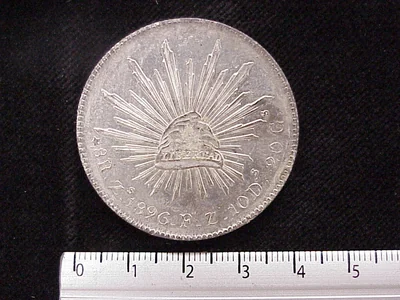
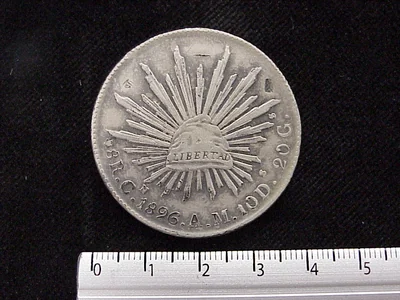
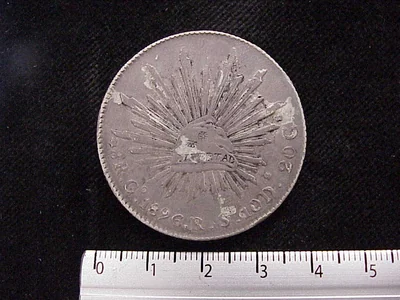
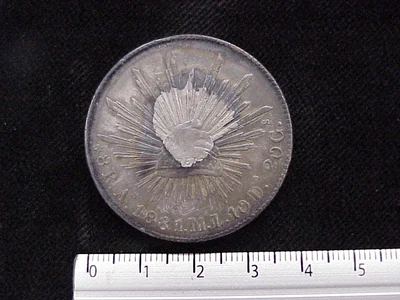
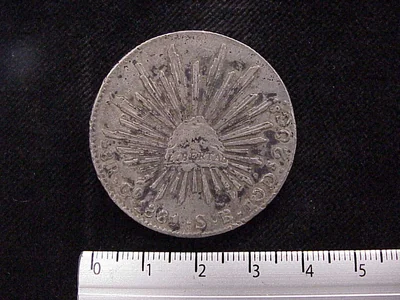
Reverse with a republican eagle facing forward devouring a serpent on a nopal, legend "REPÚBLICA MEXICANA". Piece attributed to the Mexico mint, 1896.
Obverse
Obverse with a Phrygian cap over solar rays (radiant sunburst) and the legend "LIBERTAD". Struck in .9028 silver per the republican octaval standard in force until the 1905 monetary reform.
The 8 Reales Resplandor Mexico 1896: Value & Silver Content is worth between $745 and $1,961 MXN depending on its grade of preservation.
Prices updated: August 2026
How much is the 8 Reales Resplandor Mexico 1896: Value & Silver Content worth?
The estimated value of the 8 Reales Resplandor Mexico 1896: Value & Silver Content ranges from $745 (circulated, XF) up to $1,961 (official blister pack), with $1,519 as a reference for an uncirculated (UNC) piece. The estimate is based on the official mintage and the historical behavior of the family.
The real price depends on four factors: the grade of preservation (a circulated piece is worth the low end of the range; an uncirculated one, or one still in its official blister pack, the high end), the finish (satin vs mirror/proof), the rarity within the series based on the mintage, and the metal spot price on the day of the deal when the piece is silver or gold. Check the value-by-grade table above and compare with equivalent pieces before buying or selling.
Where to buy or sell this coin?
Browse the national directory of numismatic shops or the community forum to trade directly with other collectors.
Price today
How much is the gold in a Centenario worth?
The Centenario is Mexico's main gold investment piece. Its price follows the gold spot in USD adjusted for MXN.
Description
If you found an 1896 Mexican 8 Reales Resplandor (KM#377.10) in a drawer or an inherited collection, here is the short answer: it is a real silver coin with a built-in floor value. In worn condition it sells for roughly 20 to 40 USD, mostly for its metal. Clean, high-grade examples can bring 80 to 300 USD or more. It is not a rare coin, but it is genuine silver, and that matters.
What you actually have
The 8 Reales Resplandor is a large silver peso struck at the Mexico City Mint during the government of Porfirio Díaz. "Resplandor" means "radiance" in Spanish, and it refers to the reverse design: a Phrygian cap (a soft peaked cap, the classic liberty symbol) with the word LIBERTAD, surrounded by radiating rays. That sunburst design gave the whole series its name. The front (obverse) shows the Mexican coat of arms, an eagle on a cactus.
This coin is the direct descendant of the colonial "Real de a Ocho," the Spanish silver dollar that once circulated worldwide. By 1896 the design had this distinct radiant-cap look, and it was still trusted in international trade, especially in Asian markets where Mexican silver was prized for its consistent weight and fineness.
Specifications (check yours against these)
| Feature | Value |
|---|---|
| Denomination | 8 Reales |
| Year | 1896 |
| Catalog reference | KM#377.10 (Krause) |
| Weight | 27.07 grams |
| Diameter | 39 mm |
| Edge | Reeded |
| Silver fineness | .9027 (about 24.4 g pure silver) |
| Mint | Casa de Moneda de México (Mexico City) |
Weigh yours on a jewelry scale and measure the diameter with calipers. If it does not match 27.07 g and 39 mm, be suspicious. Counterfeits of colonial and 19th-century Mexican silver are common.
What it is worth in USD
Value comes down to three things: silver content, condition, and mint variety. This is a widely struck issue, so it is not scarce. The metal sets the floor.
- Melt value: with roughly 24.4 grams of pure silver, the intrinsic metal value is around 20 to 25 USD at typical silver prices. This is the absolute minimum a genuine piece is worth.
- Circulated grades (worn): most examples you inherit fall here. Expect 25 to 60 USD depending on eye appeal and how sharp the rays and eagle remain.
- High grade (little to no wear): coins with crisp rays in the cap design and clean fields are what collectors of Porfiriato silver chase. These run from roughly 80 to 300 USD, and certified mint-state examples can go higher.
The honest reality: this is a common coin in worn condition and a desirable one only in top grades. Do not expect a life-changing figure from a circulated piece. The value is real, but it is measured in tens to a few hundred dollars, not thousands.
Errors and varieties
Genuine mint errors (off-center strikes, die rotations, doubled dies) can multiply the value. Be careful: most "errors" people post online are post-mint damage, corrosion, or cleaning scratches, not factory errors. If you think you have a true error, get it reviewed before you assume it is valuable.
How to check what yours is worth
- Confirm it is silver. Weight and diameter first. Genuine pieces ring, not clunk, and match the specs above.
- Grade it honestly. Look at the sharpness of the radiating rays, the LIBERTAD lettering, and the eagle. Wear on the high points pulls value down fast.
- Do not clean it. Cleaning silver coins damages the surface and lowers the price. Leave the patina alone.
- Get a second opinion before selling, especially if the grade looks high or you suspect an error.
Where to sell it
Because this is a precious-metal coin, deal only with buyers who let you show the piece and confirm its weight before any money changes hands. A verified numismatic dealer will appraise it on the spot. Collector-to-collector sales avoid dealer margins but require clear photos of the obverse, reverse, and edge. Avoid dumping it to the first Facebook offer, and be wary of any offer well below the silver value.
Have an 1896 Resplandor and not sure how high your grade really is? Post clear photos of both sides in the Pesoteca forum and let collectors weigh in before you sell.
Historical context
In 1896 Porfirio Díaz was in office, with Limantour as Secretary of Finance executing the monetary reform that closed the provincial mints and prepared the shift to the gold standard (achieved in 1905).
The Mexico mint (Mo) is the oldest on the American continent, founded in 1535. It was the main producer of pesos fuertes of the Republic and operated continuously until 1929, when it was closed for good.
The 8 reales Mo have the highest mintages of the family, which is why they are the entry point to the type. Good MS grades are more attainable here than at the provincial mints.
As a catalog reference, the variant of this mint is listed as KM#377.10 in Krause. The piece is silver of .9028 fineness with a reeded edge and a theoretical weight of 27.07 grams. The 1896 Mexico (Mo) example corresponds to the mature stage of the mint, near its close (1535-1929), and is identified on the coin by the Mo mint mark.
In the Mexican numismatic market the Mo-1896 radiant peso appears regularly at auction and at the flea markets of the city center. When hunting for it, it's advisable to verify a clean reeded edge, without clipping, and that the Mo mint mark is crisp. Before paying a middleman's markup, consult the reference range by grade in public catalogs and on the Pesoteca forum; many examples of this decade (1890s) can be obtained at par without the need for speculative intermediaries.
This piece belongs to the era
República Restaurada y Porfiriato →Explore all the Mexican coins of this era, their historical context and how they connect to the monetary system of the period.
Value range of this piece
Market estimate: $745 - $1,961 MXN depending on the grade of preservation (typical range between a circulated and an uncirculated piece).
See the full breakdown by grade (VG, F, VF, EF, AU, MS-60, MS-63, MS-65) for the whole series →
Other denominations from 1896
8 Reales Republicanos (Resplandor) · Plata 0.900
Same denomination, other years
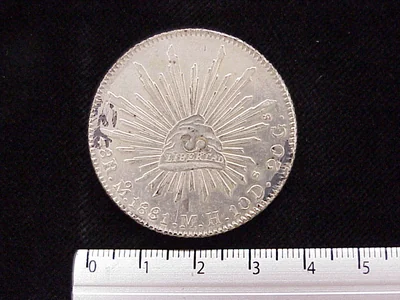
8 reales Plata 0.900 · 8 Reales Republicanos (Resplandor)
Frequently asked questions
How much is an 1896 Mexican 8 Reales Resplandor worth?
It contains about 24.4 grams of pure silver, giving it a melt floor near 20 to 25 USD at typical silver prices. Worn examples sell for roughly 25 to 60 USD, while clean high-grade coins bring 80 to 300 USD or more. Condition and eye appeal drive the price.
Is the 1896 8 Reales a rare coin?
No. It was struck in large numbers and is easy to find in circulated grades, so worn pieces are worth mostly their silver value. It only becomes genuinely desirable in high grades with sharp radiating rays and clean fields, which collectors of Porfiriato silver actively seek.
Where can I sell an 1896 8 Reales Resplandor?
Sell through a verified numismatic dealer who appraises it in person, or collector to collector in a numismatic forum. Photograph the obverse, reverse, and edge, and check the value range above first. Since it is silver, only sell to buyers who let you confirm the weight before paying.
How do I know if my 1896 8 Reales is genuine?
Check the weight (27.07 g) and diameter (39 mm) with a jewelry scale and calipers, then compare to the specs above. Look at the engraving style, mint mark, and assayer initials. Counterfeits of 19th-century Mexican silver are common, so be suspicious of any coin that misses the weight or is offered well below silver value.
Conversation
0 comments
Sources
- Ejemplar de la Coleccion Numismatica Banco de Mexico . inv. 4476
- Ejemplar de la Coleccion Numismatica Banco de Mexico . inv. 4477
- Ejemplar de la Coleccion Numismatica Banco de Mexico . inv. 4478
- Ejemplar de la Coleccion Numismatica Banco de Mexico . inv. 4479
- Ejemplar de la Coleccion Numismatica Banco de Mexico . inv. 4475
Images for informational and educational purposes, attributed to their original source. Reference values; the real price depends on the grade, the specific variant and demand.
Loading comments…