
1828 Mexican 8 Escudos Gold Coin: Value & How to Sell
The 1828 Mexican 8 Escudos Gold Coin: Value & How to Sell is worth between $51,422 and $73,074 MXN depending on its grade of preservation.
Prices updated: August 2026
Mexican Republic · Mexico City Mint · Assayer JM
Mexican Republic · Mexico City Mint · Assayer JM
The 1828 Mexican 8 Escudos Gold Coin: Value & How to Sell is worth between $51,422 and $73,074 MXN depending on its grade of preservation.
Prices updated: August 2026
How much is the 1828 Mexican 8 Escudos Gold Coin: Value & How to Sell worth?
The estimated value of the 1828 Mexican 8 Escudos Gold Coin: Value & How to Sell ranges from $51,422 (circulated, XF) up to $73,074 (official blister pack), with $65,201 as a reference for an uncirculated (UNC) piece. The estimate is based on the official mintage and the historical behavior of the family.
The real price depends on four factors: the grade of preservation (a circulated piece is worth the low end of the range; an uncirculated one, or one still in its official blister pack, the high end), the finish (satin vs mirror/proof), the rarity within the series based on the mintage, and the metal spot price on the day of the deal when the piece is silver or gold. Check the value-by-grade table above and compare with equivalent pieces before buying or selling.
Where to buy or sell this coin?
Browse the national directory of numismatic shops or the community forum to trade directly with other collectors.
Description
If you inherited an 1828 Mexican 8 escudos gold coin, you already own something with real value: it is a large gold piece, not pocket change. In 2026, the gold content alone puts a solid floor under it, and a genuine, well-preserved example can be worth thousands of dollars to collectors. Here is what actually drives the number.
What this coin is
The 8 escudos was the largest gold denomination of early independent Mexico. This 1828 piece comes from the first Mexican Federal Republic, struck at the Mexico City Mint (Casa de Moneda de México) with assayer initials JM. The design shows the republican eagle standing on a cactus with a serpent, the same symbol on the Mexican flag.
The specific numbers matter, so keep them handy:
- Metal: gold, 0.875 fine (21 karat)
- Weight: 27.04 grams
- Diameter: 36.5 mm
- Edge: diagonally reeded
- Gold content: roughly 23.66 grams of pure gold, about 0.68 troy ounces
- Mint: Mexico City, assayer JM
That 0.68 ounces of gold is the key figure. Whatever else happens, the coin is worth at least its melt value, and at recent gold prices that is comfortably above 1,500 USD.
The "Octaval" eagle explained
"Octaval" refers to a specific eagle variety used on some of these pieces: the republican eagle shown in profile with a cord (loop) in its beak, rather than the facing eagle with a sunburst. For a US buyer or seller this is a variety detail that specialists and grading services care about. For a casual owner, the important thing is confirming the eagle style, the date, and the JM assayer marks match a genuine strike.
What it's actually worth
Two values apply, and you should know both.
1. Melt (bullion) value. With about 0.68 troy ounces of gold, this coin has a hard floor tied to the international gold price. In 2026 that floor sits well over 1,500 USD. No genuine 8 escudos in this weight sells for less than its gold, period.
2. Numismatic (collector) value. Early Mexican Republic 8 escudos are actively collected, and condition drives everything. A worn, heavily circulated coin trades closer to its gold value plus a modest premium. A sharp, problem-free example, and especially one certified by NGC or PCGS in high grade, can bring several thousand dollars, well above melt.
| Condition | What you have | Approximate value (USD) |
|---|---|---|
| Heavily worn / damaged | Detail smoothed, scratches | Melt value (1,500+ depending on gold price) |
| Circulated, honest wear | Readable date, no major damage | Melt plus a modest premium |
| Extremely Fine / About Uncirculated | Sharp detail, light wear | Low thousands |
| Uncirculated, NGC/PCGS certified | Original luster, top grade | Several thousand, more for scarce varieties |
Mintage figures for individual mints and years in this early Republic series are not always fully documented, and survival rates vary a lot. That uncertainty is exactly why certified grading matters: a slab from NGC or PCGS settles both authenticity and grade in one step, which is what serious buyers pay for.
Don't fall for these myths
"It's from 1828, so it must be worth a fortune." Age alone does not make a coin valuable. Value comes from gold content, genuine rarity, demand, and grade. This coin is worth real money because it is a large gold piece that collectors want, not simply because it is old.
"A worn one is worth as much as a nice one." Not close. Condition can multiply the collector premium several times over. The gold floor protects you on a worn coin, but the upside lives in the high grades.
How to tell if yours is genuine
Gold fakes, many produced in lower fineness, almost always fail on the physical numbers. Check yours against the specs:
- Weight must be 27.04 grams. A cheap gram scale will expose most counterfeits instantly. Low-purity fakes come in light or wrong.
- Diameter should be 36.5 mm. Off-size is a red flag.
- Edge should be diagonally reeded, not plain or crudely cut.
- Design details: the eagle style, date, and JM assayer marks should be crisp and correct.
If your coin is worth more than about 300 to 500 USD, professional authentication is cheap insurance. NGC and PCGS grading is the definitive check: it confirms the coin is real, assigns a grade, and makes it far easier to sell at full value.
Where to sell it (US and international)
Because this is a gold coin, you have good options and you should never dump it at melt to the first buyer:
- Reputable coin dealers who handle world and Mexican gold. Get more than one offer.
- Major auction houses (Heritage, Stack's Bowers) if the coin is high grade or a scarce variety. This is where certified early Mexican gold reaches top prices.
- Established online collector marketplaces, but only with sellers/buyers who show clear photos of both sides and the edge, plus the exact weight.
Before you sell, photograph the obverse, reverse, and edge, weigh it, and know the current gold price so you can calculate the melt floor yourself. Any honest offer starts at or above that number.
Related pages worth a look: the full Colonial and early Republic gold escudos series, the Mexican Federal Republic era, other Mexican 8 escudos coins, and more coins dated 1828.
Got one sitting in a drawer and not sure which variety or grade you have? Post clear photos of both sides and the edge in the Pesoteca forum and the community can help you pin down what it's worth before you sell.
Historical context
Eight escudos República Mexicana, 1828, Mexico City mint, assayer JM, Krause KM#383.9. A year of the Republic's first serious political crisis: in September presidential elections were held that gave the win to Manuel Gómez Pedraza, but the result was annulled by the Acordada revolt of December led by Lorenzo de Zavala and Vicente Guerrero. Vicente Guerrero assumed the presidency in 1829. It was the first break of the post-independence constitutional order. The eight-escudo weighs 27.06 grams at 0.875 fineness. Krause KM#383.9 holds. Produced by milled coinage on a round planchet. The obverse shows the republican eagle atop a nopal with a serpent, and the reverse the arm with sword and Phrygian cap, French liberal iconography adapted to the early Mexican context. The assayer's JM signature continues, the same mark since the First Empire. Pieces from 1828 are testimony to the first moment when the young Republic showed grave institutional fragility and foreshadow the decade of military coups that would follow.
This piece belongs to the era
República Federal Mexicana →Explore all the Mexican coins of this era, their historical context and how they connect to the monetary system of the period.
Value range of this piece
Market estimate: $51,422 - $73,074 MXN depending on the grade of preservation (typical range between a circulated and an uncirculated piece).
See the full breakdown by grade (VG, F, VF, EF, AU, MS-60, MS-63, MS-65) for the whole series →
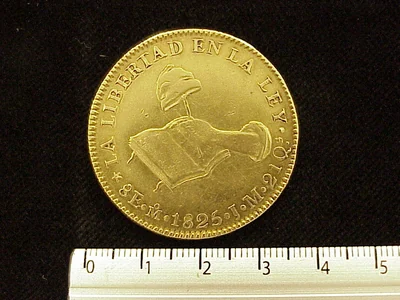
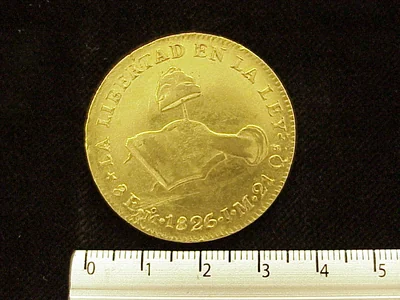
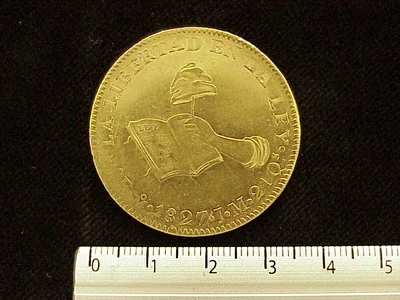
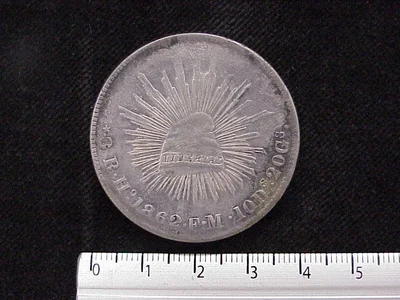
Same denomination, other years
8 escudos Oro 0.875 (21k) · Escudos Coloniales (oro)
Frequently asked questions
How much is an 1828 Mexican 8 escudos gold coin worth?
It has a hard floor from its gold content: about 0.68 troy ounces of gold, worth well over 1,500 USD in {{AÑO}} depending on the gold price. A worn coin trades near that melt value plus a small premium. A sharp Extremely Fine or Uncirculated example can bring several thousand dollars, especially certified by NGC or PCGS. Condition is the biggest factor.
How do I tell if my 1828 8 escudos is genuine?
Check the physical specs first: it must weigh 27.04 grams and measure 36.5 mm, with a diagonally reeded edge. Most gold fakes come in the wrong weight or lower fineness, so a scale usually exposes them. The eagle style, date, and JM assayer marks should be crisp. For any coin worth more than a few hundred dollars, NGC or PCGS certification is the definitive proof of authenticity.
Is the 1828 8 escudos rare?
Early Mexican Federal Republic 8 escudos are collectible and in steady demand, but exact mintage and survival figures for individual mint-and-year combinations are not always fully documented. That uncertainty is why grade and certification matter so much: a certified high-grade example commands a strong premium, while worn pieces trade closer to their gold value.
Where can I sell an 1828 Mexican 8 escudos gold coin?
Sell it through a reputable coin dealer who handles world gold, and get more than one offer. For high-grade or scarce-variety coins, major auction houses like Heritage or Stack's Bowers reach the top prices. Photograph the obverse, reverse, and edge, weigh the coin, and know the current gold price so you can confirm any offer starts at or above the melt value. You can also post photos in the [Pesoteca forum](/foro) for a second opinion.
Conversation
0 comments
Sources
Images for informational and educational purposes, attributed to their original source. Reference values; the real price depends on the grade, the specific variant and demand.
Loading comments…