
1828 Mexican 8 Escudos Gold Coin: Value & Prices
The 1828 Mexican 8 Escudos Gold Coin: Value & Prices is worth between $52,892 and $75,162 MXN depending on its grade of preservation.
Prices updated: August 2026
Scarce.
Scarce.
The 1828 Mexican 8 Escudos Gold Coin: Value & Prices is worth between $52,892 and $75,162 MXN depending on its grade of preservation.
Prices updated: August 2026
How much is the 1828 Mexican 8 Escudos Gold Coin: Value & Prices worth?
The estimated value of the 1828 Mexican 8 Escudos Gold Coin: Value & Prices ranges from $52,892 (circulated, XF) up to $75,162 (official blister pack), with $67,064 as a reference for an uncirculated (UNC) piece. The estimate is based on the official mintage and the historical behavior of the family.
The real price depends on four factors: the grade of preservation (a circulated piece is worth the low end of the range; an uncirculated one, or one still in its official blister pack, the high end), the finish (satin vs mirror/proof), the rarity within the series based on the mintage, and the metal spot price on the day of the deal when the piece is silver or gold. Check the value-by-grade table above and compare with equivalent pieces before buying or selling.
Where to buy or sell this coin?
Browse the national directory of numismatic shops or the community forum to trade directly with other collectors.
Description
If you have an 1828 Mexican 8 Escudos gold coin, you are holding a piece with real value. This is not a common pocket coin worth a few dollars. It contains almost a full ounce of gold, which sets a hard price floor, and as an early Mexican Republic gold piece it carries a collector premium on top of that. In 2026, even a worn example is worth well over 1,500 USD in metal alone.
What this coin actually is
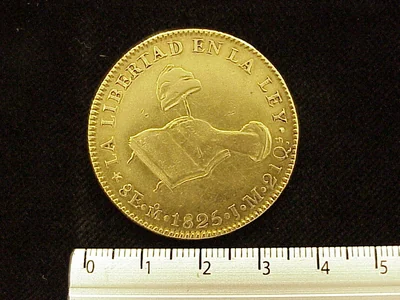
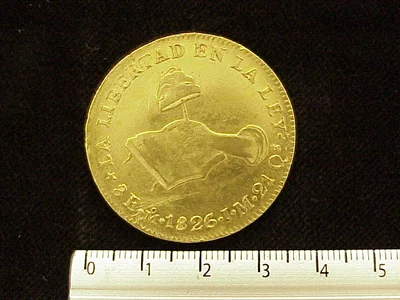
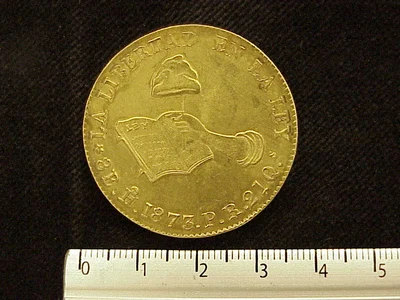
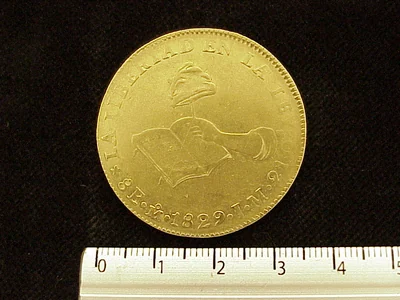
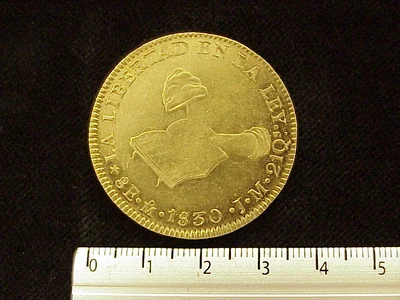
The 8 Escudos was the largest gold denomination struck in Mexico. The 1828 date belongs to the early República Federal Mexicana (Mexican Federal Republic), the period right after independence when the new nation began minting its own gold. Collectors call this the "Octaval" type. The design carries the eagle on a cactus on one side and a hand holding a liberty cap over a book on the other, the classic early Republic motif.
This particular date is considered scarce, which matters. Scarcity plus gold content is what pushes a coin like this well above its melt value.
Specifications (verify yours against these)
| Feature | Value |
|---|---|
| Denomination | 8 Escudos |
| Year | 1828 |
| Metal | Gold, 0.900 fine (0.900 fineness) |
| Weight | 27.04 grams |
| Diameter | 36.5 mm |
| Edge | Diagonally reeded |
| Series | 8 Escudos Octaval |
| Era | Mexican Federal Republic |
That 27.04 grams at 0.900 fineness works out to roughly 0.78 troy ounces of pure gold. At current gold prices, the metal alone is worth well over 1,500 USD. That number moves with the gold market, but it is your absolute floor: this coin will never be worth less than its gold content.
What it is worth by grade
Value climbs sharply with condition and with the appeal of the specific mint and assayer combination. As a rule for early Mexican gold:
- Circulated, heavily worn: driven mostly by melt value, typically 1,500 to 2,500 USD depending on the gold spot price.
- Nice circulated (clear detail, minimal damage): a collector premium kicks in, often 2,500 to 5,000 USD.
- High grade / uncirculated, certified: genuinely scarce early-date examples in top condition can reach five figures at major auction.
Because this is a precious-metal coin, two things decide where in that range yours lands: the gold spot price on the day you sell, and the grade. Check our Mexican coin grading guide to place your coin before you get an offer.
How to tell if yours is genuine
Counterfeits of early Mexican gold are common, so verification matters before any money changes hands.
- Weigh it. Use a jewelry scale. A genuine coin should be very close to 27.04 grams. A lightweight coin is a red flag.
- Measure the diameter. It should be 36.5 mm. Check the edge for diagonal reeding.
- Study the engraving, mint mark and assayer initials. Early Republic gold has specific style details for each mint and assayer. Fakes often get the lettering or eagle slightly wrong.
- Be suspicious of any offer far below the metal value. No informed seller gives away almost an ounce of gold cheap, and no honest buyer needs to.
If you want a second opinion, professional grading through NGC or PCGS confirms authenticity and grade, and a certified coin sells for more with far less friction.
Where to sell it
Because of the gold content, sell to someone who inspects the coin and its weight in front of you, and verify before you take payment.
- A verified numismatic dealer from the Pesoteca directory can appraise it on the spot.
- The Pesoteca buy-and-sell forum connects you directly with collectors.
Photograph the obverse, reverse and edge, note the weight, and compare against the range above before you accept any offer. Do not dump it to the first buyer on social media.
Got one in an inherited box and not sure what you're looking at? Post clear photos of both sides in the Pesoteca forum and let the community help you pin down the grade and value.
Historical context
Eight escudos octaval Mexican Republic, 1828, Mexico Mint. The entry declares the piece scarce, a sign of low mintage or reduced survival for the year. The year of the Republic's first serious political crisis: in September presidential elections were held that gave victory to Manuel Gomez Pedraza, but the result was annulled by the Acordada revolt of December led by Lorenzo de Zavala and Vicente Guerrero. Vicente Guerrero assumed the presidency in 1829. It was the first breakdown of the post-independence constitutional order and foreshadowed the cycle of military coups that would dominate the rest of the century. The onza weighs 27.06 grams with 0.875 fineness. Krause KM#383.9 is kept. Produced by mill with a round planchet. The obverse shows the republican eagle atop a nopal with a serpent and the reverse the arm with sword and Phrygian cap, French liberal iconography adapted to the early Mexican context. The assayer signature continues, the same mark since the First Empire. The declaration of scarcity in the entry increases the collectible value of the example. Pieces from 1828 document the first moment when the young Republic showed serious institutional fragility.
This piece belongs to the era
República Federal Mexicana →Explore all the Mexican coins of this era, their historical context and how they connect to the monetary system of the period.
Value range of this piece
Market estimate: $52,892 - $75,162 MXN depending on the grade of preservation (typical range between a circulated and an uncirculated piece).
See the full breakdown by grade (VG, F, VF, EF, AU, MS-60, MS-63, MS-65) for the whole series →
Same denomination, other years
8 escudos Oro 0.900 · 8 Escudos Octaval
Frequently asked questions
How much is an 1828 Mexican 8 Escudos gold coin worth?
It starts at its gold value, roughly 1,500 to 2,500 USD for a worn coin depending on the gold spot price, since it holds about 0.78 troy ounces of 0.900 gold. Nicer circulated examples run 2,500 to 5,000 USD, and top-grade certified pieces of this scarce date can reach five figures at auction.
Is the 1828 8 Escudos rare?
Yes, this date is considered scarce. Combined with its heavy gold content, that scarcity is what pushes it well above simple melt value. Condition and the specific mint and assayer combination determine how much premium a given example commands.
How can I tell if my 1828 8 Escudos is genuine?
Weigh it on a jewelry scale (it should be close to 27.04 grams) and measure the diameter (36.5 mm) with the diagonal reeded edge. Check the engraving, mint mark and assayer initials, since fakes of early Mexican gold are common. For certainty, have it authenticated by NGC or PCGS, and treat any bargain-price offer as a warning sign.
Where can I sell an 1828 Mexican 8 Escudos?
Sell through a [verified dealer in the Pesoteca directory](/tiendas), who can value it on the spot, or the [Pesoteca buy-and-sell forum](/foro/compra-venta) among collectors. Photograph the obverse, reverse and edge, confirm the weight, and check the price range above before accepting an offer. Because it is gold, only deal with a buyer who inspects the coin in person.
Conversation
0 comments
Loading comments…