
500 Pesos Madero 1989 (Cupronickel): Value & Facts
Prices updated: August 2026
Old peso era · Madero · Cupronickel
Old peso era · Madero · Cupronickel
Design
Banxico
Reverse
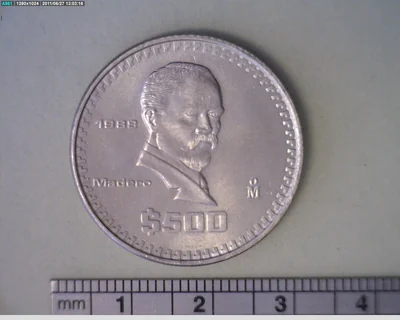
Effigy of Francisco I. Madero in three-quarter profile facing right. Below, the value "500" with the peso symbol. Around it appear the name "Madero", the year of minting (1989) and the mint mark of the Mexican Mint "Mo". The rim bears a beaded border (inner reeded edge).
Obverse
Mexican National Coat of Arms with the inscription "ESTADOS UNIDOS MEXICANOS".
How much is the 500 Pesos Madero 1989 (Cupronickel): Value & Facts worth?
The market value of the 500 Pesos Madero 1989 (Cupronickel): Value & Facts is not yet documented with enough data to give a firm range. Weigh and measure your piece, compare it against the specifications, and check the forum for a second opinion.
The real price depends on four factors: the grade of preservation (a circulated piece is worth the low end of the range; an uncirculated one, or one still in its official blister pack, the high end), the finish (satin vs mirror/proof), the rarity within the series based on the mintage, and the metal spot price on the day of the deal when the piece is silver or gold. Check the value-by-grade table above and compare with equivalent pieces before buying or selling.
Where to buy or sell this coin?
Browse the national directory of numismatic shops or the community forum to trade directly with other collectors.
Description
If you found a large silver-colored Mexican coin that says "QUINIENTOS PESOS" and "500" with a man's face on it, here is the honest answer: in 2026, a circulated 1989 500 pesos Madero is worth a few dollars at most, roughly the equivalent of pocket change to about 8 USD. Only pristine uncirculated examples graded high by a professional service bring meaningfully more, and even those top out near 120 to 130 USD at auction.
This is a common coin. Mexico struck 40 million of them. The "worth thousands" claims you see online refer to rare mint errors or exceptional graded pieces, not the everyday coin sitting in your drawer.
What this coin actually is
The 500 pesos Madero is a cupronickel circulation coin from Mexico's old peso era, before the 1993 monetary reform that lopped three zeros off the currency. The face on the reverse is Francisco I. Madero, a leader of the Mexican Revolution and president of Mexico from 1911 to 1913. He appears on the coin as a national historical figure, not because the coin is a rare commemorative.
Quick specs:
- Metal: cupronickel (75% copper, 25% nickel). No silver, no gold.
- Weight: 12.6 grams (some catalogs list 12.64 g).
- Diameter: 28.48 mm.
- Edge: reeded.
- Mint: Casa de Moneda de México (the "Mo" mint mark on the coin).
- Mintage in 1989: 40 million pieces.
Because there is no precious metal in it, this coin has no melt value. Its price is purely what a collector will pay, and for a common date that is not much.
What it's worth in 2026
Condition is everything here, since the date and design are not rare.
| Condition | Approximate value (USD) |
|---|---|
| Circulated, worn | A few cents to about 8 USD |
| Uncirculated, no grade | 5 to 15 USD |
| Certified MS64 to MS66 | About 120 to 130 USD |
Those top figures apply only to coins graded and sealed by a service like NGC or PCGS. In Mexican pesos, a circulated example trades for a few pesos up to around 150 MXN, while the best certified pieces have reached roughly 2,300 to 2,400 MXN at auction. If a piece is not certified, assume it sits in the low end of the range no matter how nice it looks to the naked eye.
The "it's worth a fortune" myth
Search this coin and you will hit headlines claiming it sells for 250,000 pesos or more. Ignore them for the ordinary coin. Those numbers apply to genuine, authenticated mint errors (off-center strikes, double dies, wrong planchets) or to flawless top-pop graded examples. A normal 1989 Madero that circulated for years is not one of those. High face value from the old peso era does not equal high collector value; inflation is why these large-denomination coins were everyday change back then.
How to tell if yours is genuine
Counterfeits of a common cupronickel coin are rare because there is little profit in faking it, but check the basics:
- Weight: should be close to 12.6 grams. A kitchen scale that reads tenths of a gram works.
- Diameter: about 28.5 mm.
- Edge: reeded (fine vertical grooves around the rim).
- Reverse: Madero in three-quarter profile facing right, "500" below, the year, and the "Mo" mint mark.
- Obverse: the Mexican coat of arms (eagle on a cactus) with "ESTADOS UNIDOS MEXICANOS" around it.
A weight that is far off, mushy or blurry lettering, or a plain edge are red flags for a reproduction.
Where to sell it
Since this is a common coin, do not expect a big payday unless you have a certified uncirculated example or a real mint error. Options:
- A local coin dealer for a quick sale, though expect a modest offer.
- Online marketplaces, where you set the price against what similar pieces actually sold for.
- For high-grade pieces, get it graded by NGC or PCGS first; the certification is what unlocks the higher end of the value range.
If you want to gauge real prices and reach buyers, check the Pesoteca directory of shops and buyers at /tiendas before you accept any offer.
Got a whole box of old Mexican coins, not just this one? Post photos of the full group in the Pesoteca forum and tell us which dates you have. The Madero is common, but there may be a sleeper in the pile worth a real look.
Historical context
Mexican circulating peso coins from the second half of the 20th century were struck in alloys that changed according to the cost of metals and inflationary processes: .720 silver in the $1, $5, $10, $25 denominations during the 1940s-50s; cupronickel from the 1970s on; aluminum bronze and stainless steel in the 1980s; pieces with figures (Hidalgo, Cuauhtémoc, Juárez, Madero, Carranza, Sor Juana) in the late 1980s just before the transition to Nuevos Pesos in 1992. 1989 corresponds to the period when this variant was in circulation. Francisco I. Madero, initiator of the Mexican Revolution, appears on circulating $500 denominations of the 1980s.
This piece belongs to the era
México Moderno (pre-1992) →Explore all the Mexican coins of this era, their historical context and how they connect to the monetary system of the period.
Value range of this piece
Value range without enough data for this piece.
See the full breakdown by grade (VG, F, VF, EF, AU, MS-60, MS-63, MS-65) for the whole series →
Same denomination, other years
500 pesos Cuproníquel · 100 Pesos Bronce Aluminio
Official sources
Frequently asked questions
How much is the 1989 500 pesos Madero coin worth?
It depends on condition. A circulated example is worth from a few cents up to about 8 USD. Only uncirculated coins certified in high grades (MS64 to MS66) have reached roughly 120 to 130 USD at auction. Claims that it is worth thousands refer to rare mint errors or exceptional graded pieces, not the common coin.
Is the 1989 500 pesos Madero rare?
No. Mexico struck 40 million of these in 1989, so it is very common. The only real scarcity is in high grade: a flawless uncirculated example is much harder to find than a worn one. The date itself is not rare.
Does this coin contain any silver?
No. It is made of cupronickel, an alloy of 75% copper and 25% nickel. There is no silver or gold in it, so it has no melt value and its price is purely what collectors will pay.
Where can I sell my 500 pesos Madero coin?
Try a local coin dealer for a fast sale, or an online marketplace where you can compare recent sold prices. Since the coin is common, expect modest offers unless it is a certified uncirculated piece or a genuine mint error. Check the Pesoteca directory of buyers at /tiendas to gauge real prices first.
Conversation
0 comments
Sources
Images for informational and educational purposes, attributed to their original source. Reference values; the real price depends on the grade, the specific variant and demand.
Loading comments…