
4 Escudos Carlos II 1695 Gold Cob: Value Guide
The 4 Escudos Carlos II 1695 Gold Cob: Value Guide is worth between $25,198 and $42,438 MXN depending on its grade of preservation.
Prices updated: August 2026
Viceroyalty · Mexico City Mint · Assayer L
Viceroyalty · Mexico City Mint · Assayer L
The 4 Escudos Carlos II 1695 Gold Cob: Value Guide is worth between $25,198 and $42,438 MXN depending on its grade of preservation.
Prices updated: August 2026
How much is the coin 4 Escudos Carlos II 1695 Gold Cob: Value Guide worth?
The estimated value of the coin 4 Escudos Carlos II 1695 Gold Cob: Value Guide ranges from $25,198 (circulated, XF) up to $42,438 (official blister pack), with $36,169 as a reference for an uncirculated (UNC) piece. The estimate is based on the official mintage and the historical behavior of the family.
The real price depends on four factors: the grade of preservation (a circulated piece is worth the low end of the range; an uncirculated one, or one still in its official blister pack, the high end), the finish (satin vs mirror/proof), the rarity within the series based on the mintage, and the metal spot price on the day of the deal when the piece is silver or gold. Check the value-by-grade table above and compare with equivalent pieces before buying or selling.
Where to buy or sell this coin?
Browse the national directory of numismatic shops or the community forum to trade directly with other collectors.
Description
If you inherited or found a heavy, irregular gold coin marked with a cross and shield, and you traced it to 1695 Mexico under Carlos II, you are holding real money. The gold content alone puts a floor of several hundred US dollars under it, and a well-preserved, certified example can bring several thousand at auction.
What you actually have
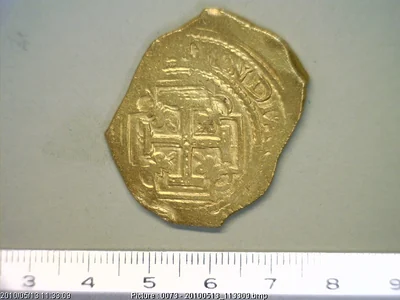
This is a 4 escudos gold cob (in Spanish, macuquina), struck in colonial Mexico in 1695 during the reign of Carlos II, the last Habsburg king of Spain. "Cob" is the English term for these hand-struck, irregular gold and silver coins the Spanish colonies produced before machine minting. They look crude and off-round because they were cut from a gold bar and struck by hand, not because yours is damaged.
Hard specs, exactly as recorded:
- Denomination: 4 escudos (half an ounce of gold, a high-value trade coin of its day)
- Weight: 13.25 grams
- Fineness: 0.875 gold (21 karat)
- Diameter: 25 mm
- Edge: plain, unmilled
- Year: 1695, single year of this listing
- Ruler: Carlos II (reigned 1665 to 1700)
At 13.25 grams of 0.875 gold, the coin contains roughly 11.6 grams of pure gold, about 0.372 troy ounces. That gives it a melt floor that moves with the gold spot price. At recent gold levels, that is well over 700 USD in metal alone, before any collector premium. This is the key point for anyone who inherited one: a genuine piece is never worth "a few dollars." The gold guarantees a real base value.
What drives the price above melt
Three things separate a 700-dollar melt coin from a several-thousand-dollar collector coin:
- Condition (grade). Cobs are graded on how much of the design, cross, shield, and legends survived the crude striking and centuries of handling. A coin where you can read the assayer marks and date clearly is worth far more than a worn, corroded blob.
- Authenticity certification. A coin graded and sealed by NGC or PCGS commands a strong premium over a raw, uncertified one, because the buyer no longer has to trust the seller.
- Provenance. Many surviving Spanish colonial cobs come from documented shipwrecks. A piece with a known salvage pedigree can carry a meaningful bonus.
Because cobs vary so widely in strike and preservation, there is no single sticker price. An honest range for a genuine 1695 Carlos II 4 escudos runs from roughly the gold value on a worn, damaged example to several thousand US dollars for a sharp, well-centered, certified coin. Exceptional colonial gold cobs from this era have sold in the five figures at major US auctions, so if yours is unusually clear, get it graded before selling.
Value at a glance
| Coin | Year | Metal / weight | Value range (USD) |
|---|---|---|---|
| 4 Escudos Carlos II cob | 1695 | 0.875 gold, 13.25 g | ~700 (melt, worn) to several thousand (certified, sharp) |
| Same, worn / damaged | 1695 | 0.875 gold, 13.25 g | Near gold melt value |
| Same, high grade + NGC/PCGS | 1695 | 0.875 gold, 13.25 g | Top of range; occasional five figures for premium examples |
Prices track the international gold spot price at the floor. Treat the upper end as auction-dependent, not guaranteed.
How to tell if yours is genuine
Gold cobs are faked, and the fakes almost always give themselves away on the scale. A real 1695 4 escudos weighs 13.25 grams and measures about 25 mm. Counterfeits, many produced overseas, tend to use lower-purity alloy and come out underweight or the wrong size. Steps to take:
- Weigh it on a gram scale accurate to 0.01 g. A reading far off 13.25 g is a red flag.
- Check the color and feel. 21-karat gold has a rich, warm tone and real heft for its size.
- Look at the design. Genuine cobs show hand-struck irregularity, a cross and Habsburg shield, and assayer/mint marks, not a perfectly round, machine-even coin.
- Get it certified for anything you plan to sell above modest money. Submitting your best piece to NGC or PCGS is the definitive insurance against both fakes and lowball offers.
Where to sell it
Because this is a precious-metal coin, only deal with buyers who let you verify the piece first. Options that work for US and international sellers:
- Established auction houses (Heritage, Stack's Bowers) for a certified, high-grade example. This is where premium colonial gold reaches top prices.
- Reputable coin dealers who handle world and Spanish colonial gold. Expect an offer near melt for worn pieces and a real premium for sharp ones.
- Collector communities where you can post clear photos of the front, back, and edge, plus the exact weight, and let knowledgeable buyers bid.
Do not dump a genuine gold cob to the first online buyer. Photograph the obverse, reverse, and edge, confirm the weight, and compare against the ranges above before you accept anything.
The bottom line for an inherited piece
Unlike most old coins that people hope are worth a fortune, a real 1695 Carlos II 4 escudos genuinely has value, because it is gold and because Habsburg colonial gold is scarce and collected. The floor is the metal. The ceiling depends on grade and certification. Verify the weight first, then decide whether it is worth the cost of professional grading.
Have one in a box of inherited coins and unsure if it is the real thing? Post clear photos of both sides and the edge, plus the exact weight, in the Pesoteca forum and let collectors help you place it before you sell.
Historical context
Cob four escudos in the name of Carlos II, struck in 1695 at the Mexico City Mint under the viceregal administration of Gaspar de la Cerda, Count of Galve, who still governed New Spain that year. The assayer's mark is L, the same one that appears on the two-escudo listing from the same period, a sign of continuity in the workshop. The four escudos is half an ounce and exactly half of the eight-escudo cob. It was hammer-struck on planchets cut with shears from the cast gold bar. The theoretical weight is close to 13.5 grams with a fineness near 0.916, though wear and the method itself mean that surviving pieces show considerable variation. Krause does not assign a specific running number to the type; it is documented within the Carlos II Mo cob family. This precise year, 1695, is historically dense: Sor Juana Ines de la Cruz died on April 17 and several floods struck Mexico City. The piece lived through that viceregal setting before circulating in the commercial network of the Atlantic.
This piece belongs to the era
Colonial / Virreinato →Explore all the Mexican coins of this era, their historical context and how they connect to the monetary system of the period.
Value range of this piece
Market estimate: $25,198 - $42,438 MXN depending on the grade of preservation (typical range between a circulated and an uncirculated piece).
See the full breakdown by grade (VG, F, VF, EF, AU, MS-60, MS-63, MS-65) for the whole series →
Other denominations from 1695
Escudos Coloniales (oro) · Oro 0.875 (21k)
Frequently asked questions
How much is a 1695 Carlos II 4 escudos worth?
It has a floor at its gold value, over 700 USD at recent gold prices, since it contains about 0.372 troy ounces of pure gold. A worn or damaged piece sells near that melt value; a sharp, well-struck example certified by NGC or PCGS can bring several thousand dollars, and premium coins have reached five figures at major auctions. Grade drives everything.
Is the 1695 Carlos II 4 escudos rare?
Spanish colonial gold cobs from Carlos II, the last Habsburg king, are genuinely scarce and collected for both their age and gold content. No firm mintage figure survives for this issue, which is normal for hand-struck colonial gold. Survivors are limited, and clean, readable examples are considerably rarer than worn ones.
How can I tell if my 4 escudos is genuine?
Start with the scale. A real one weighs 13.25 grams and measures about 25 mm. Most counterfeits use lower-purity gold and come out underweight or the wrong size, so the weight usually exposes them. Genuine cobs show hand-struck irregularity, a cross and Habsburg shield, and assayer marks. For anything you plan to sell above modest money, submit it to NGC or PCGS for certification.
Where should I sell a 1695 Carlos II gold cob?
For a certified, high-grade coin, use an established auction house like Heritage or Stack's Bowers, where colonial gold reaches top prices. Reputable dealers in world and Spanish colonial gold are good for worn pieces. Wherever you sell, photograph the obverse, reverse, and edge, confirm the exact weight, and never accept the first lowball offer without checking current gold and auction values.
Conversation
0 comments
Sources
Images for informational and educational purposes, attributed to their original source. Reference values; the real price depends on the grade, the specific variant and demand.
Loading comments…