
1823 Iturbide 4 Escudos Gold Coin: Value & Where to Sell
The 1823 Iturbide 4 Escudos Gold Coin: Value & Where to Sell is worth between $25,654 and $36,456 MXN depending on its grade of preservation.
Prices updated: August 2026
First Empire · Mexico City Mint · Assayer JM
First Empire · Mexico City Mint · Assayer JM
The 1823 Iturbide 4 Escudos Gold Coin: Value & Where to Sell is worth between $25,654 and $36,456 MXN depending on its grade of preservation.
Prices updated: August 2026
How much is the 1823 Iturbide 4 Escudos Gold Coin: Value & Where to Sell worth?
The estimated value of the 1823 Iturbide 4 Escudos Gold Coin: Value & Where to Sell ranges from $25,654 (circulated, XF) up to $36,456 (official blister pack), with $32,528 as a reference for an uncirculated (UNC) piece. The estimate is based on the official mintage and the historical behavior of the family.
The real price depends on four factors: the grade of preservation (a circulated piece is worth the low end of the range; an uncirculated one, or one still in its official blister pack, the high end), the finish (satin vs mirror/proof), the rarity within the series based on the mintage, and the metal spot price on the day of the deal when the piece is silver or gold. Check the value-by-grade table above and compare with equivalent pieces before buying or selling.
Where to buy or sell this coin?
Browse the national directory of numismatic shops or the community forum to trade directly with other collectors.
Description
If you inherited or found an 1823 Agustín de Iturbide 4 Escudos, you own one of the most historically significant gold coins Mexico ever struck. It carries a real floor from its gold content and, in higher grades, sells well into the thousands of dollars at auction. This is not a common coin, and 1823 is the only year it was made.
Quick answer: is it worth money?
Yes, in two different ways. First, it contains real gold, so it can never be worth less than its melt value. Second, it is a genuinely scarce type from the short-lived First Mexican Empire under Agustín de Iturbide, which gives it collector demand on top of the metal. Certified examples in strong grades trade in the thousands of dollars. A worn, uncertified piece still carries several hundred dollars in gold alone.
The range is wide because condition drives everything. A heavily circulated coin sits near its bullion value. A sharp, certified Mint State example can bring a large multiple of that.
What exactly is a 4 Escudos?
The escudo was Mexico's gold denomination inherited from the Spanish colonial system. Coins came in 1, 2, 4 and 8 escudos. The 4 escudos is the second-largest gold piece, the smaller companion to the famous 8 escudos "doubloon." This particular issue is special because it was struck in 1823, during the brief reign of Emperor Agustín I (Iturbide), before Mexico became a federal republic.
Specifications (check yours against these)
| Spec | Value |
|---|---|
| Denomination | 4 Escudos |
| Year struck | 1823 (one year only) |
| Weight | 13.49 grams |
| Diameter | 30.44 mm |
| Metal | Gold, .875 fine (21 karat) |
| Edge | Diagonal reeded |
| Era | Transition to the Mexican Republic (Iturbide's Empire) |
Weight and diameter are your first fraud test. If your coin does not match 13.49 grams and 30.44 mm, treat it with suspicion. Most gold fakes come in underweight or in lower fineness, and the scale gives them away fast.
Why this coin commands a premium
Three things stack up here:
- One-year type. Struck only in 1823. There are no later dates to pad the supply, so every genuine example comes from a single, short production window.
- Short-lived issuing authority. Iturbide's empire lasted less than a year. Coinage tied to failed or brief regimes tends to survive in small numbers and draws steady collector interest.
- Gold content. At 13.49 grams of .875 gold, the piece holds roughly 0.379 troy ounces of pure gold. That sets a hard price floor that moves with the gold market.
The exact mintage of this issue is not officially documented, which is common for Mexican coinage from this chaotic period. Low documented survival plus real historical weight is exactly the combination that pushes prices up at auction, especially for certified Mint State examples.
What it's actually worth
Be realistic about the two tiers:
- Melt / bullion floor: roughly 0.379 oz of gold. At current gold prices that alone is worth several hundred dollars, and it never goes to zero.
- Collector value: genuine examples in collectible grades routinely sell for a multiple of melt, and top certified pieces reach into the thousands of dollars. Circulated, damaged or cleaned coins sit closer to the floor.
A certified grade from NGC or PCGS changes the picture completely. The same coin can be worth two or three times more with a numeric grade on a slab than as a raw coin a buyer has to trust on faith. For a piece with this kind of history, certification is worth the cost.
Myth check: "old gold coin, must be worth a fortune"
Old and gold does not automatically mean six figures. What separates a few hundred dollars from a few thousand here is condition, authenticity and certification, not just age. A cleaned or damaged 1823 4 escudos loses a large share of its collector premium and falls back toward melt. Age gets you in the door; grade decides the payout.
How to tell if yours is genuine
- Weigh it. Should be 13.49 grams. A digital gram scale settles most cases in seconds.
- Measure it. 30.44 mm diameter. Off by more than a hair is a red flag.
- Check the edge. It should have diagonal reeding. Smooth or crude edges point to a cast fake.
- Get it certified. For a coin in this value range, send it to NGC or PCGS. Their slab authenticates the metal, confirms the grade and protects your resale price. This is the definitive check.
Before buying one from anyone, always ask the seller for photos of the obverse, reverse and edge, plus the exact weight.
Where to sell (and get paid fairly)
Because this is a precious-metal coin with real collector value, sell where buyers understand what they are looking at:
- A verified dealer from the Pesoteca directory, who can appraise it on the spot.
- The Pesoteca buy-and-sell forum, direct to collectors who know the type.
- Established auction houses if you have a high-grade certified example, since strong pieces perform best at auction.
Photograph the coin fully (both faces and the edge) and check the value ranges here before you accept an offer. Do not dump it to the first bidder on a social media group, and never buy or sell without seeing the coin and its weight first.
Think you have a genuine 1823 Iturbide 4 escudos? Post clear photos of both sides and the edge in the Pesoteca forum and let collectors help you pin down the grade and value before you sell.
Historical context
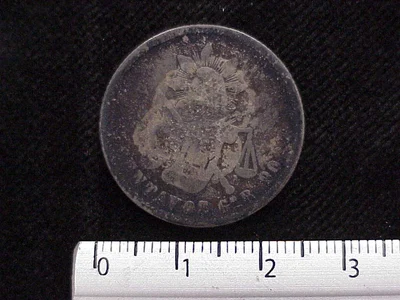
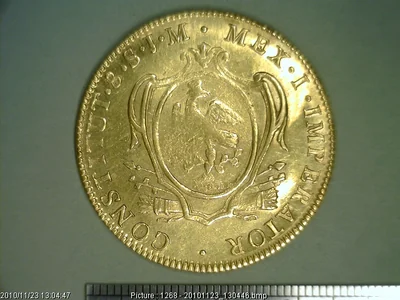
Four escudos Agustín de Iturbide, 1823, Mexico mint, assayer JM, Krause KM#312. Half onza in the name of the first emperor of Mexico. Iturbide was proclaimed emperor on May 19, 1822 after the mutiny of Sergeant Pío Marcha and crowned on July 21. His empire lasted barely ten months: in March 1823 he abdicated under pressure from the Plan de Casa Mata led by Antonio López de Santa Anna, and went into exile in Europe. The 1823 piece was struck in the last months of the First Empire and in the transition to the Republic. The signature JM is the assayer's mark at the capital mint. Half onza weighs theoretically 13.53 grams with 0.875 fineness. Produced by mill press with a round blank, with medal die alignment and diagonal reeded edge (data already in the database for this entry). First Empire pieces are collectible for the brevity of the regime. Krause KM#312 is the reference for the four escudos with the Iturbide bust.
This piece belongs to the era
República Federal Mexicana →Explore all the Mexican coins of this era, their historical context and how they connect to the monetary system of the period.
Value range of this piece
Market estimate: $25,654 - $36,456 MXN depending on the grade of preservation (typical range between a circulated and an uncirculated piece).
See the full breakdown by grade (VG, F, VF, EF, AU, MS-60, MS-63, MS-65) for the whole series →
Other denominations from 1823
Escudos Coloniales (oro) · Oro 0.875 (21k)
Frequently asked questions
How much is the 1823 Iturbide 4 Escudos worth?
It has two value tiers. As gold, it holds about 0.379 troy ounces of pure gold, worth several hundred dollars minimum. As a collectible, genuine examples in good grades sell for a multiple of melt, and top certified pieces reach into the thousands of dollars. Condition and certification decide where in that range yours lands.
Is the 1823 Iturbide 4 Escudos rare?
Yes. It was struck only in 1823, during Iturbide's brief empire, so there is a single production year and no later dates to expand supply. The exact mintage is not officially documented, which is common for this turbulent period, and surviving examples in high grade are genuinely scarce.
How can I tell if my 1823 4 Escudos is genuine?
Weigh it (13.49 grams) and measure it (30.44 mm). Fakes usually come underweight or in lower-fineness gold, so the scale often exposes them immediately. Check for diagonal reeding on the edge. For a coin this valuable, send it to NGC or PCGS for certification, which is the definitive authenticity and value check.
Where can I sell an 1823 Iturbide 4 Escudos?
Sell to a verified dealer from the Pesoteca directory who can appraise it in person, or list it in the Pesoteca buy-and-sell forum among collectors who know the type. High-grade certified examples do best at established auction houses. Always photograph the obverse, reverse and edge, and never sell without showing the coin and its exact weight.
Conversation
0 comments
Sources
Images for informational and educational purposes, attributed to their original source. Reference values; the real price depends on the grade, the specific variant and demand.
Loading comments…