
Mexican 20 Centavos 2008 (Aluminum-Bronze): Value Guide
Prices updated: August 2026
Centavos aluminum bronze 2008.
Centavos aluminum bronze 2008.
Design
Banxico
Reverse
Value "20" at the center with the year above and the mint mark (Mo) below, framed by a partial border of stylized glyphs taken from the Sun Stone (Aztec Calendar): the Acatl (reed) sign, one of the days of the Mexica calendar.
Obverse
Obverse with the Mexican National Coat of Arms and legend "ESTADOS UNIDOS MEXICANOS" per official convention. Struck by the Mexico City Mint under Banxico decree.
How much is the Mexican 20 Centavos 2008 (Aluminum-Bronze): Value Guide worth?
The market value of the Mexican 20 Centavos 2008 (Aluminum-Bronze): Value Guide is not yet documented with enough data to give a firm range. Weigh and measure your piece, compare it against the specifications, and check the forum for a second opinion.
The real price depends on four factors: the grade of preservation (a circulated piece is worth the low end of the range; an uncirculated one, or one still in its official blister pack, the high end), the finish (satin vs mirror/proof), the rarity within the series based on the mintage, and the metal spot price on the day of the deal when the piece is silver or gold. Check the value-by-grade table above and compare with equivalent pieces before buying or selling.
Where to buy or sell this coin?
Browse the national directory of numismatic shops or the community forum to trade directly with other collectors.
Description
Let's be direct: the 2008 Mexican 20 centavos coin is worth its face value in almost every case, roughly 20 to 25 US cents at auction in top condition. Mexico's mint struck 214,313,000 of them in that single year, so this is one of the most common circulation coins of its era, not a rare find.
If you inherited a jar of Mexican change and this is in it, you have a common circulation piece. It contains no silver and no gold, so there is no precious-metal value to recover. The only versions that bring more than face value are flawless uncirculated examples or a genuine, verifiable minting error.
What it's actually worth (in USD)
Here is the honest breakdown. The Spanish term centavos simply means cents; 20 centavos is one-fifth of a Mexican peso.
| Condition | Realistic value | Notes |
|---|---|---|
| Circulated, worn | Face value (about 1 US cent equivalent) | Spendable pocket change, no collector premium |
| Uncirculated (UNC) | About 20 to 25 US cents | Numista catalog lists it near 4 to 5 pesos |
| Verified mint error | Case by case | Only if authenticated by a grading service |
The numbers above are not a typo. With over 214 million struck, supply crushes any premium. Even a perfect coin trades for pennies unless a collector specifically needs it for a set.
What the coin is
This is the small version of the 20 centavos, the one Mexico's central bank (Banxico) struck in aluminum-bronze between 1992 and 2009. Aluminum-bronze is a copper alloy mixed with aluminum. It looks gold-colored but holds no precious metal.
Your 2008 piece has these specs, which are worth knowing if you want to confirm what you have:
- Weight: 3.04 grams
- Diameter: 19.5 mm
- Edge: plain (smooth)
- Composition: aluminum-bronze (copper and aluminum)
The front (obverse) carries the Mexican national coat of arms, the eagle on a cactus. The back (reverse) shows the value "20" in the center, the year above, and the mint mark "Mo" below (Mo stands for the Mexico City mint, Casa de Moneda de Mexico). Around the edge runs a border of stylized glyphs taken from the Piedra del Sol, the Aztec sun stone: the Acatl symbol, meaning "reed," one of the day-signs of the Mexica calendar.
Is it rare? No.
Mintage tells the whole story. The 214,313,000 figure for 2008 alone means these coins are everywhere. Age does not make a coin valuable; scarcity and demand do, and this coin has neither in its favor. If you were hoping for a windfall, this particular piece is not it.
The only realistic paths to a premium are a top uncirculated grade or a real, documented minting error (off-center strike, wrong planchet, major die break). Scratches, discoloration, or ordinary wear do not count as errors.
How to tell if yours is genuine
Counterfeits of a coin worth a few cents are almost nonexistent because there is no profit in faking it. Still, if you want to verify:
- Weigh it. It should hit 3.04 grams. A jewelry scale is enough.
- Measure it. Diameter should be 19.5 mm. A caliper confirms it.
- Check the edge is plain, the obverse shows the coat of arms, and the reverse shows the "20" with the calendar glyph border.
Those three checks rule out any crude fake instantly.
Where to buy or sell
Since this is a common coin, only high grades (UNC or better) justify paying above face value. If you are assembling the full aluminum-bronze 20 centavos series or placing it within Mexico's new pesos era, it slots in easily and cheaply. To buy a clean example or to find a dealer, check the Pesoteca shop directory.
Don't pay shipping fees to sell a handful of these. If you have a full jar of Mexican coins, the smart move is to sort out anything silver first (older peso and centavo coins from before the 1970s often are) and treat coins like this 2008 piece as pocket change.
Historical context
Context of the twenty-centavo piece of 2008
This twenty-centavo coin (KM#548) was struck by the Mexico City Mint in 2008, under the presidency of Felipe Calderón Hinojosa. It is part of the family of circulating coins in an alloy of bronze and aluminum with nickel that Banxico issued between 1992 and 2009, with a 19.5 mm diameter and 2.26 g weight.
The year in Mexico. It is the year of the global financial crisis that began in September with the collapse of Lehman Brothers. The peso depreciated from 10.36 to 13.83 per dollar between January and December. Inflation closed at 6.53%, the highest since 2000. That year, according to INEGI's INPC, annual inflation closed at 6.53% and the Bank of Mexico's FIX exchange rate ended the year at 13.83 pesos per dollar.
How it circulated. In 2008 these pieces circulated during the worst external economic blow since 1994-1995. Small change became more important in the household and neighborhood economy. Public services accepted these pieces to make exact payments.
Numismatic note. The 2008 die is from an abundant minting despite the context. Banxico kept production up to ensure enough fractional coinage in circulation. The obverse design is Banxico's official National Coat of Arms and the reverse shows the face value together with the year of minting. From year to year the design remains identical and only the engraved date changes, so the visible difference is minimal. Internal die variations, when they exist, are documented in the Bank of Mexico catalog.
This piece belongs to the era
Nuevos Pesos y actualidad →Explore all the Mexican coins of this era, their historical context and how they connect to the monetary system of the period.
Value range of this piece
Value range without enough data for this piece.
See the full breakdown by grade (VG, F, VF, EF, AU, MS-60, MS-63, MS-65) for the whole series →
Same denomination, other years
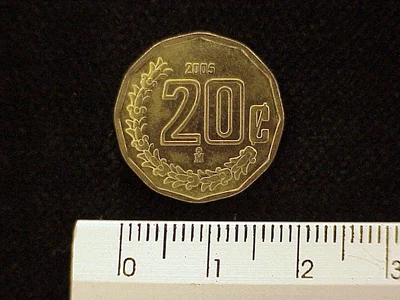
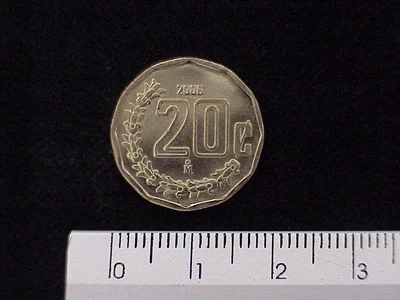
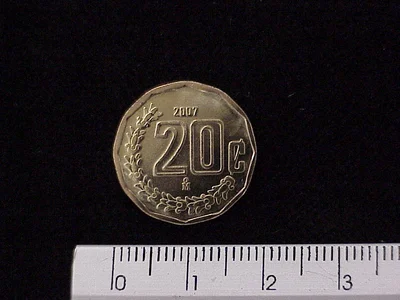
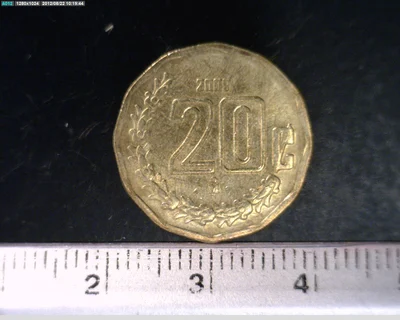
20 centavos Aluminio-bronce · 20 Centavos Bronce Aluminio
Frequently asked questions
How much is the 2008 Mexican 20 centavos worth?
In uncirculated (UNC) condition, catalog values put it around 20 to 25 US cents (4 to 5 Mexican pesos). Circulated and worn, it is worth its face value and nothing more. It is a common coin, not a rarity.
Is the 2008 20 centavos coin rare?
No. With more than 214 million struck in a single year, it is one of the most common Mexican coins of its era. Only a flawless high grade or a genuine, verifiable minting error would make it worth more than face value.
Does this coin contain any silver or gold?
No. It is made of aluminum-bronze, a copper-and-aluminum alloy. It holds no precious metal, so there is no melt value to recover.
Where can I buy or sell this coin?
For clean examples or to find a dealer, check the Pesoteca shop directory at /tiendas. Because it is a common coin, only high grades (UNC or better) justify paying above face value, so selling a single worn piece is rarely worth the effort.
Conversation
0 comments
Loading comments…