
1997 Mexican 20 Centavos (Aluminum-Bronze): Value Guide
Prices updated: August 2026
Centavos aluminum bronze 1997.
Centavos aluminum bronze 1997.
Design
Banxico
Reverse
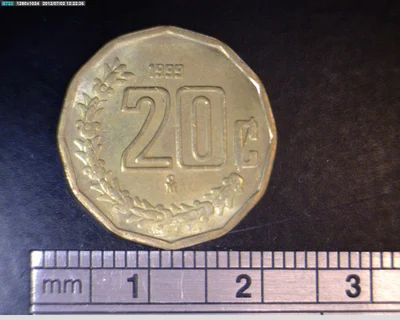
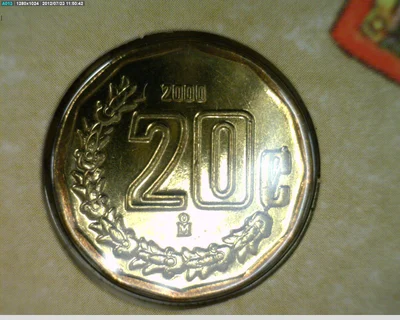
At the center, the number 20 as the main motif, accompanied by the centavos symbol, the year of minting, the mint mark of the Mexico City Mint (M°), and a stylization of the Acatl, the glyph representing the thirteenth day of the Sun Stone (Aztec Calendar). Dodecagonal 12-sided coin. Source: Banxico and Numista (KM# 548).
Obverse
Obverse with the Mexican National Coat of Arms and the legend "ESTADOS UNIDOS MEXICANOS" per official convention. Struck by the Mexico City Mint under Banxico decree.
How much is the 1997 Mexican 20 Centavos (Aluminum-Bronze): Value Guide worth?
The market value of the 1997 Mexican 20 Centavos (Aluminum-Bronze): Value Guide is not yet documented with enough data to give a firm range. Weigh and measure your piece, compare it against the specifications, and check the forum for a second opinion.
The real price depends on four factors: the grade of preservation (a circulated piece is worth the low end of the range; an uncirculated one, or one still in its official blister pack, the high end), the finish (satin vs mirror/proof), the rarity within the series based on the mintage, and the metal spot price on the day of the deal when the piece is silver or gold. Check the value-by-grade table above and compare with equivalent pieces before buying or selling.
Where to buy or sell this coin?
Browse the national directory of numismatic shops or the community forum to trade directly with other collectors.
Description
If you inherited or found a 1997 Mexican 20 centavos coin, here is the honest answer: a worn one is worth its face value, 20 centavos. An uncirculated example runs about 9 to 10 pesos among collectors, roughly half a dollar to a dollar. The year alone does not make it valuable, because almost 179 million were struck.
This is one of the most common modern Mexican coins in existence. If you are hoping it funds a vacation, it will not, unless it carries a genuine mint error. We will show you exactly what to look for.
What this coin actually is
The 1997 20 centavos belongs to what Mexican collectors call Familia C (Family C), the coin series that began circulating on January 1, 1996, to complete the switch to the "nuevos pesos" (new pesos) currency reform.
Key specs, all official Banxico (Bank of Mexico) figures:
- Metal: aluminum-bronze, an alloy of copper, aluminum and other metals. No silver, no gold.
- Weight: 3.04 grams
- Diameter: 19.5 mm
- Shape: dodecagonal (12 sides), with a smooth edge
- Obverse: the Mexican national coat of arms (the eagle on a cactus with a snake)
- Reverse: the number 20, the centavos symbol, the year, the M° mint mark, and a stylized Acatl, the glyph for the thirteenth day on the Aztec Sun Stone calendar
Because it is not made of precious metal, there is no melt value to fall back on. A silver coin at least has a floor at its bullion price. This one does not.
How much is it worth?
| Condition | What it's worth |
|---|---|
| Circulated (worn) | Face value, 20 centavos |
| Uncirculated, well preserved | About 9 to 10 pesos (roughly 0.50 to 1 USD) among collectors |
| Genuine mint error | Varies, potentially much more |
The uncirculated figure comes from the Numista catalog. That is the whole story for a normal coin. There is no year premium, no secret rarity, no "it's old so it's worth something" bump.
Is it rare? No.
Numista records a 1997 mintage of 178,807,000 pieces, and every year of this series was struck in the tens of millions. Its rarity index is among the lowest in the catalog. Common does not mean worthless, but it does mean supply massively outweighs collector demand. You can buy one cheaply any time you want. The only challenge is finding a truly uncirculated example.
The one thing that could make yours valuable
What lifts a common coin like this above face value is a genuine, verifiable mint error. The kinds that matter:
- Double strike: doubled numbers or design elements
- Off-center strike: the design shifted well off the coin's center
- Wrong planchet: struck on a blank meant for a different coin
- Die rotation: the obverse and reverse are misaligned when you flip the coin
Here is how to check: put your coin next to a normal 1997 20 centavos. If you do not see a clear, obvious, repeatable anomaly, you have a standard coin worth face value. Minor scratches, toning and light wear are not errors. When in doubt, an error worth money is one an expert can confirm, not one you have to squint to see.
How to tell if yours is worth checking further
- Grade it honestly. Is there real luster and no wear, or is it worn from circulation? Condition drives the tiny premium that exists.
- Inspect for errors using the checklist above, ideally under magnification.
- Compare, don't guess. Side-by-side with a normal example is the fastest reality check.
Where to buy or sell one
Because it is so common, this coin is easy to find at low cost, and equally hard to sell for more than face value unless it is uncirculated or carries an error. To find a dealer or track down a high-grade example, check the Pesoteca store directory. This is a perfect starter coin if you are beginning a collection of nuevos pesos era coinage or the full 20 centavos aluminum-bronze series.
Got one that looks off-center or doubled? Post clear photos in the Pesoteca forum and we'll help you tell a real error from ordinary wear.
Historical context
Context of the twenty-centavo piece of 1997
This twenty-centavo coin (KM#548) was struck by the Mexico City Mint in 1997, under the presidency of Ernesto Zedillo Ponce de León. It is part of the family of circulating pieces in a bronze and aluminum alloy with nickel that Banxico issued between 1992 and 2009, with a 19.5 mm diameter and 2.26 g weight.
The year in Mexico. It is the year of the country's first competitive midterm elections. On July 6, 1997, the PRI lost its absolute majority in the Chamber of Deputies and Cuauhtemoc Cárdenas won the first election for Head of Government of the Federal District. That year, according to INEGI's INPC, annual inflation closed at 15.72% and the Banco de México FIX exchange rate closed the year at 8.07 pesos per dollar.
How it circulated. In 1997 these pieces circulated in a country with inflation still in double digits. They served for exact payments at the corner store and as small change in supermarkets. The Mexico City Metro cost 1.50 pesos, so three fifty-centavo coins were enough.
Numismatic note. The 1997 die comes from an abundant mintage. In the numismatic market, circulated pieces from this year are among the most common of the entire bronze-aluminum family. The obverse design is Banxico's official National Coat of Arms and the reverse shows the face value along with the year of minting. From year to year the design stays identical and only the engraved date changes, so the visible difference is minimal. Internal die variations, when they exist, are documented in the Banco de México catalog.
This piece belongs to the era
Nuevos Pesos y actualidad →Explore all the Mexican coins of this era, their historical context and how they connect to the monetary system of the period.
Value range of this piece
Value range without enough data for this piece.
See the full breakdown by grade (VG, F, VF, EF, AU, MS-60, MS-63, MS-65) for the whole series →
Same denomination, other years
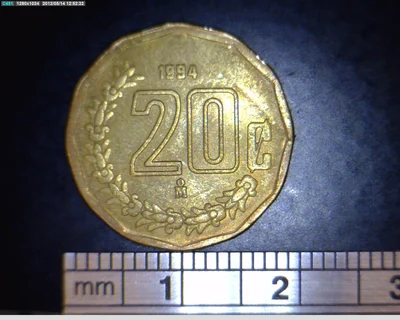
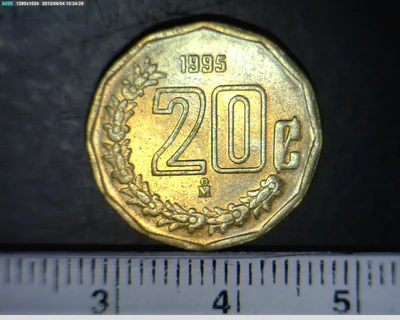
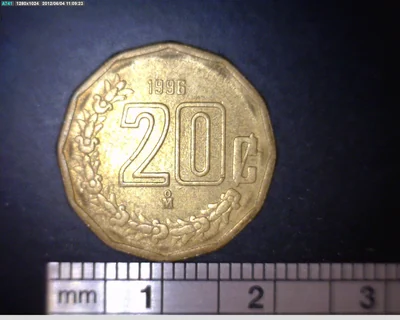
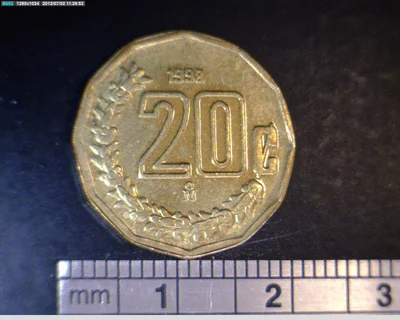
20 centavos Aluminio-bronce · 20 Centavos Bronce Aluminio
Frequently asked questions
How much is a 1997 Mexican 20 centavos coin worth?
A circulated one is worth its face value, 20 centavos. An uncirculated, well-preserved example runs about 9 to 10 pesos among collectors, roughly 0.50 to 1 USD, per the Numista catalog. The year alone adds no premium, since 1997 saw nearly 179 million struck.
Is the 1997 20 centavos coin rare?
No. With 178,807,000 pieces struck in 1997 alone, and tens of millions every year of the series, it is very common. Its rarity index is among the lowest in the catalog.
Is the 1997 20 centavos made of silver?
No. It is aluminum-bronze, an alloy of copper, aluminum and other metals. It contains no silver or gold, so it has no melt or precious-metal value.
How can I tell if my 1997 20 centavos is worth more because of an error?
Only a genuine, verifiable mint error raises the price: a double strike, strong off-center strike, wrong planchet, or die rotation. Compare yours to a normal coin. If you don't see a clear, obvious anomaly, it's a standard piece worth face value.
Conversation
0 comments
Sources
- Ejemplar de la Coleccion Numismatica Banco de Mexico . inv. 20034
- Ejemplar de la Coleccion Numismatica Banco de Mexico . inv. 20033
- Ejemplar de la Coleccion Numismatica Banco de Mexico . inv. 20035
- Ejemplar de la Coleccion Numismatica Banco de Mexico . inv. 20036
- Ejemplar de la Coleccion Numismatica Banco de Mexico . inv. 20037
Images for informational and educational purposes, attributed to their original source. Reference values; the real price depends on the grade, the specific variant and demand.
Loading comments…