
100 Pesos Carranza 1990: Value & What It's Really Worth
Prices updated: August 2026
Old peso era · Carranza · Aluminum bronze
Old peso era · Carranza · Aluminum bronze
Design
Banxico
Reverse
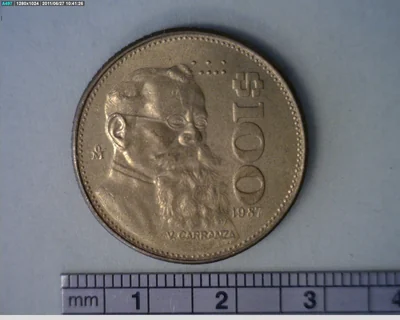
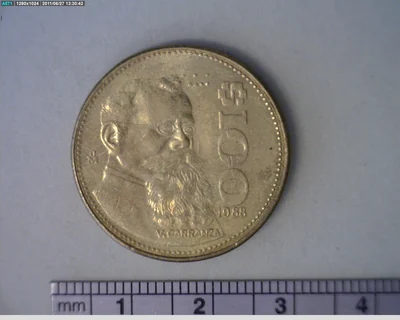
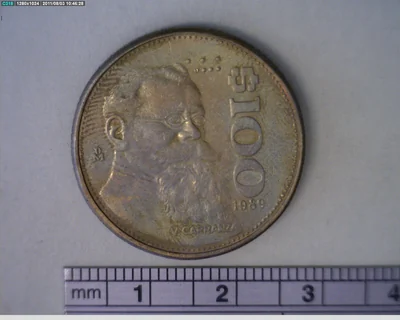
Bust of Venustiano Carranza in three-quarter view facing right, with the legend "V.CARRANZA". To one side, the value "100" on a diagonal, the "Mo" mint mark (Mexican Mint), the year "1990" and the Braille dots representing 100. The obverse bears the National Coat of Arms (eagle atop a nopal cactus devouring a serpent) with the legend "ESTADOS UNIDOS MEXICANOS".
Obverse
Mexican National Coat of Arms with the inscription "ESTADOS UNIDOS MEXICANOS".
How much is the 100 Pesos Carranza 1990: Value & What It's Really Worth worth?
The market value of the 100 Pesos Carranza 1990: Value & What It's Really Worth is not yet documented with enough data to give a firm range. Weigh and measure your piece, compare it against the specifications, and check the forum for a second opinion.
The real price depends on four factors: the grade of preservation (a circulated piece is worth the low end of the range; an uncirculated one, or one still in its official blister pack, the high end), the finish (satin vs mirror/proof), the rarity within the series based on the mintage, and the metal spot price on the day of the deal when the piece is silver or gold. Check the value-by-grade table above and compare with equivalent pieces before buying or selling.
Where to buy or sell this coin?
Browse the national directory of numismatic shops or the community forum to trade directly with other collectors.
Description
If you inherited or found a 1990 Mexican 100 Pesos Carranza coin, here is the honest answer: a normal circulated example is worth a few cents to about 1 US dollar, and an uncirculated one runs around 2 USD. The viral posts claiming it is worth 180,000 or 220,000 pesos are talking about rare mint-error versions, not the standard coin most people have.
This is one of the most heavily minted Mexican coins of its era, so scarcity is not on your side. What follows is what the coin is, what it actually sells for, and how to tell if you happen to have one of the rare error pieces that genuinely fetch real money.
What this coin is
The 100 Pesos Carranza is a bronze-aluminum coin struck at the Casa de Moneda de México (the Mexican Mint). The reverse shows the bust of Venustiano Carranza, a central figure of the Mexican Revolution, facing right, with the legend V. CARRANZA, the mint mark Mo, and Braille dots. The obverse carries the Mexican national coat of arms (an eagle on a cactus devouring a serpent).
This is old-peso money. It belongs to the last cycle of the pre-1993 peso, before Banxico introduced the Nuevo Peso and dropped three zeros from the currency. The coin was demonetized on November 15, 1995, so it is no longer legal tender and cannot be exchanged at a bank. Its only value today is as a collectible.
Specifications
| Feature | Detail |
|---|---|
| Metal | Bronze-aluminum (92% copper, 6% aluminum, 2% nickel) |
| Weight | ~11.9 g (official spec ~11.97 g) |
| Diameter | 26.5 mm |
| Thickness | ~2.8 mm |
| Edge | Segmented reeded |
| Mint | Casa de Moneda de México (Mo) |
| Mintage (1990) | 248,350,000 |
| Precious metal | None |
Note the metal: there is no silver or gold here. Bronze-aluminum has no bullion value, so the coin will never have a melt-value floor the way a silver piece does. If you are checking whether your Mexican coins are silver, this is not one of them.
What it's actually worth in 2026
A normal, circulated 100 Pesos Carranza is worth a few cents to about a dollar. An uncirculated (UNC) example with the original bronze-aluminum luster intact runs closer to 2 US dollars. Numista lists it at roughly 34 pesos in UNC condition, which is about 2 USD.
Condition is the only real lever on price for the standard coin. Most examples circulated hard and came back worn, so a bright, uncirculated piece is the most desirable version of a very common coin. Even so, do not expect more than pocket-change money for a normal specimen in any grade.
Is it rare? No
The mint struck 248,350,000 of these in 1990 alone. Across the full 1984 to 1992 Carranza series, production topped 2 billion coins. This is one of the easiest Mexican coins to find in decent shape. Rarity is not what makes any version of it valuable.
The "worth 180,000 pesos" myth
The eye-catching numbers you see online, 180,000 or 220,000 pesos, come from viral posts describing mint-error coins: double strikes, off-center strikes, or mules (a coin struck with mismatched dies). A normal, error-free 100 Pesos Carranza does not sell for anything close to that.
Before you get excited, the question is whether your specific coin has a real, verifiable minting error, not just wear, damage, or a common die crack. Errors that command serious money are dramatic and consistent, and they need authentication to sell for real prices. The overwhelming majority of these coins have no error at all.
How to check what yours is worth
- Confirm it's genuine. Weigh it (should be near 11.9 g) and measure it (26.5 mm). Check that the reverse shows the Carranza bust facing right, the V. CARRANZA legend, the Mo mint mark, and Braille dots, with the national coat of arms on the obverse.
- Grade the condition. Is it worn smooth, or does it still have sharp detail and original luster? Only high-grade, near-UNC pieces bring even a small premium.
- Look for a real error. Compare against known documented errors. If you think you have a double strike or a mule, get it authenticated before assuming it is worth a fortune.
- Set expectations. For a normal coin, this is a low-value collectible, not a payday.
Where to sell it
Because the coin is so common, prices are low unless yours is uncirculated or carries a documented, authenticated error. You can browse the Pesoteca shop directory at /tiendas to find dealers and collectors. For anything you suspect is an error coin, professional authentication is worth the cost before you list it.
Have one sitting in a drawer and not sure if it's just wear or an actual error? Post clear photos of both sides in the Pesoteca forum and let the community weigh in before you sell.
Historical context
Circulating Mexican peso coins from the second half of the 20th century were struck in alloys that changed with the cost of metals and inflationary processes: .720 silver in the $1, $5, $10, $25 denominations during the 1940s-50s; cupronickel from the 1970s; aluminum bronze and stainless steel in the 1980s; pieces with historical figures (Hidalgo, Cuauhtemoc, Juarez, Madero, Carranza, Sor Juana) in the late 1980s just before the transition to Nuevos Pesos in 1992. 1990 corresponds to the period when this variant was in circulation. Venustiano Carranza, constitutionalist leader of the Revolution, appears on circulating $100 denominations of the 1980s.
This piece belongs to the era
México Moderno (pre-1992) →Explore all the Mexican coins of this era, their historical context and how they connect to the monetary system of the period.
Value range of this piece
Value range without enough data for this piece.
See the full breakdown by grade (VG, F, VF, EF, AU, MS-60, MS-63, MS-65) for the whole series →
Other denominations from 1990
100 Pesos Bronce Aluminio · Aluminio-bronce
Same denomination, other years
100 pesos Aluminio-bronce · 100 Pesos Bronce Aluminio
Official sources
Frequently asked questions
How much is the 1990 100 Pesos Carranza coin worth?
A normal circulated example is worth a few cents to about 1 US dollar. An uncirculated one runs around 2 USD (Numista lists it near 34 pesos in UNC). The high figures you see online refer to rare mint-error coins, not the standard piece.
Is the 100 Pesos Carranza 1990 rare?
No, it is very common. The Mexican Mint struck 248,350,000 in 1990 alone, and more than 2 billion across the 1984 to 1992 series. It is easy to find in good shape.
Is this coin made of silver or gold?
Neither. It is bronze-aluminum, an alloy of 92% copper, 6% aluminum, and 2% nickel. It contains no precious metal, so it has no melt or bullion value.
Why do some sites say it's worth 180,000 or 220,000 pesos?
Those figures come from viral posts about mint-error coins such as double strikes or mules. A normal, error-free coin is not worth that. Check whether your piece has a real, verifiable, authenticated error before believing the number.
Conversation
0 comments
Sources
Images for informational and educational purposes, attributed to their original source. Reference values; the real price depends on the grade, the specific variant and demand.
Loading comments…