
10 Centavos 2013 Stainless Steel: What It's Worth
Prices updated: August 2026
Centavos stainless steel 2013.
Centavos stainless steel 2013.
Design
Banxico
Reverse
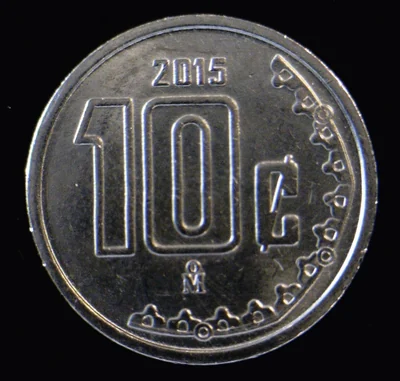
Value "10¢" at the center, with the date (2013) above and the mint mark "Mo" (Mexico City) below, framed by a partial border of stylized solar rays taken from the Ring of Sacrifice of the Sun Stone (Aztec calendar). Small stainless-steel version, family D, KM#934.
Obverse
Obverse with the Mexican National Coat of Arms and the legend "ESTADOS UNIDOS MEXICANOS" per the official convention. Struck by the Mexico City Mint under Banxico decree.
How much is the 10 Centavos 2013 Stainless Steel: What It's Worth worth?
The market value of the 10 Centavos 2013 Stainless Steel: What It's Worth is not yet documented with enough data to give a firm range. Weigh and measure your piece, compare it against the specifications, and check the forum for a second opinion.
The real price depends on four factors: the grade of preservation (a circulated piece is worth the low end of the range; an uncirculated one, or one still in its official blister pack, the high end), the finish (satin vs mirror/proof), the rarity within the series based on the mintage, and the metal spot price on the day of the deal when the piece is silver or gold. Check the value-by-grade table above and compare with equivalent pieces before buying or selling.
Where to buy or sell this coin?
Browse the national directory of numismatic shops or the community forum to trade directly with other collectors.
Description
If you found a Mexican 10 centavos coin dated 2013 and hoped it was worth a fortune, here is the honest answer: in circulated condition it is worth its face value, roughly a quarter of a US cent, and even a flawless mint-state example tops out around 4 Mexican pesos (about 20 US cents). This is one of the most common coins Mexico ever struck. Below we explain why, and we dismantle the viral "edge error worth thousands" claim.
What this coin actually is
The 10 centavos 2013 belongs to the Banco de México "Familia D" series. It is the small stainless steel version that replaced the larger type in 2009. This is the coin almost everyone in Mexico has carried in their pocket.
Specs, exactly as issued:
- Metal: stainless steel (16% to 18% chromium, plus trace nickel). No silver, no gold, no intrinsic metal value.
- Weight: 1.755 grams
- Diameter: 14 mm
- Edge: a perimeter groove around the rim (this is a factory design feature, not damage and not an error)
- Obverse: the Mexican National Coat of Arms (eagle on a cactus)
- Reverse: the value "10¢" in the center, the date above, the mint mark "Mo" below (Mo stands for the Mexico City Mint, the Casa de Moneda de México), framed by a partial border of sun rays taken from the Ring of Sacrifice on the Piedra del Sol, the Aztec calendar stone.
If your 2013 coin measures 17 mm and weighs about 2.08 grams, look again. The large type was discontinued before 2013, so a genuine 2013 should be the 14 mm small version.
How much is it worth?
Nothing rare here. The Banco de México struck 399,143,000 ten-centavo pieces in 2013. That is nearly 400 million coins, so scarcity is not on your side.
| Condition | Realistic value |
|---|---|
| Circulated (worn, from pocket change) | Face value: 10 centavos (about a nickel is generous) |
| Uncirculated / mint state (flor de cuño) | Around 4 Mexican pesos, roughly 20 US cents |
"Flor de cuño" is the Spanish term for a coin in pristine, never-circulated condition. Even at that grade, this coin sells more as a curiosity than as a scarce item. There is no silver or precious metal to give it a floor, so it will never carry a bullion value.
The "edge error worth thousands" myth
You have probably seen listings claiming this coin is worth 40,000 or even 800,000 pesos because of an "error" on the edge. That is false.
The perimeter groove on the rim is a deliberate design element of the entire Familia D series. The Banco de México confirmed this when the coins launched: they left the mint that way on purpose. Numismatic specialists have flatly called the inflated listings a hoax. Any price of thousands of pesos for a common circulation coin is a red flag, not an opportunity.
Real minting errors (major off-center strikes, doubled dies, wrong planchets) can carry value, but they are genuinely rare and must be verified in hand by a specialist. What circulates online as the "edge error" is simply the normal design.
How to tell if yours is genuine
Check the three basics:
- Weight close to 1.755 grams
- Diameter of 14 mm
- Edge with the perimeter groove (not smooth, not standard reeding)
Stainless steel does not rust like iron, so heavy corrosion is a warning sign. If your coin falls well outside these measurements, examine it under a loupe or have it checked.
Where to buy or sell
Because it is so common, the circulated version has no real market beyond face value. If you want a mint-state example or you are building the complete Familia D set, skip the inflated resale-platform listings and work with a reputable dealer. See the Pesoteca store directory to find trusted numismatic shops. You can also browse the complete 10 centavos stainless steel series to see how it fits with the rest of the family.
Think you have a real error and not just the standard edge groove? Post clear photos in the Pesoteca forum and let collectors weigh in before you trust any online price.
Historical context
This 10-centavo piece from 2013 belongs to the family B without the N$ prefix issued by Banxico. The 10 centavos is the most-used fractional step in Mexico. It appears when paying cash for odd prices and as change in supermarkets, tortillerias, and pharmacies. Its national-eagle + denomination + year face is one of the most familiar to the ordinary Mexican.
Stainless steel made it resistant to corrosion and cheap to mint. The piece replaced the copper-nickel that earlier generations had under the old peso system.
In 2013 annual inflation closed at 4.0% according to INEGI, and the average exchange rate was 12.77 pesos per dollar according to Banxico's FIX. It was the year of the Pacto por Mexico and of the structural reforms: energy, telecommunications, education, and fiscal. Banxico cut the reference rate from 4.5% to 3.5%. The country was under the Presidency of Enrique Peña Nieto (PRI).
Catalog reference: Krause to be confirmed. The piece is part of the official Banxico Numismatic Collection catalog and follows the convention of the PSM System, one ID per distinct physical piece, not per design shared with other years of the same series.
This piece belongs to the era
Nuevos Pesos y actualidad →Explore all the Mexican coins of this era, their historical context and how they connect to the monetary system of the period.
Value range of this piece
Value range without enough data for this piece.
See the full breakdown by grade (VG, F, VF, EF, AU, MS-60, MS-63, MS-65) for the whole series →
Same denomination, other years
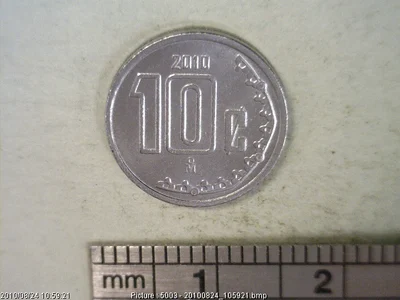
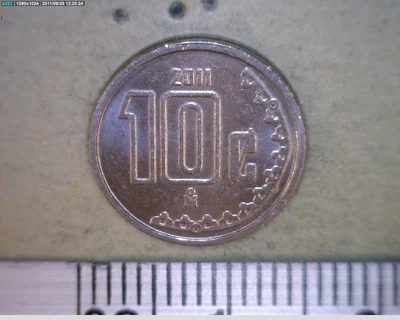
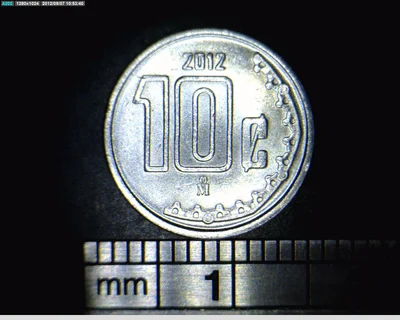
10 centavos Acero inoxidable · 10 Centavos Acero Inoxidable
Frequently asked questions
How much is a 2013 Mexican 10 centavos coin worth?
Circulated, it is worth its face value of 10 centavos, a fraction of a US cent. It is extremely common: the Banco de México struck 399,143,000 pieces in 2013. In uncirculated mint state, numismatic catalogs place it around 4 Mexican pesos (roughly 20 US cents), and that is the most you should expect except in very specific cases.
Is the 2013 10 centavos coin rare or valuable?
No. With nearly 400 million coins minted in 2013, it is one of the most common Mexican coins in circulation. It contains no silver or precious metal (it is stainless steel), so it has no intrinsic value. The only mild premium is for pristine uncirculated examples, worth cents, not dollars.
Is it true this coin is worth thousands because of an edge error?
No. The groove around the rim is a factory design feature of the entire Familia D series, not a minting error. The Banco de México confirmed this at launch, and numismatic specialists have called the inflated listings (40,000 or 800,000 pesos) an outright hoax. Do not trust those prices for a common circulation coin.
How do I know if my 2013 10 centavos coin is genuine?
Check three things: weight near 1.755 grams, diameter of 14 mm, and the edge with a perimeter groove (not smooth, not standard reeding). Stainless steel does not rust like iron, so heavy corrosion is a warning sign. Any piece that falls well outside these measurements should be examined under a loupe or by a specialist.
Conversation
0 comments
Loading comments…