
En resumen
Grade is the single factor that separates a Mexican coin worth its metal from one worth 10 or 20 times more. Here is how the grading scale actually works in dollars, and how to check a coin yourself before you overpay.
Coin Grading Explained (2026): Why the Same Coin Can Be Worth 15 Times More
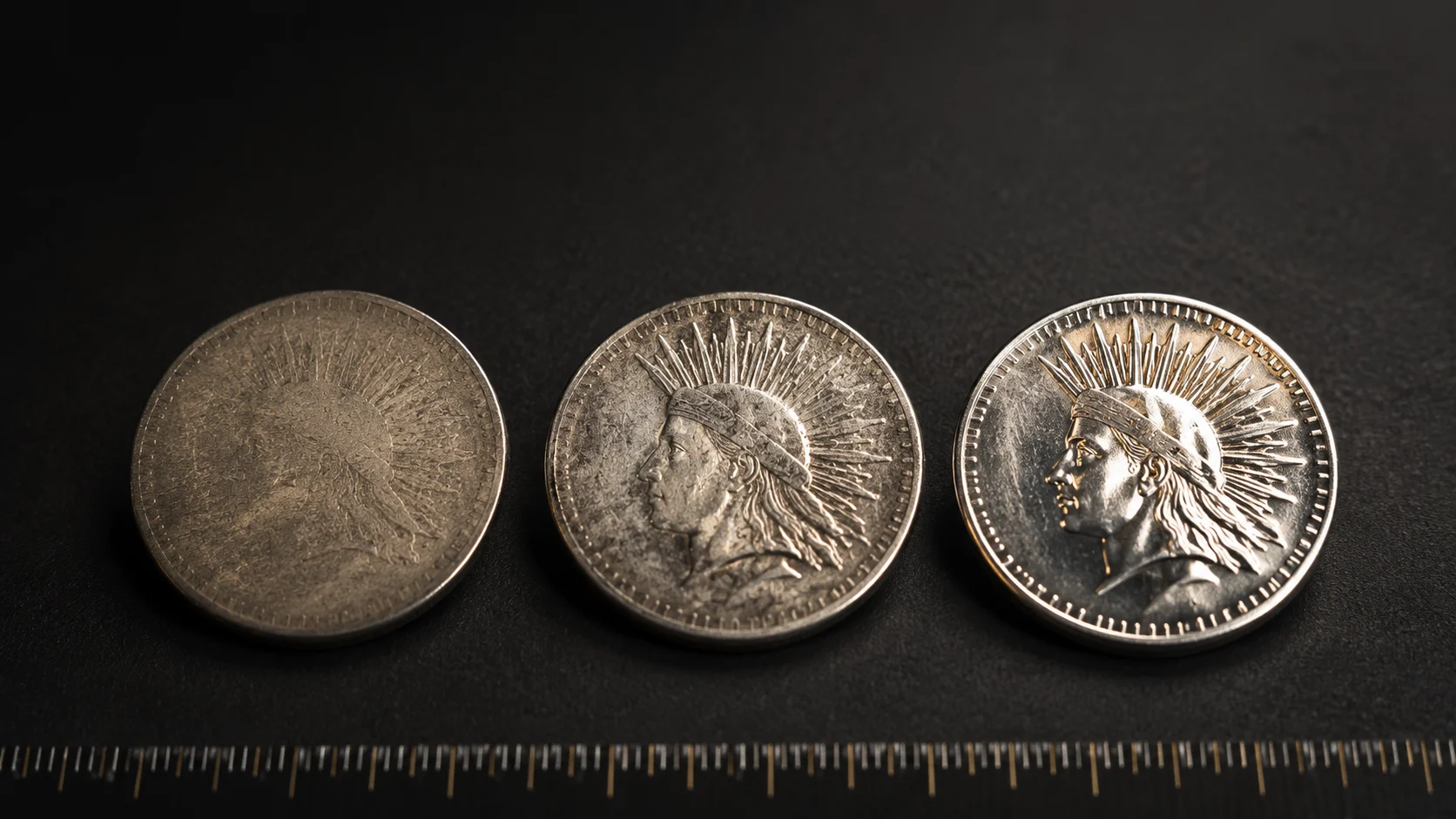
Grade is what separates a common coin worth face value from the identical piece in uncirculated condition selling for 15 times as much. It is not magic, opinion, or "it looks nice." It is a classification system most people misread, and one that sellers exploit to charge a premium.
Here is the honest scale, plus the part that actually matters: how much the real price jumps when a coin moves from one grade to the next, and how to verify the grade yourself before you overpay for a coin that is "supposedly" uncirculated.
Why grade matters more than mintage
Consider two real scenarios. The exact figures vary by coin, but the pattern repeats across the whole Mexican commemorative series:
- A common circulated commemorative coin, pulled from your change: worth face value only.
- The same coin in UNC (uncirculated, original luster): roughly 8 to 15 USD on the collector market.
- The same coin in its original Banco de México blister pack: 13 to 25 USD.
Same coin. Same mintage. Same year. The only thing that changes is the grade.
That is exactly why grade is the favorite lever for dishonest sellers. It is the easiest thing to overstate in conversation and the hardest to defend if you do not know what to look for. "This one is really well preserved" can mean anything from "flawless" to "I didn't scrub it, so call it new."
The Sheldon scale in market language
The Sheldon scale runs from 1 to 70. It was created in the United States and is used by grading agencies like NGC and PCGS. Most casual sellers never talk in Sheldon numbers, but everyone uses the letter abbreviations that derive from it. Here are the ones that matter:
| Grade | Common code | What it means in practice | Does it raise the price? |
|---|---|---|---|
| Poor / Fair | PO, FR | Denomination barely visible, nearly illegible | No, metal floor only |
| Good | G | Design worn but identifiable | No, unless extremely rare |
| Very Good | VG | Main details visible | Slightly, for antique pieces |
| Fine | F | Design legible, even wear | Yes, for serious collectors |
| Very Fine | VF | Clear details, luster gone | Yes, +30% to +80% over common value |
| Extremely Fine | XF (EF) | Nearly all detail, residual luster | Yes, 2x to 5x over common value |
| About Uncirculated | AU | Almost UNC, minimal rub on high points | 5x to 15x over common value |
| Uncirculated | UNC | Never circulated, full mint luster | 10x to 30x over common value |
| Brilliant Uncirculated | BU | UNC with intense luster, no rubs | 15x to 40x over common value |
| Proof | PR | Special mirror strike, never meant to circulate | Different market, not comparable |
That is the full scale. In reality, most of the market operates on four practical grades: circulated, XF, UNC, and proof. The rest is nuance almost nobody distinguishes with the naked eye.
The 4 grades the market actually uses
1. Circulated (F, VF, XF range)
This is your pocket change. It passed through hands, cash registers, piggy banks. It has visible wear, marks, maybe a dark spot. It is worth its metal value if silver or gold, and face value if it is a common alloy.
Example: a bimetallic 1 peso from 2000 pulled from your change today is worth 1 peso. Zero grade premium.
2. Extremely Fine (XF)
Here things change. The coin looks good, with almost all its detail, but it has lost the original luster. It clearly was not heavily circulated, but it went somewhere.
Real example: a 20-peso Belisario Domínguez commemorative (2013) in XF trades for about 5 to 9 USD. The same coin in common circulated condition, 2 to 4 USD. The same coin in an original Banxico blister, 18 to 30 USD.
How to spot it: the luster is matte, not mirror. The high points of the relief (the tip of the nose on the portrait, the eagle's wings) still look complete. The fields (flat backgrounds) may have micro-abrasions invisible to the naked eye but visible under angled light.
3. Uncirculated (UNC)
Never circulated. Never sat in anyone's pocket. The original mint luster is intact. The die detail is perfect. This is the most sought-after condition for serious collectors.
Real example: an Onza Libertad silver ounce from 2020 in UNC trades near the silver spot price plus a small premium. The same coin in its original Banxico blister runs meaningfully higher. The gap between a loose UNC and a blister UNC can be 3x to 4x.
How to spot it: full luster. No rub in the fields. The coin should look like it just left the die. This is where roughly 90% of the market lies: "UNC" often means "AU photographed under soft light," not real UNC.
4. Proof
A special strike. The coin is struck two or three times with mirror-polished dies on selected planchets. The result is mirror fields and frosted relief. It was never designed to circulate.
Real example: the 12 coins of the 2026 World Cup series have proof versions in gold and silver. The proof version does not compete with the BU version; they are separate markets. Comparing a proof price to a UNC price is like comparing a limited-edition vinyl to a CD.
How to spot it: the fields are mirror (you can see your reflection). The relief is frosted matte. They usually come in a sealed acrylic capsule from Banxico. Touch a proof with your fingers and it drops a grade instantly.
The #1 buyer mistake: confusing XF with UNC
This is the mistake that costs the most, and the reason online marketplaces fill up with complaints after the sale.
Quick test to know if a coin is truly UNC:
- Tilt the coin under angled light. If you see a single micro-rub in the fields, it is not UNC. It is AU at best.
- Check the high points (nose on the portrait, eagle's wings, top letters). If they are matte while the rest shines, the coin touched something. Not UNC.
- Count the marks. A true UNC can have bag marks (from the mint's coin bags) but not circular rubs. Circular rubs signal circulation.
- If it comes with no blister, be suspicious. Banxico ships collectible releases in blister packs. A loose "UNC" from the same year can be anything from AU to true UNC.
State the rule plainly: you pay for the grade, not the packaging.
How much the price jumps by grade, with real cases
Ballpark figures for the current market, not promises. The specific coin rules:
| Scenario | Grade | Typical price (USD) |
|---|---|---|
| Recent commemorative 20 peso from change | Circulated | Face value |
| Same coin XF, no blister | XF | 3 to 7 |
| Same coin in original Banxico blister | UNC | 13 to 27 |
| Recent silver Onza Libertad | Circulated | Silver spot |
| Same coin loose UNC | UNC | Spot + 15 to 27 |
| Same coin in original Banxico blister | UNC-BU | Spot + 45 to 80 |
| Restruck gold Centenario (post-1970) | Circulated | Gold spot |
| Original gold Centenario (1921 to 1931) | UNC | Spot + 20% to 40% |
One caveat: grade does not create value in a coin that never had any. A modern 10-centavo coin in UNC is still worth 10 centavos. Grade multiplies the value of coins that are already collectible for their scarcity, history, or metal. It does not turn your change into gold.
Myths worth burying
"It's really clean, so it must be UNC"
No. The opposite. A used-market coin that "looks very clean" was almost always cleaned with something (lemon, cola, metal polish, a brush). Cleaning destroys 100% of the collectible value. A true UNC is not "clean," it is untouched.
"The seller told me it's UNC"
The seller has no grading protocol. Sellers slap "UNC" on AU or XF coins because the word raises the price. Verify it yourself with the criteria above before paying a grade premium.
"It's in a blister, so it's UNC"
False. There are genuine Banxico blisters (with issue codes), blisters repackaged by third parties, and circulated coins dropped into loose blister packaging. A blister seals the coin in whatever state it was when sealed. That can be UNC, or it can be a well-photographed circulated coin.
"It's from year X, that alone makes it valuable"
The year matters less than the condition. An original 1921 gold Centenario in circulated grade is worth less than a 1925 Centenario in UNC, even though 1921 is the first of the series. Year scarcity is one component. Condition is the multiplier.
Grades the serious agencies use: NGC and PCGS
Once a coin becomes valuable (roughly 250 USD or more), it is often sent for certification to agencies like NGC (Numismatic Guaranty Company) or PCGS (Professional Coin Grading Service). They return the coin in a sealed holder with a numeric Sheldon grade (for example MS-65 or PR-68).
- MS = Mint State, equivalent to UNC (60 to 70 on the Sheldon scale)
- PR = Proof, for special strikes
- AU = About Uncirculated (50 to 59)
- XF = Extremely Fine (40 to 49)
Certifying a coin costs roughly 40 to 100 USD per coin plus shipping. It only makes sense for coins that already trade high. Certifying a recent circulated Onza Libertad is not worth it. Certifying a 1980 Onza Libertad in supposed UNC can make sense, because the price gap between certified and uncertified UNC usually covers the cost.
At the formal market level, almost all Mexican coins selling above about 1,000 USD at auction come with NGC or PCGS certification. Without it in that range, buyers arrive with a loupe and a discount.
Estimating surviving pieces by grade
Here is the honest problem: there is no hard data on how many pieces survive today in each grade. Neither Banco de México nor the Mint publishes it. All we know officially is the mintage of each coin (how many left the factory), not how many still exist or in what condition.
What can be estimated by series, using market evidence:
- Common mass-circulation series (regular 5, 10, 20 peso coins): most live in circulation or in piggy banks. True UNC represent under 5% of the mintage based on what surfaces at auction and in collector groups.
- Commemorative series in Banxico blisters (20-peso commemoratives, 2026 World Cup): the blister-sold fraction survives better. Group estimates: 30% to 60% remain in UNC, depending on how many were bought to collect versus to flip.
- Silver Onza Libertad: most are held as investment. Estimate: over 70% remain UNC because they do not circulate by design.
- Antique series (Caballito 1910, Cuauhtémoc 1947, 19th-century pieces): the UNC sample is so small that pieces are counted individually, not by percentage. Each certified UNC is an auction event.
When someone tells you "only 200 of these survive in UNC worldwide," ask for the source. If it is an NGC or PCGS census, that is data. If it is "a friend told me," it is smoke.
Checklist before paying a grade premium
If you are about to pay more than 3x the common price for a coin because it is "UNC," do this first:
- Request macro photos of obverse, reverse, and edge under angled light, not flat light.
- Compare the high points (nose on the portrait, top letters) against a published image of the coin in uncirculated condition. If they are matte where they should shine, it is not UNC.
- Verify the blister if applicable. Genuine ones have an issue code, clean thermal sealing, and sometimes a printed Banxico logo.
- Ask about provenance. A coin held by the owner for 20 years since a bank exchange is more credible than "just bought from a lot."
- Get a second opinion on the Pesoteca forum before closing. Post the photos and the community will tell you whether the grade holds up.
- If the amount is high (over about 500 USD), request NGC or PCGS certification. Without it in that range, the coin is worth whatever the buyer chooses to believe.
Where this leaves you
Grade is not the holy grail, but it is the quiet multiplier that separates the coin you pull from your change from the one you pay 15 times more for. And because it is the easiest thing to exaggerate, it is where the market lies most.
If you have a coin and cannot tell whether it is XF or UNC, post macro photos on the Pesoteca forum with obverse, reverse, and edge. Angled light reveals the details that vanish in a flat photo. We will help you check the real grade, not the one you were sold.
Do you already have your own rule for telling XF from UNC apart? Tell us in the forum how you verify it. It helps build a sharper guide for anyone just starting out.

Loading comments…