
En resumen
Mexico's commemorative silver coins are no longer reaching regular buyers. Lines of 200 for 50 coins, resellers charging 150% over melt, and months of silence from the central bank. Here is how the market broke.
Most people assume you can just walk into a bank in Mexico and buy the country's newest commemorative coins at face price. In 2026, that is rarely how it works. The World Cup silver ounces, released through BBVA branches, sold out in hours and reappeared on Facebook the same afternoon at a 40 percent markup. Here is how Mexico's official coin distribution funnels collectors straight into the hands of resellers.
What happened at the BBVA branch on launch day
The Mexican Mint (Casa de Moneda de México) and the central bank (Banxico) released commemorative pieces for the 2026 World Cup through just six BBVA branches: four in Mexico City, one in Guadalajara, one in San Pedro Garza García.
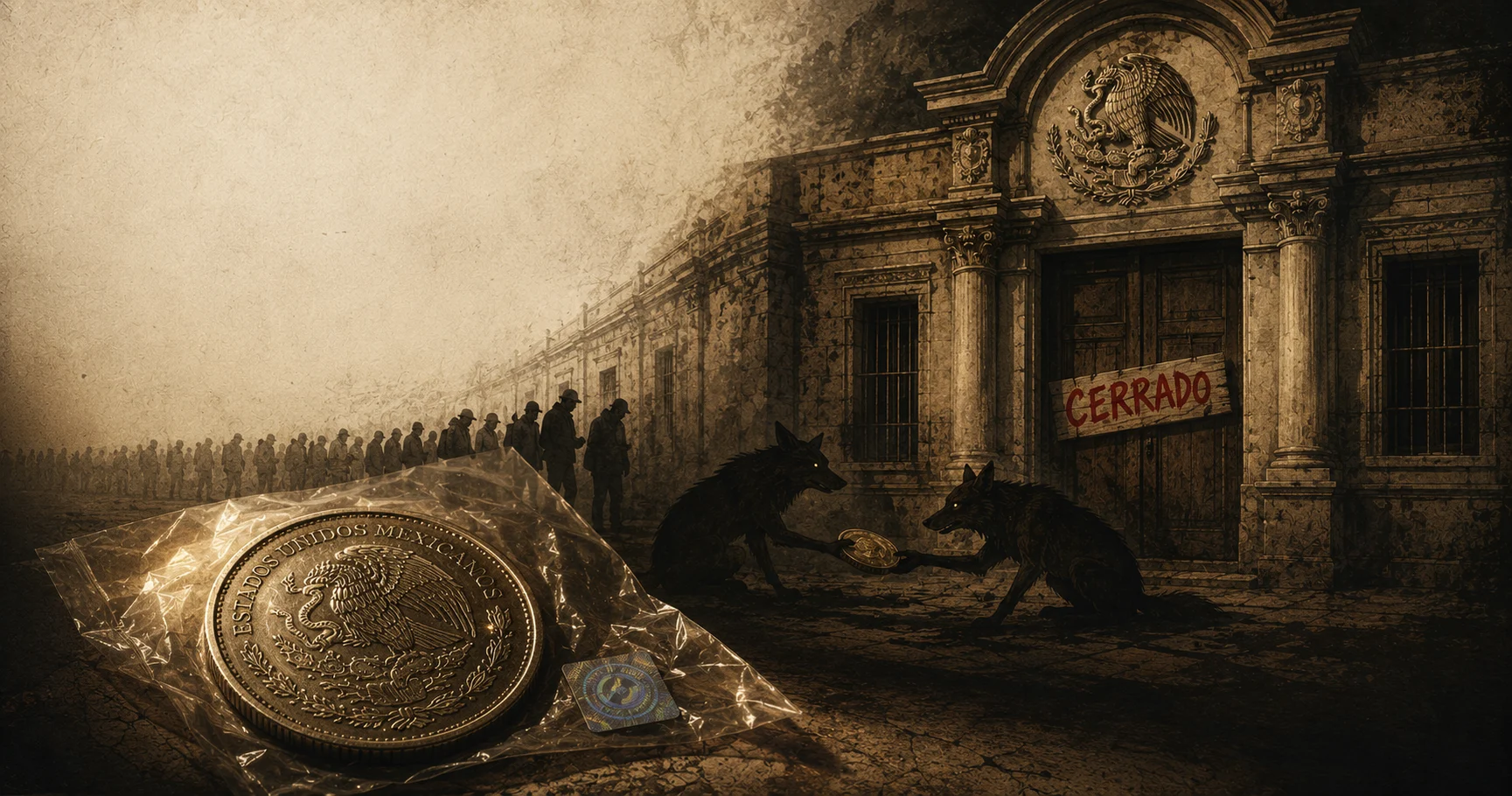
The launch landed on the same day as the World Cup opening match. No public price announcement. No published quota per branch. No list of which models each branch would stock. People started lining up on Paseo de la Reforma the day before. By 6:30 a.m. the queue was already deep, and someone at the front, not a bank employee, had taken over an improvised sign-up list.
When the doors opened at 8:30, the line barely moved. By the time the first buyers came out, the terms were clear:
- Three models available (Mexico City, Guadalajara, Monterrey; the Triple-Host Jaguar piece was missing)
- One coin per person
- 3,500 pesos each (roughly 190 US dollars at the time), in a week when silver spot was around 1,400 pesos per ounce
- Stock ran out after roughly 50 to 60 buyers, while more than 200 people waited
Meanwhile, resellers on Facebook were already offering those exact three coins at 5,000 pesos (about 270 US dollars) with same-day delivery.
The man controlling the line was not managing the crowd for the bank's benefit. He was protecting his own spot near the front so he could buy and resell. That is the whole model in one image.
The real problem is upstream, not on the sidewalk
The branch is the last link in a chain that starts much higher, at Banxico and the Mexican Mint, in how they decide to produce, distribute, and communicate pieces that are supposed to be national cultural heritage. The institution that mints, safeguards, and should promote Mexican numismatics operates with enough opacity that the only reliable route for the public ends up being the reseller.
On launch day itself, the Mexican Mint posted an infographic of its four official distribution steps: minting, certification, distribution to banks, and the mint mark as a guarantee seal. A collector summed it up in the comments:
"The last step is missing... The reseller pipeline." (Coleccionismo Ramirez AGS)
No response from the Mint. The thread below that post ran more than 20 comments from Mexican collectors telling their own institution, to its face, what everyone already knows.
Six months trying to buy five catalog pieces, still empty-handed
This is not about rare coins. This is about the public catalog the Mexican Mint itself publishes as a PDF so collectors can request a quote.
On February 11, 2026, we emailed Banxico's Numismatic Commercialization Office with a list of five standard catalog products: a 5-peso Independence and Revolution collector frame, three 100th Anniversary banknotes in cardboard cases, and three separate 20-peso commemoratives (Plan Marina 50th, Plan DN-III-E 50th, and the Constitution Centennial). Just a quote and availability. No discounts, no special treatment.
Banxico replied on May 4, almost three months later. The reply included no prices, no availability, nothing resembling a quote. It asked for a full name, a Tax Situation Certificate (Constancia de Situación Fiscal) issued within the last three months, and the product list again.
Requiring a recent Tax Situation Certificate filters out the student, the retiree without an active tax ID, the salaried worker who has never needed that document. It filters out most of the people who simply want a 400-peso commemorative piece. And because the certificate expires quickly, if the next reply takes another 82 days, you start over. It is a loop built to exhaust you before you ever get a price.
The five pieces are still not bought.
The math behind selling a spot in line
The reseller's arithmetic is simple:
| Step | Cost per coin (pesos) | Notes |
|---|---|---|
| Buy at BBVA counter | 3,500 | Public price |
| Pay someone to hold the line | 500 | Optional |
| Sell on Facebook | 5,000 | Same-day delivery |
| Net margin | ~1,000 | After paying a line-holder |
If a reseller has a contact inside Banxico who buys at the internal employee price of 2,071 pesos through the official form, the margin doubles again. And if you control the order of the line yourself, as happened on Reforma, you skip the line-holder entirely: you queue, you buy, and you make sure nobody ahead of you undercuts your resale.
Two days later, a collector wrote on the Mint's page:
"And who decides to hand them to the resellers who pay vagrants to hold spots on Reforma? Who tips them off, and who are they colluding with? They never announced the FIFA coins on social media the way they said they would, and today the resellers already sell them." (Carolina Laius)
No official statement came out that day. Not from BBVA, not from Banxico, not from the Mexican Mint. No consolidated figures on how many pieces sold at each of the six branches, no date for the next batch, no schedule for the other banks that were promised distribution (HSBC, Santander, Banamex, Banorte, Banco Azteca, Banregio, Multiva). Only silence, while the entire conversation moved to closed Facebook groups where the coin already had a firm price and guaranteed delivery.
Bank tellers are part of it too
Hoarding does not start with the reseller on the curb. It starts inside the banks. One collector wrote:
"The bank tellers themselves are denying they have the 20-peso World Cup commemoratives, but they pull them and sell them at 50 pesos, and these are barely about to circulate." (Rigoberto Gonzalez Piña)
If you have tried to collect the bimetallic commemoratives by asking for change at a teller window, you know the line: "we don't have any, they haven't arrived, come back another day." They do arrive. They just do not reach the counter. The teller identifies them, sets them aside, and they surface in informal channels at 50, 80, 100 pesos each.
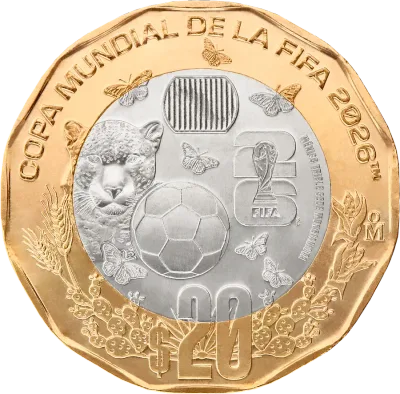
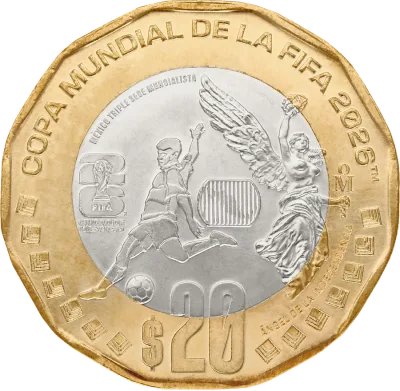
Official figures put the 20-peso Jaguar bimetallic mintage at 22 million. In practice, if only 1 percent reaches the ordinary public after Banxico, the banks, the tellers, and the resellers take their cut, that is 220,000 in circulation. That number matches what you see in Facebook trades far better than the official mintage does.
There is no online store, and that is the root of it
The most useful comment in the thread:
"There is resistance from the Mint to online sales, the way the Royal Mint does it, which would let collectors in the rest of the country acquire pieces." (Rigoberto Gonzalez Piña)
Compare the systems:
| Mint | Buy online | Ships to your home | Handles high demand |
|---|---|---|---|
| The Royal Mint (UK) | Yes, live stock | Yes | Standard e-commerce |
| United States Mint | Yes | Yes | Lottery system when stock runs short |
| Casa de Moneda de México | No | No | PDF forms, 82-day email replies |
At cmm.gob.mx you can download catalogs, fill out forms, wait 82 days for a reply asking for your tax certificate, wait another 82 days for the next one, and eventually buy nothing.
Geography makes it worse. The six BBVA branches were four in Mexico City, one in Guadalajara, one in San Pedro Garza García. If you live in Mérida, Querétaro, Aguascalientes, Hermosillo, Veracruz, Tijuana, or Cuernavaca, your only real option to complete the 2026 World Cup set is paying the reseller who actually ships nationwide. Official distribution excludes you by location.
This is not new
The World Cup case is the most visible, but the pattern was already documented.
"The silver dinosaur medal collection sold out very fast and reappeared at three times the price among resellers." (Rigoberto Gonzalez Piña)
Limited distribution, fast sellout, near-immediate appearance on the secondary market at 3x the official price. Same script, different series.
And the historical contrast that stings most:
"The silver coins from the Mexico 86 World Cup were sold even at newsstands. One came out every few days. And NOW NOT A SINGLE BANK HAS THEM. Only resellers." (Nacho VM)
In 1986, World Cup silver was sold at newsstands. In 2026, only resellers have it. Institutional distribution got worse over 40 years, not better. The fixes are not exotic: an online store, a public calendar published 60 days ahead, a lottery when demand exceeds stock, certified nationwide shipping, and a public audit of internal sales to Banxico employees. All of it is already running at the Royal Mint, the US Mint, and the Spanish and Argentine mints. The Mexican Mint has been striking coins for 480 years and still does not run an e-commerce site. That is not a technical limitation. It is a choice.
What you can do
If you went to one of the six BBVA branches on June 11 or 12, tell us in the forum: what time you arrived, where you landed in line, whether you got a coin, at what price, and which models were available. We are assembling the real distribution timeline, branch by branch, because Banxico, BBVA, and the Mint would not publish it.
If you have a documented email exchange with the Numismatic Commercialization Office, share it too. Cross-referenced with others, the pattern of response times and requirements gets clearer. Institutional opacity loses power as public documentation grows.
And if you ever consider paying 4,000 pesos to a reseller for a piece that officially costs 3,500, think twice. The reseller premium exists because there is demand willing to pay it. If the demand breaks, the model breaks. For context on how the parallel market prices these pieces, see our breakdown of the 2026 World Cup silver ounces and the gray market.
Editorial note: The quoted comments were taken as signed by their authors on the public Facebook page of Casa de Moneda de México. The emails with the Numismatic Commercialization Office are correspondence between a citizen and a public institution, with no third-party personal information. The BBVA branch line report from June 12, 2026 is a first-hand account. If you authored one of the quoted comments and prefer it anonymized, write to us in the forum and we will adjust it.
Loading comments…