
En resumen
How Mexican coins are made, from blank to finished strike, and why the same coin can vary in detail. Plus the mint errors collectors pay a premium for.
Most Mexican coins in your pocket or your inherited box are worth exactly their face value. But coins that escaped the mint with a defect, a doubled strike, an off-center design, a mismatched core, can sell for 5x, 10x, or more once certified. Understanding how these coins are made is the fastest way to spot the ones that matter.
This guide explains the official process: who orders a coin, who physically strikes it, the step-by-step production, and the mint errors that turn an ordinary coin into a collectible. The sourcing comes straight from Banxico Educa, the Bank of Mexico, and the Mexican Mint.
Which mint errors are actually worth money
Before the history, the part US readers came for. When something goes wrong on the press, the coin can slip past quality control and reach circulation. These are the errors collectors chase, and they can multiply a coin's value once slabbed by NGC or PCGS:
| Error type | What it looks like | Why it matters |
|---|---|---|
| Double strike | Ghosted, overlapping relief | The press struck twice; dramatic examples command strong premiums |
| Off-center | Part of the design runs off the blank | The more off-center with a visible date, the higher the value |
| Die clash | Mirrored ghost marks in the fields | Dies struck each other without a blank between them |
| Wrong planchet | Coin struck on a blank meant for another denomination | Rare and highly sought after |
| Loose core (bimetallic) | The center pops out of the ring | Specific to modern 10-peso type coins |
A certified Mexican error coin can sell for 5 to 10 times a normal example, and dramatic cases go much higher. Value depends on how visible the error is, the denomination, and the grade. If you think you have one, do not clean it and get it authenticated before selling.
Who orders a coin vs. who strikes it
Mexico draws a clear line between issuing and minting a coin:
- Issues: the Bank of Mexico (Banxico). It has been the country's monetary authority since 1925 and is the only body legally allowed to put currency into circulation.
- Mints: the Mexican Mint (Casa de Moneda de México), a decentralized agency of the Ministry of Finance and the oldest mint in the Americas, founded in 1535.
Banxico states it plainly:
Since its creation in 1925, the Bank of Mexico has been responsible for issuing the national currency. (...) The minting of coins takes place at the Casa de Moneda, more than 400 years old and administratively dependent on the Ministry of Finance (SHCP). Legal-tender coins are minted only by express instruction of the Bank of Mexico.
Source: Banxico Educa, Manufacturing of banknotes and minting of coins
So who designs the reverse of each coin? Banxico approves the design (proposed by its governing board, sometimes through public competitions), the specifications are published by decree in the Official Gazette (Diario Oficial de la Federación, DOF), and the Mexican Mint executes the physical strike to those authorized specs.
The physical minting process, step by step
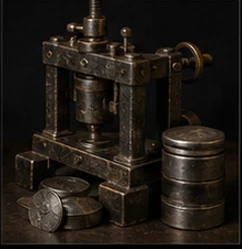
Modern minting at the Casa de Moneda follows a standardized industrial sequence of eight steps:
- Metal selection and alloying. Every coin has a composition fixed by decree: cupronickel, aluminum-bronze, 0.999 silver (the Libertad), 0.999 gold, nickel-plated steel, and so on. The metal is melted in electric furnaces and cast into ingots.
- Rolling. Ingots pass through roller mills until they become strips of the exact required thickness. This step sets the coin's final thickness.
- Blank cutting. A press punches circular discs, called blanks or planchets (in Spanish, cospeles or flanes), out of the metal strip. The blank is the coin before any design.
- Annealing. The blanks are heated to restore ductility after the mechanical stress of cutting.
- Cleaning and burnishing. They are washed with mild acids and polished to remove oxides and prepare the surface for the die.
- Rimming. A machine raises a rim on both faces of the blank. That raised edge protects the design from wear.
- Striking. The blank enters a coining press that hits it simultaneously with two dies (obverse and reverse) under several tons of pressure. In the same motion, a lateral collar imprints the edge (reeded, plain, or lettered).
- Inspection, counting, and packaging. Each coin goes through visual and mechanical quality control. Defective pieces are melted down. Approved coins are packed in sealed bags that Banxico receives and distributes through its vault network and commercial banks.
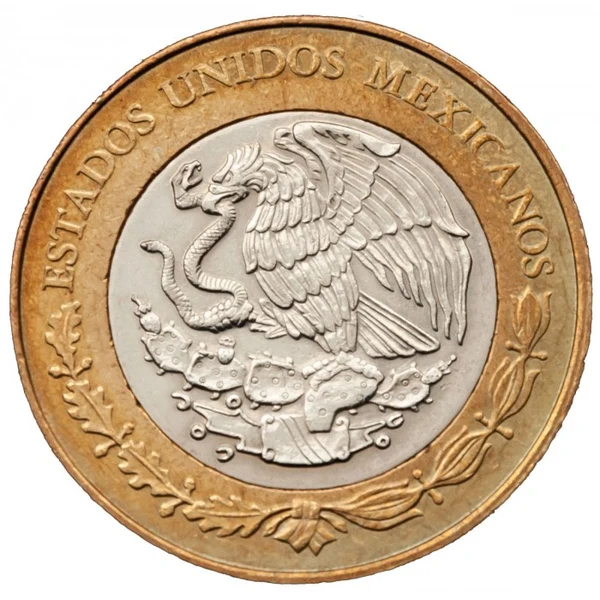
Worth knowing: a bimetallic 10-peso coin needs two concentric blanks, a center core and an outer ring, assembled before they reach the press. That is why you sometimes see coins with a loose core: they are factory errors collectors look for.
Circulation, proof, and special strikes
Not all coins are made the same way. The Mexican Mint distinguishes three main qualities that show up regularly in numismatic certification:
- Circulation quality (BU, Brilliant Uncirculated). Standard industrial striking with fresh blank and dies, no special polishing. This is your everyday pocket coin.
- Satin / proof-like (PL). Polished dies but normal-speed striking. Brighter surface than BU.
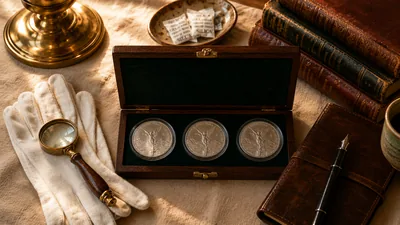
- Proof quality (PR). Hand-polished mirror dies, polished blank, double strike at low speed. Result: mirror-like fields and frosted relief. This is the quality sold in numismatic display cases at higher prices.
Commemoratives (the 1986 World Cup, the 2010 Bicentennial, the 2026 World Cup, and others) are usually issued in both circulation and proof finishes. Proof mintages often run 10 to 1 smaller than circulation versions, which is exactly why the proof examples become the sought-after pieces.
Mint marks, assayer initials, and the 'Mo' symbol
Every coin struck by the Mexican Mint carries the 'Mo' mint mark (an M with a small o above it), a symbol inherited from the colonial period. It confirms the coin was struck in Mexico City and has been in use since 1535. Other historic mint marks appear on older Mexican coins:
| Mark | Mint | Period |
|---|---|---|
| Mo | Mexico City (Casa de Moneda) | 1535 - present |
| Zs | Zacatecas | 1810 - 1905 |
| Cn | Culiacán (Sinaloa) | 1846 - 1905 |
| GoM | Guanajuato | 1812 - 1900 |
| Ga | Guadalajara | 1818 - 1895 |
| Do | Durango | 1811 - 1895 |
| Pi | San Luis Potosí | 1827 - 1893 |
On 19th-century republican coins you will also see the assayer's initials, the official who verified the metal's fineness. "8 Reales 1888 Mo MH" means: eight reales, Mexico City mint, assayer with initials MH. These initials changed with staff and are essential for dating and authenticating pieces.
The legal chain: why Banxico decides
Banxico's authority to order minting comes from the Monetary Law of the United Mexican States (articles 1 and 2-bis) and the Bank of Mexico Law. Every new denomination or commemorative series requires:
- A decree from Congress (for commemoratives, a specific law authorizes the issue).
- Technical specs in the DOF (weight, diameter, fineness, obverse/reverse design, edge).
- An order from Banxico to the Mexican Mint setting volume and schedule.
That is why planning a commemorative typically takes 18 to 24 months from decree to circulation.
The Mexican Mint today
The modern plant operates in San Luis Potosí, running since 1983. The traditional site in Mexico City's historic center is preserved as a museum. The mint strikes not only Mexican coinage but also coins for other countries under contract, making Mexico an exporter of minting services.
Current production lines include:
- Circulation coinage of the C and C1 families
- Gold Centenarios and gold and silver Onza Libertad coins (.999 fine)
- Silver and aluminum-bronze commemoratives
- Official and commemorative medals
Each line has different controls. The Libertad line, for example, individually weighs every coin to a tolerance of hundredths of a gram.
How to check whether yours is worth something
If you have Mexican coins and want to know their value:
- Look for an error first. Off-center strikes, doubling, and mismatched blanks are what create real premiums. Most normal coins are worth face value or melt value.
- Do not clean the coin. Cleaning destroys value on collectible pieces.
- Check the metal. A 0.999 silver Libertad or a gold Centenario has a floor at bullion value regardless of collectibility.
- Get it graded by NGC or PCGS if you suspect an error or a scarce date. A slabbed grade is what unlocks the higher auction figures.
Think you have a Mexican coin with a mint error, or a proof piece you cannot identify? Post clear photos of both sides on the Pesoteca forum and we will help you figure out what it is.
Loading comments…