
En resumen
Cleaning an old coin can slash its value by 30 to 70 percent. Here is how to store and protect your Mexican coins the right way, using safe holders, humidity control, and habits that keep the patina intact.
How to Store Mexican Coins Without Destroying Their Value (2026)
Cleaning an old coin can cut its value by 30 to 70 percent in one wipe. A 1925 Centenario that trades around 2,500 USD in original condition drops to roughly 1,100 USD or less once a grading service stamps it "Cleaned." If you inherited Mexican coins, the single best thing you can do right now is leave them alone. Here is how to store them correctly using what you already have at home.
Why you should NEVER clean your coins
This is the most important rule and the most ignored. Over decades, an old coin develops a natural protective layer of oxides and sulfides called patina. It gives 1920s Centenarios their warm, uneven tone and the 1947 Cuauhtémoc peso its bluish-gray surface.
Patina is not dirt. It is a shield that keeps moisture and air from attacking the raw metal underneath. When you rub it off with a cloth, lemon juice, toothpaste, or "professional" cleaning products, you expose virgin metal. Within weeks it starts spotting again, this time with dark, irregular blotches that have none of the beauty of the original patina. It does not come back.
The costly part is grade. A coin sitting at AU (About Uncirculated) drops to what NGC and PCGS label "Cleaned" or "Details." That designation cuts value by 30 to 70 percent depending on the piece. A 1925 Centenario in AU worth about 2,500 USD falls to roughly 1,100 USD or less with a "cleaned" flag. You lost around 1,400 dollars by wiping it.
If anyone offers to "clean them for free" so they "look better," walk away. They are trying to buy them cheaper after ruining them.
The 3 silent enemies
Serious coin damage rarely comes from dramatic events. It comes from three things you barely notice.
Ambient humidity
Silver starts actively oxidizing above 55 percent relative humidity. In a typical home, humidity swings between 40 and 70 percent by season. In a rainy climate you climb past 65 percent easily; on the coast you sit between 60 and 85 percent all year. Without humidity control, silver coins like the Onza Libertad (Mexico's one-ounce silver bullion coin) will spot on their own within six months.
Direct finger contact
The natural oils on your skin contain chlorides, salts, and fatty acids. In three to six months, greenish or brown spots appear where you touched the coin. And you always touch the same spots: the rim and the center of the front face. That is why you see pieces with darkened thumbprints across the portrait.
PVC in flips and albums
This is the worst one. Polyvinyl chloride (PVC) is the cheap material in many clear plastic flips sold as "collector holders." Over time it releases hydrochloric acid that attacks the metal and leaves a sticky green film. You usually notice it too late.
How to tell if your holder is PVC: bend a sheet. If it crackles loudly and sounds dry, it is PVC. If it is flexible and quiet, it is probably polypropylene or Mylar (the safe ones). Another test: smell it. PVC has a strong sweet plastic odor even years after manufacture. Any flip bought before 2010 from a general stationery store is almost certainly PVC. Throw them out.
The 3 real friends
For under 30 USD you can build the basic kit that solves 90 percent of storage problems.
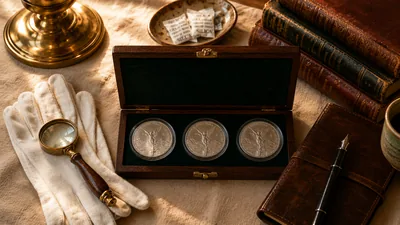
White cotton gloves. About 2 to 3 USD a pair. Put them on every time you handle a piece. No gloves? Hold the coin only by the edge (the rim), never by the faces. That is the whole rule.
Air-Tite or Guardhouse capsules. Clear acrylic capsules with an inner polyethylene ring that seals the coin without touching the faces. Roughly 0.70 to 1.50 USD each by diameter. Buy 100 or more and they drop to around 0.50 to 0.70.
Reusable silica gel. The same packets that come in shoe boxes, vitamin bottles, and new cameras. They absorb moisture and saturate in three to six months depending on your climate. Reactivate them in a microwave for 5 minutes on high, or in an oven at 100 degrees C (212 F) for 2 hours. Repeat indefinitely.
Start there: capsules, gloves, silica gel. Move up to albums, hygrometers, and safes later.
Capsules: when yes, when no
Not every coin deserves a capsule. Sometimes the acrylic costs more than the coin.
When to encapsulate:
- High-grade pieces (AU or better)
- Bullion coins (Onza Libertad, Centenario, silver kilos)
- Gifts or pieces you plan to pass down
- Anything worth more than about 30 USD
When not to:
- Circulating coins you still swap with family
- Low-grade pieces (VG, F) where there is nothing left to preserve
- Teaching sets where handling is the point
Most common Air-Tite sizes for Mexican coins:
| Coin | Diameter | Air-Tite model |
|---|---|---|
| Onza Libertad silver (1 oz) | 40 mm | Model H |
| Centenario 50 pesos gold | 37 mm | Model X |
| 20 pesos bimetallic | 32 mm | Model A |
| 10 pesos bimetallic | 28 mm | Model T |
| 5 pesos Bicentenario | 25 mm | Model I |
| 1 peso bimetallic modern | 21 mm | Model E |
Bulk packs of 100 identical capsules bring the per-unit cost down. Amazon and eBay are competitive above 50 units.
Albums, folders, and safes
The right choice depends on what you collect and your budget.
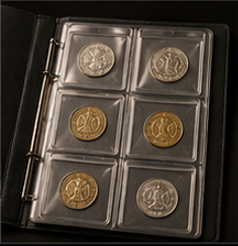
Dansco or Whitman albums
These US standards work perfectly for Mexican coins. Use them for complete series where you want to see the gap: the 20 pesos commemoratives, the 100 pesos Federated States, the Onza Libertad by year. When you have 90 percent of a set, the empty slot tells you exactly what to hunt. Around 25 to 45 USD each. Buy only the ones you know you will fill. An empty album is just frustration.
Collector folders with safe pages
A lighter option. Some dealers sell folders with polypropylene pages (not PVC) that hold coins by series. Less elegant than Dansco, and about half the cost.
Small safes with humidity control
For bullion (gold, pure silver, kilos). Small 30 to 50 liter safes with an electronic humidity readout run higher in cost, but SentrySafe and Barska are the common picks. Rule: only buy the safe if the value justifies it. One Centenario and two ounces do not need a safe. Forty Centenarios do.
What does NOT work (and everyone uses)
- Shoe boxes: moisture and dust get in on their own
- Vinyl photo albums: almost certainly PVC
- Ziploc bags: permeable to air, no humidity barrier
- Open metal tins: metal reacts with the coin metal over time
- Jam jars with metal lids: moisture builds up inside
The best album is the one you will actually open. Store everything on the top shelf of a closet and even you will forget what you own.
Home humidity control
Humidity is enemy number one. Two simple tools handle it.
A basic hygrometer. Measures relative humidity, roughly 10 to 20 USD. Put it inside the album, drawer, or safe and check weekly. Target: under 50 percent for silver, under 55 percent for gold.
Active silica gel. One 5-gram packet per 10 encapsulated coins, one 50-gram packet for a full album. It saturates when it changes color (if it has an indicator) or every three to six months otherwise. Reactivate in the microwave for 5 minutes on high, or in the oven at 100 degrees C for 2 hours.
Climate guidance:
- Humid coastal areas: 60 to 85 percent. Air conditioning, silica gel required, weekly hygrometer checks.
- Temperate highland cities: 40 to 65 percent by season. Silica in summer and rainy season.
- Dry inland regions: 25 to 45 percent. Low risk, silica optional.
- Semi-desert areas: 15 to 35 percent. No humidity problem, but watch dust and heat.
If you live near the coast, do not negotiate on this. Unprotected silver spots in three months.
What to do if you ALREADY cleaned it
It happens. Most collectors have cleaned a coin thinking they were saving it. Here is what comes next.
Step 1: Stop. Do not touch the coin with anything else. It will not improve.
Step 2: Do NOT try to re-tone it. YouTube videos teach artificial patina with sulfur, vinegar, or tea. Graders at NGC and PCGS spot fake toning in seconds. Try to sell it as high grade and you get an "artificial toning" label, which is worse than "cleaned."
Step 3: Accept the loss. The coin dropped from its original grade to "Details/Cleaned." It is worth 30 to 70 percent less. That is final.
Step 4: Use it. Keep it until you find an original-grade replacement. It is the teaching piece that reminds you never to do it again. Or sell it honestly as "cleaned" on the Pesoteca forum. Serious collectors prefer an honest cheap "cleaned" coin to an overpriced one with a lie in the description.
Storing by series: 3 practical tips
Different series store differently. Do not dump everything in one box.
Onza Libertad
Each ounce goes in an Air-Tite Model H (40mm) or Guardhouse equivalent. Store years in order, oldest to newest. Label each capsule with year, pure weight (31.1g for 1 oz), finish (regular vs proof), and purchase price.
20 pesos commemoratives
A Whitman modern commemoratives album protects each coin in a polypropylene page, so no capsule needed. Group by editorial family: the bimetallic C1 pieces together, world-event series on their own.
Centenarios
Individual Air-Tite Model X (37mm) capsules. Each Centenario holds 41.67g of gold, so an album of 20 weighs a full kilo. A safe beats an album here, and it adds theft protection, which matters with gold.
Labeling
Every piece should carry: year of mintage, mint mark (Mo for Mexico City, Zs for Zacatecas, and so on), the grade you assigned, purchase price, and purchase date. Now your collection doubles as a simple ledger. When you sell, you know what you paid and what it is worth today.
The final rule
The most important thing you can do for your collection today is two things: leave it alone and control the humidity. Everything else is incremental. Capsules help but do not save you from humidity. Albums help but do not save you from dirty fingers. Gloves help but do not save you from PVC.
If you do only three things, do them in this order:
- Stop cleaning your coins. Ever. Under any circumstances.
- Buy silica gel and a hygrometer, under 30 USD. Get humidity below 50 percent.
- Store every piece worth more than about 30 USD in an Air-Tite capsule matched to its diameter.
Do that and your collection holds for 30 years without degrading. When a child or grandchild inherits it, it will be worth what it should be worth, not half because someone wiped it thinking they were helping.
Have a specific piece you are unsure about? Head to the Pesoteca forum, describe what you have and how you are storing it, and the community will tell you if you are on track or need to fix something before it is too late.
Loading comments…