
En resumen
Mexico's central bank set a limit of 10 World Cup 2026 20-peso coins per person, but a photo shows a factory-sealed Mint bag of 700 for sale. Here's who has the wholesale lots and why the distribution stays hidden.
Mexico's central bank (Banxico) said the new 20-peso World Cup 2026 coins would be handed out at regional teller windows, capped at 10 pieces per person. A photo circulating in collector groups in 2026 shows a factory-sealed Mint bag holding 700 pieces of the Mexico City design, with the original label still on it, offered for sale. Something in the distribution chain does not add up.
If you found this article searching for what a 20-peso World Cup coin is worth, here is the short version: face value is 20 pesos, roughly a little over one US dollar. These are circulation-grade commemorative coins, not silver or gold, so there is no melt value floor and no built-in fortune. What makes this story worth reading is not the coin itself. It is the gap between what the public was told and what is actually moving in the market.
This is a separate issue from the silver and gold World Cup 2026 Onzas, which have their own parallel-market problem (covered here). This is about the bimetallic 20-peso pieces already in circulation that ordinary buyers still struggle to get.
What the 20-peso World Cup coin actually is
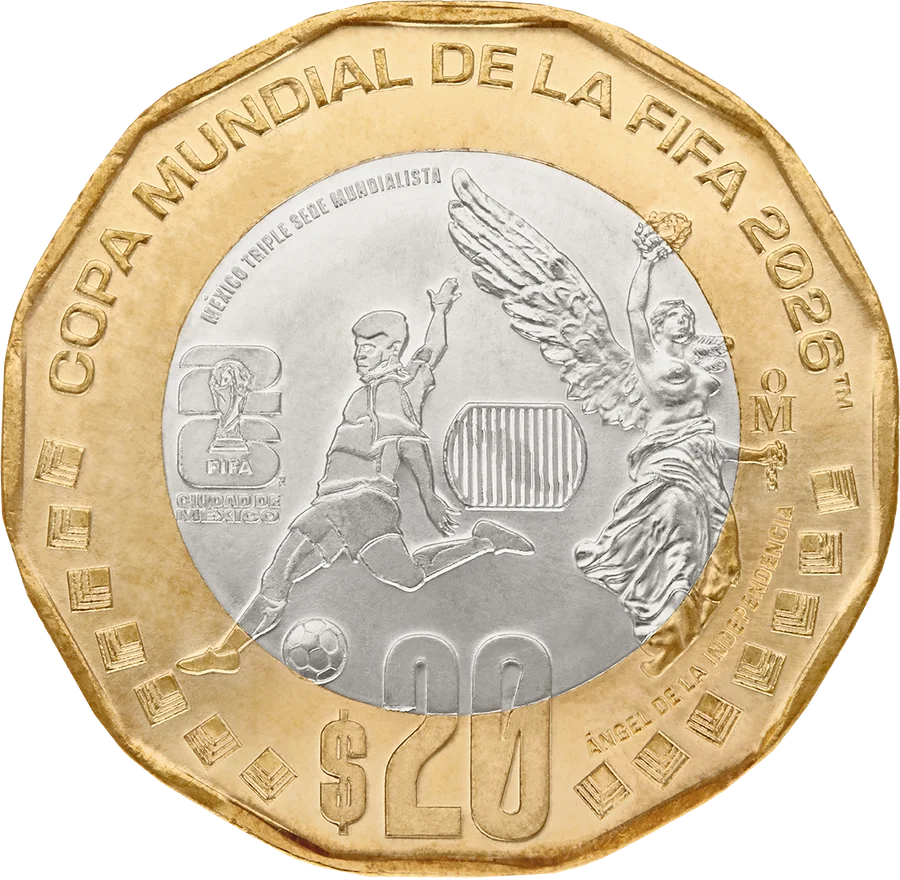
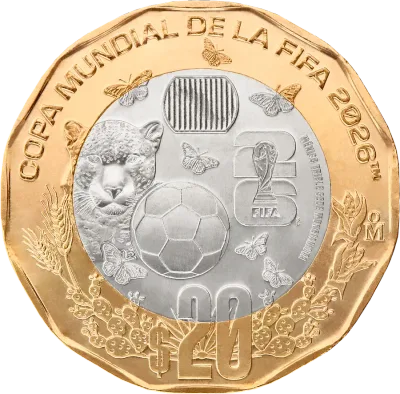
Banxico authorized four bimetallic 20-peso commemorative designs for the 2026 FIFA World Cup, which Mexico co-hosts with the United States and Canada:
"Bimetallic" means a two-metal coin: a center core and an outer ring in a different alloy, like the US does with nothing right now but Europe does with the 1- and 2-euro coins. These are base-metal coins. No silver, no gold. That matters for value, and we come back to it below.
The official Banxico limit
In late May 2026, Banxico announced the distribution plan for the four bimetallic 20-peso World Cup coins. The official terms:
- Distributed at six regional teller windows of the Bank of Mexico: Mexico City, Guadalajara, Monterrey, Hermosillo, Mérida, and Veracruz
- Limit: up to 10 pieces per person, per design
- Paid in cash, at face value: 20 pesos per coin
- First come, first served, no reservation
- No requirement to be a bank customer
The public read it plainly: show up early at the nearest window, pay 20 pesos per coin, take up to 10. That is what the notice said.
What happened on the ground was different.
The photo of 700 sealed coins
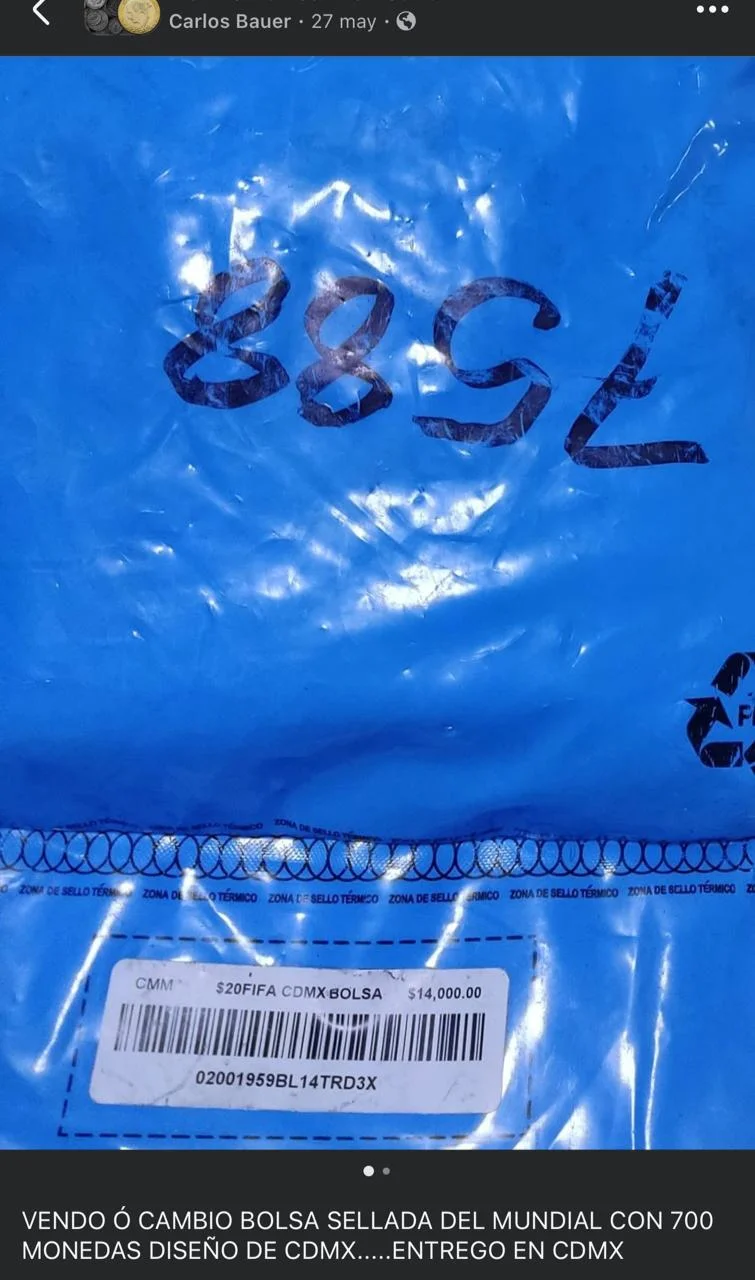
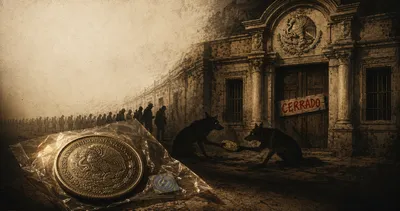
Factory-sealed bag from Casa de Moneda de México holding 700 twenty-peso World Cup 2026 coins, Mexico City design. Original CMM label reads: CMM 20 FIFA CDMX BOLSA 14,000.00. Photo posted in a collector group, June 2026.
In early June, someone posted the photo above in a closed group of Mexican collectors. It shows a bag sealed by Casa de Moneda de México (the Mexican Mint, abbreviated CMM), with an original label reading:
CMM $20 FIFA CDMX BOLSA $14,000.00
The code breaks down like this: CMM is the Mint's internal inventory code, 20 FIFA CDMX identifies the piece (20-peso World Cup 2026, Mexico City host design), BOLSA means sealed wholesale format, and the 14,000 figure is the gross face value: 700 coins times 20 pesos. That is not a commercial price. It is the raw face amount, no premium.
The bag is heat-sealed in the Mint's own plastic. The seller offered it at its gross face value.
The number per coin looks cheap. But the real question is this: how does a private individual have 700 sealed Mint coins in hand, when the official notice said 10 per person at a teller window?
The only possible explanations
There are three answers. All three are problematic.
1. A wholesale distributor with a direct Mint relationship
Beyond supplying Banxico for retail at regional windows, Casa de Moneda de México sells to authorized wholesale distributors. These distributors receive sealed lots (bags like the one in the photo) and resell them to numismatic dealers, coin shops, and bulk collectors.
The problem: Banxico never published how many wholesale bags it shipped, to which distributors, or on what dates. The public has no way to know whether the Mint sent 10 bags or 1,000 bags to wholesalers alongside the regional windows.
2. A Mint or Banxico employee with internal access
As with the silver World Cup 2026 Onzas, Mint and Banxico staff have internal purchase channels for special issues. It is reasonable that some accessed sealed bags for personal collection or institutional gifts.
The problem: if that access is funneled into public resale, it breaks the spirit of the internal privilege.
3. An undocumented government-linked distribution
Casa de Moneda de México is a decentralized federal government agency. Institutional purchases (protocol gifts, diplomatic exchange, ceremonies) can include sealed bags. If any of those channels leaks into the open market, that also explains the photo.
The problem: there is no public audit of these special distributions.
Why this matters to the everyday collector
The Banxico notice said 10 per person. The serious buyer went early to a regional window, waited two or three hours, and got 10 pieces if the stock held. The same day, somewhere else, someone had 700 sealed pieces ready to resell.
That is not a scandal by itself. Wholesale bags exist everywhere; it is standard mint practice worldwide. The scandal is the opacity:
- The public does not know how many pieces went to regional windows versus wholesalers
- The public does not know the total mintage per host design
- The public does not know what share of the mintage went to bulk buyers
If Banxico published something like "we struck 5 million Mexico City pieces, sent 2 million to regional windows, 1.5 million to wholesalers, 500,000 to general circulation through commercial banks, 1 million held in reserve," collectors would know where they stand.
Today they do not. When the photo of 700 pieces surfaces, no one can tell whether it is the exception or the rule. The reading inside collector groups is simple: there is a parallel wholesale channel the general public does not know about.
The cost of opacity for the real market
For the new collector: waits three hours in Mexico City for 10 coins, sees sealed 700-piece bags online the next day, feels cheated, and probably does not come back for the next release.
For the intermediate collector: knows the individual buyer cannot compete with the wholesaler, accepts it, and pays a premium on the secondary market. That normalizes prices above face value.
For the speculator and reseller: opacity is an advantage. If nobody knows how many pieces exist, a reseller can inflate the price claiming "they're almost gone" with no official figure to contradict it.
For the Mint: it loses control of the story. An issue that should be a national celebration turns into suspicion of favoritism, even when the wholesale practice is technically legitimate.
What Banxico and the Mint should publish
Minimum information for each commemorative issue:
- Exact mintage per design and per host city
- Distribution by channel: how much to regional windows for retail, how much to authorized wholesalers, how much to general circulation, how much held in reserve
- Public list of authorized wholesale distributors with assigned quantities
- Restock schedule for regional windows
- Live stock visibility for active windows
- Post-issue audit with a summary of internal sales to employees
The Mexican Mint has the technical capacity to publish all of this. Other national mints (the Royal Canadian Mint, the Royal Mint in the UK, the United States Mint, Casa da Moeda do Brasil) already publish nearly all of it. This is not a fantasy standard.
Is a sealed-bag coin worth more?
Not automatically. The coins are identical. A sealed Mint bag does add value for collectors who want guaranteed uncirculated (UNC) condition and documented Mint provenance, and on the secondary market a 700-piece UNC bag with the CMM seal trades above face value. But paying more than twice face value for a single coin pulled out of the bag rarely makes sense. Face value is 20 pesos. Anything above that is a scarcity premium, not a Banxico price.
What you can do
If you waited at a window and got your 10 pieces: document it. What time did you arrive? How many were left? When did they run out? Multiplied across many reports, that builds the real timeline Banxico never published.
If you saw sealed bags for sale: report the price and the host city, no seller names. Not to shame anyone, but to build a public record of how much moves through wholesale.
If you buy from a reseller: know what you are paying. Face value is 20 pesos, a little over one dollar. Any figure above that is a scarcity premium. If you decide that informed, fine. If you think it is the Banxico price, that is a problem.
Reported in the Pesoteca forum, all of it builds the citizen-side transparency the institution chose not to build.
What comes next
We will update this article when Banxico publishes exact mintage and channel distribution for each bimetallic 20-peso World Cup coin, when an authorized wholesaler list appears, or when the Mint opens an online store with visible stock. Until then, this stands as a record of the problem.
Did you wait in line? Get your 10? Or did you spot someone with a sealed bag for sale? Tell us in the forum, and tell us what price you saw.
Loading comments…