
Mexico 50,000 Pesos Banknote (1986)
Familia A · algodón
Period: México Contemporáneo
Design
Banxico
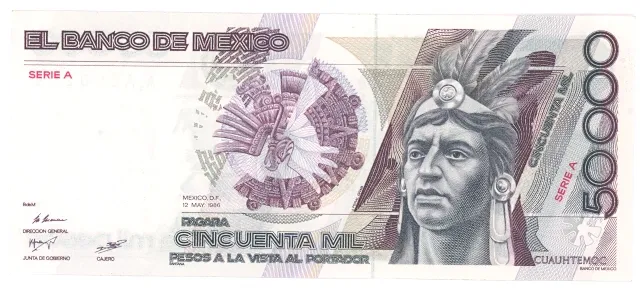
Obverse
Cuauhtémoc
Bust of Cuauhtémoc wearing a feathered headdress
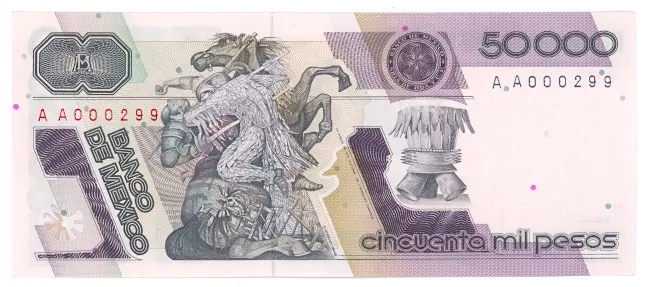
Reverse
A monumental equestrian sculpture and pre-Hispanic elements of the Mexica culture
About this banknote
Most 1986 Mexican 50,000 pesos notes are worth a few dollars in used condition. A crisp uncirculated example, a low or radar serial number, or a genuine printing error can push the price to several times that. This is a demonetized note, so its value is collector value, not spending value.
The 50,000 pesos note is part of the Banco de México Family A series. It circulated during the high-inflation years of the 1980s, before the 1993 currency reform (the "nuevos pesos" conversion) knocked three zeros off the peso. That reform is why a note with a face value of 50,000 old pesos is no longer legal tender: it corresponds to 50 modern pesos, and the old paper was withdrawn.
What it looks like
The note is dominated by a purple color scheme. The front (anverso) shows Cuauhtémoc, the last Aztec tlatoani (ruler), who led the resistance against the Spanish conquest. According to the Banco de México circular, the secondary design pulls a fragment of the solar disc from the sculpture of the Teocalli de la Guerra Sagrada (Temple of Sacred War) and a reproduction of a descending eagle from the Codex Laud.
The back (reverso) carries a monumental equestrian sculpture with pre-Hispanic Mexica cultural elements.
How much is it worth in 2026
Because the note no longer circulates, forget face value. Everything hinges on condition and any special feature:
- Circulated, average condition (folds, soft corners, light soiling): worth a few US dollars. This is the most common outcome.
- Uncirculated (UNC): crisp, no folds, sharp corners, no stains. This grade commands a real premium over a used note, often several times more.
- Low serial numbers, radar/palindrome serials, or early series: collectors pay extra for these regardless of the base value.
- Genuine printing errors: misaligned cuts, ink smears, factory folds, repeated or off-center serials. These turn a common note into a scarcer piece worth several times face.
Be skeptical of the inflated "buy it now" prices you see on general marketplaces. Asking prices are not sale prices. What a note actually sells for at a numismatic dealer or between collectors is the honest number.
| Note | Series | Condition | Typical collector value (USD) |
|---|---|---|---|
| 50,000 pesos, Cuauhtémoc | Banco de México, Family A | Circulated | A few dollars |
| 50,000 pesos, Cuauhtémoc | Family A | Uncirculated (UNC) | Several times the circulated price |
| 50,000 pesos, Cuauhtémoc | Family A | Low/radar serial or error | Highest premium, sold case by case |
The myth to kill
An old, high-denomination note with lots of zeros is not automatically worth a fortune. The 50,000 pesos figure looks impressive, but it reflects 1980s inflation, not rarity. Millions of these were printed and many survive. The value comes from grade and special features, not from the big number on the paper.
How to tell if yours is genuine
Compare your note against official Banco de México images and check the built-in security features:
- Watermark: hold the note to the light and look for the portrait watermark.
- Security thread: an embedded strip visible against light.
- Microprinting: tiny text that stays sharp under magnification.
- Relief/intaglio feel: genuine notes have a raised texture you can feel with a fingertip.
- Paper and color: reproductions tend to use smooth paper and flat, printed color rather than the layered feel of a real note.
If anything looks off, post clear photos of both sides in the Pesoteca forum and the community can weigh in.
Where to sell
To sell your 1986 50,000 pesos note safely, use a verified numismatic dealer from the Pesoteca directory, who can appraise it on the spot, or the Pesoteca buy-and-sell forum among collectors. Photograph both faces in good light and note the serial number and condition before agreeing on a price. Avoid dumping it to the first bidder on social media.
Want to double-check your note before you sell? Post the serial and photos in the forum. To get a sense of what fakes look like, read our guide to the most counterfeited banknotes in Mexico.
Historical context
The 50,000 pesos of 1986 returns to Cuauhtémoc, the last Mexica tlatoani, here depicted with a headdress, symbol of Indigenous resistance during the fall of Tenochtitlan in 1521. The choice of a pre-Hispanic figure for such a high denomination sought to lend solemnity to a note born of economic emergency.
The reverse combines a monumental equestrian sculpture with pre-Hispanic elements of Mexica culture, in a composition that links the Indigenous past with national iconography.
This piece fully reflects the crisis of the 1980s. In 1986 inflation was still out of control, and Banco de México had to issue fifty-thousand-peso notes, figures that years earlier would have seemed absurd. It belongs to the last of the "old pesos," whose enormous face values would be corrected by the 1993 monetary reform that divided everything by a thousand.
Frequently asked questions
How much is the 1986 Mexican 50,000 pesos note worth?
It no longer circulates, so the value is collector value, not face value. A used note is worth a few US dollars. An uncirculated example, a low or radar serial number, or a genuine printing error can be worth several times more. Condition and rarity decide the price.
Is the 50,000 pesos note rare?
Not in average condition. Millions were printed during the 1980s and many survive, so common used notes are inexpensive. Scarcity comes from high grade (uncirculated), special serial numbers, or factory printing errors, which are the pieces collectors actually chase.
Where can I sell my 1986 50,000 pesos note?
The safest options are a verified dealer from the [Pesoteca directory](/tiendas), who values it in person, or the [Pesoteca buy-and-sell forum](/foro/compra-venta) among collectors. Photograph both faces in good light and check for a low or radar serial or any error, which raise the value. Don't sell to the first social-media bidder.
How do I tell if my 50,000 pesos note is genuine?
Check the security features: hold it to light for the watermark and security thread, look for microprinting, and feel the raised intaglio texture. Compare the design, paper, and signatures with official Banco de México images. Fakes usually have smooth paper and flat color. If unsure, ask in the [forum](/foro).
Familia A
This banknote belongs to the BIL-A family within the Sistema PSM . Explore all the banknotes that share origin, era and design with this piece.
Ver todos los billetes de la familia A →