
Mexico 5,000 Pesos Banknote (1980): Value & Prices
Familia A · algodón
Period: México Contemporáneo
Design
Banxico
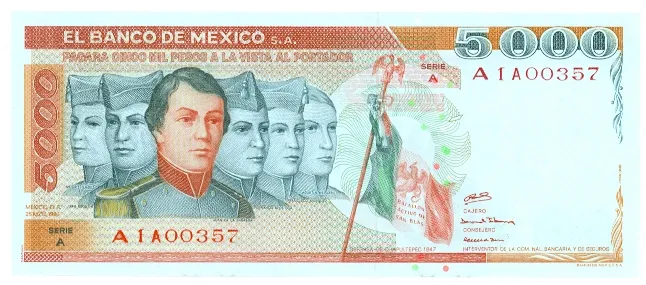
Obverse
Cadetes del Heroico Colegio Militar (Niños Héroes)
The cadets of the Military College with the standard-bearer and the flag
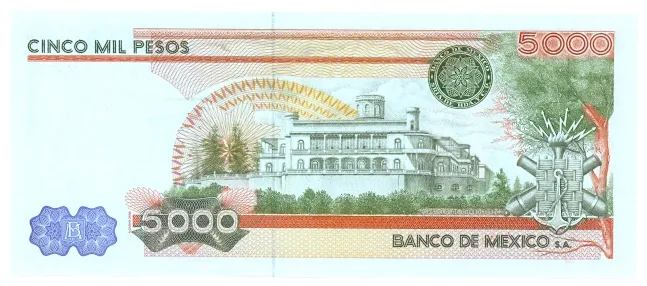
Reverse
Chapultepec Castle
About this banknote
Most Mexican 5,000 pesos notes from 1980 are worth a few dollars, not a fortune. This is a common banknote from the Banco de México Series A, and circulated examples trade for pocket change to collectors. The ones that bring real money are uncirculated notes, low or radar (palindrome) serial numbers, and genuine printing errors. Here is what yours is actually worth in 2026 and how to check.
What this banknote is
The 5,000 pesos note (1980) honors the Cadetes del Heroico Colegio Militar, known in Mexico as the Niños Héroes ("Boy Heroes"), the military cadets who defended Chapultepec Castle in 1847 during the US invasion. The front (anverso) shows the cadets in formation with the standard-bearer and the Mexican flag.
The back (reverso) shows Chapultepec Castle itself, home of the Military College at the time and now the National History Museum. This is a Banco de México note from the Series A family, a large denomination issued during the high-inflation years before Mexico's currency was redenominated in 1993 (when three zeros were dropped and the "nuevo peso" arrived).
How much is it worth in 2026
This note is demonetized, so it no longer has spending value. Its worth is purely collector value, and for most examples that is modest. Condition drives everything.
- Circulated (folds, creases, soft corners): typically a few US dollars. Series A notes were printed in large numbers and survived in quantity.
- Uncirculated (crisp, no folds, sharp corners, no stains): several times more than a worn note, but still usually a modest figure for the common signature and series combinations.
- Low serial numbers, radar/palindrome serials, or first-series notes: command premiums with collectors who chase fancy serials.
- Genuine printing errors: the real money. A misaligned cut, ink smear, factory fold, or repeated serial can turn a common note into a piece worth many times face.
Ignore the inflated "worth thousands" listings you see online. Most Series A 5,000 pesos notes are common. A price only climbs when a note is genuinely scarce: exceptional grade, a fancy serial, or a verified error.
| Note | Year | Condition | Approx. collector value (USD) |
|---|---|---|---|
| 5,000 pesos, Series A | 1980 | Circulated | A few dollars |
| 5,000 pesos, Series A | 1980 | Uncirculated | Higher, still modest |
| 5,000 pesos, Series A | 1980 | Low/radar serial | Premium over normal |
| 5,000 pesos, Series A | 1980 | Verified printing error | Several times face, varies |
Values for individual notes depend on grade and the specific signature/series variant. A professionally graded note (PMG or PCGS Banknote) in a high grade like 65 EPQ or better will always outsell a raw circulated example.
What makes a note worth more
Three things flip a common note into something collectors want:
- Grade. Uncirculated with original paper (no folds, full crispness, bright color) is the baseline for any premium.
- Serial number. Low numbers (like 000012), radar/palindrome serials (reads the same both ways), or solid/repeating digits attract fancy-serial collectors worldwide.
- Errors. Genuine factory errors (misaligned cutting, ink runs, missing print, doubled serials, foldovers) are the rarities. Normal wear and handling damage is not an error.
How to tell if yours is genuine
Check the security features against official Banco de México images for this issue: the watermark visible when held to light, the security thread, the paper texture, and the signatures. Reproductions and photocopies usually give themselves away with smooth paper, flat colors, and no watermark. Genuine notes have crisp intaglio detail you can feel with a fingertip on parts of the design. If a note feels like plain printer paper, it is a copy. When in doubt, post clear photos of both sides in the Pesoteca forum and the community will weigh in.
Where to sell it
To sell your 5,000 pesos (1980), the safest routes are a verified dealer from the Pesoteca shop directory, who can appraise it on the spot, or the Pesoteca buy-and-sell forum among collectors. For international buyers, world-paper-money platforms and eBay reach a wider notaphily audience, and a PMG-graded note sells faster and for more. Before you sell, photograph both faces in good light and check for a low serial, a radar serial, or any error, all of which raise the price. Do not dump it to the first bidder on social media.
Got one with an unusual serial or still in its original wrapper? Post it in the forum and let the community take a look. For context on what to watch out for, see Mexico's most counterfeited banknotes.
Historical context
The 5,000 pesos of 1980 honors the cadets of the Heroic Military College, the so-called Niños Héroes (Boy Heroes) who in September 1847 defended Chapultepec Castle against the invading United States army. Tradition holds that one of them, Juan Escutia, threw himself into the void wrapped in the flag so that it would not fall into enemy hands; the note captures that scene with the cadets and the flag bearer.
The reverse shows, consistent with the theme, Chapultepec Castle, setting of the defense and today home of the National Museum of History.
The piece belongs to Family A of the "old pesos." A five-thousand-peso note in 1980 already betrayed the erosion of the currency: as the decade began, inflation was starting to demand high denominations that within a few years would climb to a hundred thousand pesos, before the 1993 reform removed three zeros from the peso.
Frequently asked questions
How much is the Mexican 5,000 pesos (1980) banknote worth?
Since it is demonetized, its value is collector value, not face value. A circulated note is worth a few US dollars. An uncirculated example, a low or radar (palindrome) serial number, or a genuine printing error can sell for several times more. Condition and rarity decide the price.
Is the 5,000 pesos (1980) note rare?
In circulated grade, no. Banco de México Series A 5,000 pesos notes were printed in large numbers and survived in quantity, so most are common. Scarcity comes from top grade (uncirculated with original paper), fancy serial numbers, or verified factory errors, which are the notes that bring real premiums.
Where can I sell my 5,000 pesos (1980) banknote?
The safest options are a verified dealer from the [Pesoteca shop directory](/tiendas), who appraises it in person, or the [Pesoteca buy-and-sell forum](/foro/compra-venta) among collectors. For a wider audience, world-paper-money platforms reach international buyers, and a PMG-graded note sells faster and for more. Photograph both sides and check the serial before selling.
How can I tell if my 5,000 pesos (1980) note is genuine?
Check the security features against official Banco de México images: watermark held to light, security thread, paper texture, and signatures. Genuine notes have raised intaglio detail you can feel and crisp color. Copies use smooth paper and flat, printed color with no watermark. If unsure, post clear photos of both sides in the [Pesoteca forum](/foro).
Familia A
This banknote belongs to the BIL-A family within the Sistema PSM . Explore all the banknotes that share origin, era and design with this piece.
Ver todos los billetes de la familia A →