
500 Pesos Banknote (1906): Banco de Zacatecas Value
Familia PRIV · algodón
Period: Bancos privados de emisión
Design
Banxico
Obverse
Banco de Zacatecas
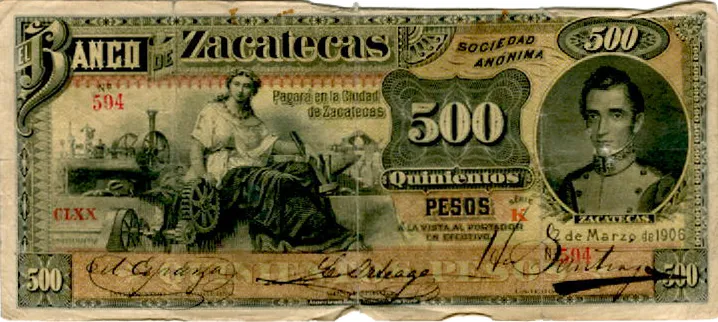
Engraved allegorical vignettes: a miner on the left, a female figure with goods in the center, and the profile portrait of a young man on the right
Reverse
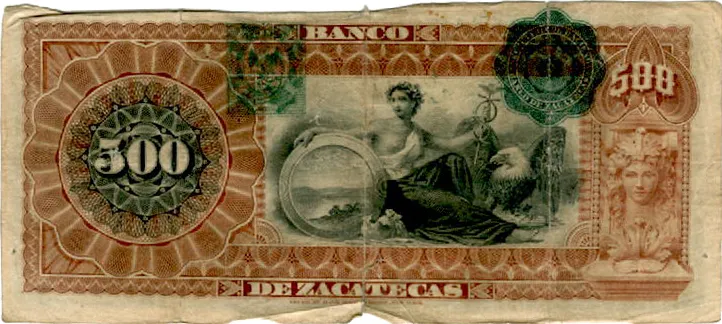
Scenes of mining and labor, or a monument set against the mountainous landscape of Zacatecas
About this banknote
If you inherited or found a 500 pesos note dated 1906 from the Banco de Zacatecas, you are holding a piece of Porfiriato-era private-bank paper money, not modern Mexican currency. These notes have no face value today. They are worth what collectors pay, which ranges from roughly 50 USD for a worn, common survivor to several hundred, and into the low thousands for crisp uncirculated examples or scarce varieties. Grade and the specific issuing bank drive everything.
What you actually have
Before Mexico had a single central bank, individual states chartered private banks that were legally allowed to print their own paper money, each note backed by silver held in reserve. The Banco de Zacatecas was one of them. Zacatecas was a legendary silver-mining region, which is why the note's vignettes lean on mining imagery: the metal in the ground was the guarantee behind the paper.
This system of multiple issuing banks ended when the Banco de México was founded in 1925 and took over sole authority to issue currency. That is why these older state-bank notes are collectible historical objects rather than spendable money.
Design details
The face (anverso) carries engraved allegorical vignettes: a miner on the left, a female figure with merchandise in the center, and a young man's profile portrait on the right. The back (reverso) typically shows mining and labor scenes, or a monument set against the mountainous Zacatecas landscape. These are steel-engraved notes, printed by security printers of the era, and the fine engraving is one of the first things a collector checks for authenticity.
How much is it worth in 2026
There is no single number. Value depends on four things: the specific issuing bank, condition (grade), whether the note was issued or remained a specimen/proof, and how many survive today. Many of these private-bank notes circulated very briefly or were redeemed and destroyed, so complete, intact examples can be genuinely scarce.
As a working guide for 2026:
| Condition | What it looks like | Rough value (USD) |
|---|---|---|
| Well-circulated | Soft, folded, edge wear, possible tears | 40 to 100 |
| Fine / Very Fine | Clear detail, moderate handling | 100 to 300 |
| Extremely Fine | Crisp, minor folds only | 300 to 700 |
| Uncirculated / Specimen | No folds, original paper | 700 to 2,500+ |
These are collector ranges for typical Porfiriato private-bank notes. A specimen or proof, a note with a low or repeating serial number, or a printing error can push the figure well above the top of this table. A common bank in poor shape sits at the bottom. Do not assume "over 100 years old" means "worth a fortune," because age alone does not create scarcity in this market.
The myth to ignore
A lot of listings online tag these notes with fantasy prices simply because the date reads 1906. Age is not rarity. What separates a 60-dollar note from a 2,000-dollar note is grade and survival rate, not the year printed on it. If yours has been folded into quarters and taped, it is at the bottom of the range regardless of how old it is.
How to check what yours is worth
- Confirm the issuing bank. Read the bank name on the note. Banco de Zacatecas is one of many state banks, and values differ sharply between them.
- Grade the condition honestly. Lay it flat under good light. Folds, tears, stains, pinholes and tape all lower value. Crisp paper with sharp corners is what commands the higher figures.
- Check the serial number. A low number, a repeating pattern, or a palindrome (radar) number adds a premium.
- Look for errors. Genuine factory errors (misaligned cuts, ink smears, folds baked in at printing, misplaced serials) turn a common note into a rarity. Ordinary wear from handling is not an error.
Is it genuine?
Study the paper and the engraving. Original notes were printed on quality banknote paper with sharp steel-engraved lines and layered ink tones. Reproductions and reprints tend to have flat, printed-looking color, smooth modern paper, and fuzzy line detail under magnification. Compare your note against reference images of confirmed Banco de Zacatecas issues, and check the signatures and printer's imprint. When something looks off, get a second opinion before you buy or sell.
Where to sell it
World paper money (notaphily) is an active English-language market, so you have real options. For a firm valuation and a fast sale, use a verified numismatic dealer from the Pesoteca directory, who can appraise it in person. To sell peer to peer among collectors, the Pesoteca buy-and-sell forum connects you with people who specialize in Mexican paper money. For grading and authentication of a higher-value example, third-party grading (PMG) protects both buyer and seller. Photograph both sides in good light, note the serial number, and never dump it to the first bidder on social media.
Have a Banco de Zacatecas note or another Porfiriato private-bank issue? Post clear photos of both sides in the Pesoteca forum and let collectors help you pin down the bank, the grade and a fair price.
Historical context
This 500-peso note of 1906 belongs to the years of full maturity of the Banco de Zacatecas, by then consolidated as a key piece of the Porfiriato's system of private banks of issue. With its head office in the Zacatecan capital and branches in the Bajío, the bank served miners, merchants, and hacienda owners across a wide region.
The bank's highest denomination bore the same vignettes as always: the miner, symbol of the state's silver wealth; the female allegory of commerce; and the youthful portrait in profile, with mining and mountains on the reverse. All designed to project confidence and roots.
Engraved by the American Bank Note Company, this 500-peso note was an instrument for large financial operations, not for daily spending. It circulated at a time when Mexico was still nearly twenty years away from centralizing issuance with the birth of the Banco de México.
Frequently asked questions
How much is the 1906 Banco de Zacatecas 500 pesos note worth?
It has no spendable face value today, only collector value. A worn, common example runs roughly 40 to 100 USD, mid-grade notes 100 to 300 USD, and crisp uncirculated or specimen examples can reach several hundred to over 2,000 USD. Grade, the issuing bank and rarity decide the price.
Is the 1906 500 pesos banknote rare?
It can be. These Porfiriato private-bank notes circulated briefly and many were redeemed and destroyed, so intact, high-grade survivors are scarce. Rarity varies a lot by issuing bank and by condition, so a common bank in poor shape is inexpensive while a crisp or specimen example is genuinely hard to find.
Where can I sell my 1906 Banco de Zacatecas banknote?
The safest routes are a verified dealer from the [Pesoteca directory](/tiendas), who values it in person, or the [Pesoteca buy-and-sell forum](/foro/compra-venta) among collectors. For a higher-value note, third-party grading (PMG) adds trust. Photograph both sides, note the serial number, and avoid selling to the first social-media bidder.
How can I tell if my 1906 500 pesos note is genuine?
Check the paper and the engraving. Originals use quality banknote paper with sharp steel-engraved lines and layered ink; reproductions look flat, feel like modern paper, and blur under magnification. Compare the design, signatures and printer's imprint against confirmed Banco de Zacatecas images, and post it in the [forum](/foro) if in doubt.
Características Banxico
CLXX
Familia PRIV
This banknote belongs to the BIL-PRIV family within the Sistema PSM . Explore all the banknotes that share origin, era and design with this piece.
Ver todos los billetes de la familia PRIV →