
500 Pesos Banknote (1905), Banco de Zacatecas
Familia PRIV · algodón
Period: Bancos privados de emisión
Design
Banxico
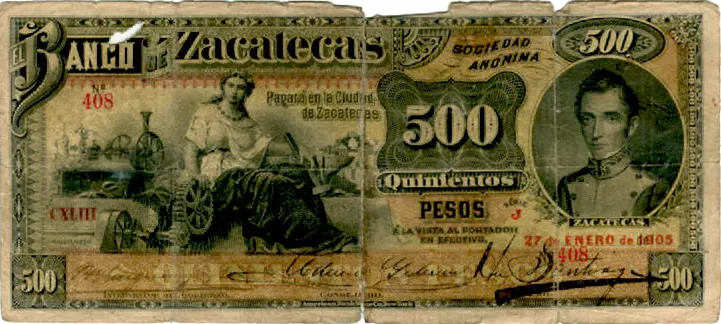
Obverse
Banco de Zacatecas
Engraved allegorical vignettes: a miner on the left, a female figure with goods in the center, and the profile portrait of a young man on the right
Reverse
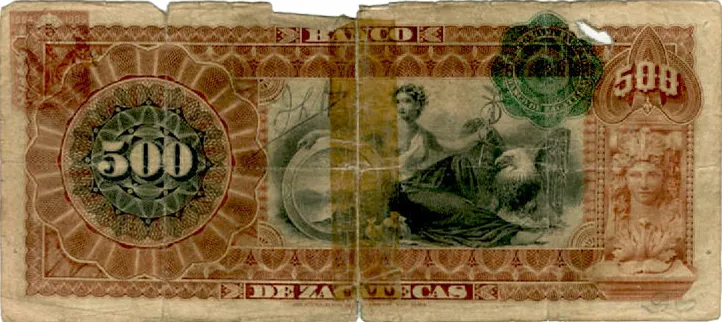
Scenes of mining and labor, or a monument set against the mountainous landscape of Zacatecas
About this banknote
If you inherited a large old Mexican note reading "Banco de Zacatecas" and "Quinientos Pesos," here is the honest answer: it is a private-bank note from around 1905, worth to collectors, not banks. Depending on condition and how many survived, most examples trade from roughly 20 USD to a few hundred USD, with pristine or scarce varieties going higher. It is not legal tender and has no face value today.
This is a collector item (a field called notaphily, or paper-money collecting), not a modern peso note you can cash. The price is driven entirely by condition, rarity of the issuing bank, and demand from world-banknote collectors.
What this note actually is
Before Mexico had a single central bank, individual states hosted private banks licensed to print their own paper money, each backed by silver. The Banco de Zacatecas was one of them, based in a legendary mining state. That mining wealth is why the vignettes on the note show miners and industry: the silver in the ground was the guarantee behind the paper.
This whole system of multiple issuing banks ended when the Banco de México was founded in 1925 and took over note issuance. That makes surviving Banco de Zacatecas notes over a century old and permanently out of circulation, which is exactly why they have a collector market instead of a face value.
Design details (to help you identify yours)
- Front (obverse): engraved allegorical vignettes. A miner on the left, a female figure with goods in the center, and a portrait of a young man in profile on the right.
- Back (reverse): mining and labor scenes, or a monument set against the mountainous Zacatecas landscape.
- Issuer: Banco de Zacatecas, a Porfiriato-era state issuing bank (the Porfiriato is the long rule of Porfirio Díaz, roughly 1876 to 1911).
- Denomination: 500 pesos.
How much is it worth in 2026
This is historic paper money over a century old, so the value is purely collector-driven. Two things move the price more than anything else: condition and how rare the issuing bank and denomination are.
Private-bank notes from the Porfiriato and paper scrip from the Mexican Revolution have their own active market. Some issues are common; others are extremely scarce. Many circulated so little, or were redeemed and destroyed, that finding a complete, intact example today is genuinely hard. High denominations like 500 pesos were rare in daily use to begin with, so fewer entered circulation and fewer survived.
Honest ranges for a note like this:
| Condition | What it looks like | Typical collector value (USD) |
|---|---|---|
| Heavily worn / damaged | Tears, missing corners, tape, staining | 15 to 50 |
| Circulated, complete | Folds and handling but fully intact | 50 to 150 |
| High grade / crisp | Bright paper, sharp corners, minimal handling | 150 to 500+ |
| Rare variety or specimen | Proof, specimen (SPECIMEN overprint), unissued remainder | Several hundred and up |
These are guide ranges. A specific serial, a signature combination, or an uncirculated survivor of a scarce issue can push well past the top of the table. Because private-bank issues vary so much bank to bank, a firm number requires seeing the exact note.
Watch for remainders and specimens
Many Banco de Zacatecas notes survive as remainders (printed but never signed or issued) or specimens (marked SPECIMEN, used as reference samples). These are common in the market and usually worth less than a genuinely issued, circulated note of the same type, because so many were saved intact. If your note has no serial number, no signatures, or a punched hole and SPECIMEN overprint, that changes the valuation. Read how printing errors and varieties affect value before assuming yours is the rare kind.
What makes one worth more than another
- Grade: crisp, uncirculated paper with sharp corners beats a soft, folded example every time. This is the single biggest factor.
- Issued vs. remainder: a properly signed, serial-numbered issued note is generally scarcer than an unsigned remainder.
- Completeness: no tears, no missing corners, no tape repairs, no trimming.
- Rarity of the issue: some Zacatecas denominations and dates are far scarcer than others.
How to tell if yours is genuine
For a note this old, forgeries and modern reproductions do exist. Check the fundamentals:
- Paper: genuine notes use quality rag paper with a distinct feel. Modern reproductions often print on smooth, flat paper.
- Engraving quality: the vignettes were steel-engraved, giving fine, sharp lines and depth. Flat, fuzzy, or dotted printing (a sign of a photocopy or inkjet) is a red flag.
- Color and detail: compare against archived images of Banco de Zacatecas notes. Reproductions tend to show flat, uniform color.
- Serial and signatures: issued notes carry hand-applied or overprinted serials and signatures. Confirm they match the format used by the bank.
If you are unsure, photograph both sides in good light and post them in the Pesoteca forum for a second opinion before you buy or sell.
Where to sell it
Don't take the first online price. For a private-bank note like this, your safest options are a verified numismatic shop from the Pesoteca directory, which can appraise it in person, or the Pesoteca buy-and-sell forum where world-banknote collectors trade directly. World paper money is a serious international market, so specialist auction houses that handle Latin American notes are also worth considering for higher-grade or scarce examples. Always share clear photos of both sides and note the serial and condition before agreeing on a price.
Got an 1905 Banco de Zacatecas 500 pesos note in a drawer? Post front-and-back photos in the Pesoteca forum and let collectors tell you whether yours is a common remainder or the scarce issued variety.
Historical context
The Banco de Zacatecas maintained its 500-peso denomination throughout almost all of its life as an issuing bank. This 1905 example circulated at the turn of the century, when Mexican regional banking operated under the framework of the General Law of Credit Institutions of 1897, which had organized and regulated the system of issuing banks.
Its design preserves the characteristic iconography: the miner, a tribute to the silver that made Zacatecas famous; the female figure of commerce; and the young man in profile, with mining scenes and mountainous landscape on the reverse.
Like all of the bank's output, the piece was engraved by the American Bank Note Company of New York. A 500-peso note was, in 1905, an enormous sum reserved for the world of bankers and great mercantile houses, far removed from the everyday use of silver coin.
Frequently asked questions
How much is the 1905 Banco de Zacatecas 500 pesos note worth?
It has no face value today, only collector value. Most examples sell from about 15 to 50 USD when worn, 50 to 150 USD when circulated but complete, and 150 to 500 USD or more when crisp and high grade. Scarce issued varieties or true specimens can go higher. Condition and rarity decide the price.
Is the 500 pesos Banco de Zacatecas note rare?
It depends on the exact type. Some Zacatecas denominations are common as unsigned remainders or SPECIMEN samples, which lowers value. Genuinely issued, signed, serial-numbered notes in high grade are much scarcer, especially in a large 500 pesos denomination. An intact uncirculated survivor is the hard part to find.
Where can I sell an 1905 Banco de Zacatecas 500 pesos note?
The safest routes are a verified numismatic shop from the Pesoteca directory, which can appraise it in person, or the Pesoteca buy-and-sell forum where world-banknote collectors trade. Specialist auction houses handling Latin American paper money suit high-grade examples. Photograph both sides and note the serial before agreeing a price.
How do I tell if my Banco de Zacatecas note is genuine?
Check the paper (quality rag paper with real texture, not smooth flat stock), the engraving (sharp steel-engraved lines, not fuzzy or dotted printing), the color depth, and the serial and signatures against archived Banco de Zacatecas images. Reproductions usually show flat color and smooth paper. When in doubt, post clear photos in the Pesoteca forum.
Características Banxico
CXLV
Familia PRIV
This banknote belongs to the BIL-PRIV family within the Sistema PSM . Explore all the banknotes that share origin, era and design with this piece.
Ver todos los billetes de la familia PRIV →