
500 Pesos Banknote (1899): Value & Guide
Familia PRIV · algodón
Period: Bancos privados de emisión
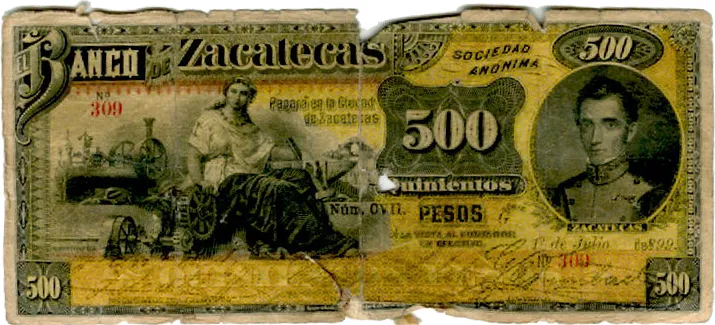
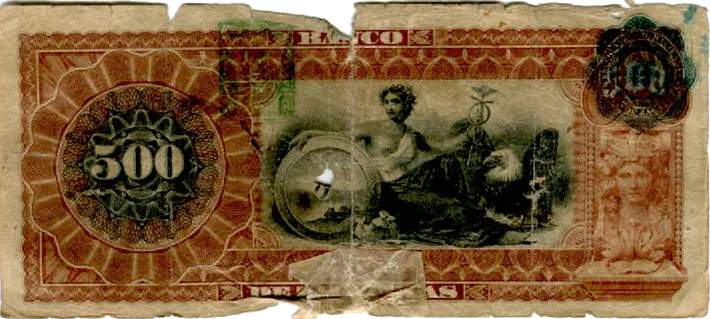
Design
Banxico
Obverse
Banco de Zacatecas
Engraved allegorical vignettes: a miner on the left, a female figure with goods in the center, and the profile portrait of a young man on the right
Reverse
Scenes of mining and labor, or a monument set against the mountainous landscape of Zacatecas
About this banknote
Most people who inherit an old Mexican banknote assume it's worthless paper or a hidden jackpot. The truth on the 1899 500 pesos note sits between those extremes: it's a genuine piece of pre-central-bank Mexican history, and depending on condition and issuing bank, examples change hands from roughly 50 USD to several hundred, with the rarest signed and dated survivors reaching four figures at specialist auction.
This is not a Banco de México note. In 2026, this is one of the most misunderstood pieces US collectors run into, because it predates the modern peso system entirely.
What you actually have
The 1899 500 pesos is a private state-bank note, issued by the Banco de Zacatecas during the Porfiriato (the long rule of Porfirio Díaz). Before Mexico had a single central bank, individual states chartered private banks that were legally allowed to print their own paper money, backed by silver reserves. Zacatecas was mining country, so the note's engravings lean into that: a miner on the left, an allegorical female figure with goods at the center, and a young man's portrait in profile on the right. The reverse shows mining and labor scenes, or a monument set against the mountainous Zacatecas landscape.
This whole system of multiple issuing banks ended when the Banco de México was founded in 1925. That makes surviving state-bank notes historical artifacts, not currency you can spend.
How much is it worth
Because this note is over a century old and no longer legal tender, its value is purely collector value (notaphily), driven by three things: condition, the issuing bank's rarity, and whether the note was fully issued (signed, dated, serial-numbered) or left as an unissued remainder.
Here is the honest picture for the world-paper-money market:
| Condition / type | Typical range (USD) |
|---|---|
| Heavily worn, tears, repairs | 20 to 60 |
| Circulated but complete, clean | 75 to 200 |
| Crisp, problem-free, well-centered | 250 to 600 |
| Rare signed-and-issued or top-grade example | 700 to 2,000+ |
Unissued remainders (notes printed but never put into circulation, often with no signatures) usually sit at the lower end because more of them survived intact. Fully issued notes that actually circulated in Zacatecas are scarcer and command a premium when they survive in decent shape.
Serial number matters too. A low serial number, a solid or repeating number, or a genuine printing error can push a common note several times above its baseline. Everyday wear is not an error, so torn corners and folds lower value rather than raise it.
The myth to kill
Every few months someone posts that an old Mexican banknote is "worth millions." For the 1899 500 pesos, that's clickbait. No verified public sale of this note has approached that level. The realistic ceiling for an exceptional, high-grade, genuinely issued example is in the low thousands of dollars at a specialist auction, and that's the top of the market, not the average. Most examples that people inherit fall in the double or low triple digits.
How to tell if yours is genuine
Reproductions and modern souvenir prints of Porfiriato-era notes exist. Check these:
- Paper feel. Original notes were printed on quality rag paper with texture and slight tone. Reproductions tend to feel smooth, bright white, or coated.
- Engraving detail. Genuine notes show fine line engraving. Under a loupe, reproductions look dotted or fuzzy (they're photographic reprints).
- Colors. Originals have layered, slightly muted ink. Flat, uniform color is a red flag.
- Signatures and serials. Fully issued notes carry hand-applied or press-applied signatures and a printed serial. Compare the design and layout against reference images of Banco de Zacatecas issues.
If you're unsure, post clear photos of both sides in the Pesoteca forum and the community will help you assess it before you buy or sell.
Where to sell it
For a note like this, the safest routes are a verified numismatic dealer from the Pesoteca directory, who can appraise it in person, or the Pesoteca buy-and-sell forum where collectors of Mexican paper money actually shop. For higher-grade or clearly issued examples, a specialist world-paper-money auction house (the kind that handle Latin American issues) will reach the strongest buyers.
Before you sell: photograph both sides in good light, note the serial number, and flag any printing anomaly. Avoid dumping it to the first bidder on social media, that's where genuine rarities get sold for a fraction of their worth.
If you've got a Banco de Zacatecas note or another Porfiriato-era state-bank issue in the drawer, share the serial and a photo in the Pesoteca forum and let's figure out what you're really holding.
Historical context
In a Mexico without a central bank, the Banco de Zacatecas issued convertible paper money backed by its own capital, much of it contributed by mining entrepreneurs. This 500-peso note of 1899 corresponds to the bank's highest denomination, a turn of the century when the institution was at the height of its prestige.
Its vignettes sustain the usual narrative: the miner of Zacatecan silver, the female allegory with goods symbolizing commerce, and the youthful portrait in profile, with mining and mountains on the reverse. It was a way of imprinting the state's economic identity onto the paper.
The printing came from the American Bank Note Company, a safeguard against counterfeiting of such a valuable piece. Five hundred pesos rarely reached the common citizen; it was the currency of the great transactions of the Porfiriato.
Frequently asked questions
How much is the 1899 500 pesos banknote worth?
It has no face value as spendable money, so its worth is entirely collector value. A worn example runs roughly 20 to 60 USD, a clean circulated note 75 to 200 USD, and a crisp problem-free piece 250 to 600 USD. Rare signed-and-issued or top-grade examples can reach 700 to 2,000 USD or more at specialist auction.
Is the 1899 500 pesos banknote rare?
It depends on whether it was issued or is an unissued remainder. Remainders survived in larger numbers and are more affordable, while notes that were actually signed, dated, and circulated in Zacatecas are genuinely scarce and command a premium in good condition.
Where can I sell an 1899 500 pesos banknote?
The safest options are a verified dealer from the [Pesoteca directory](/tiendas) for an in-person appraisal, or the [Pesoteca buy-and-sell forum](/foro/compra-venta) among collectors. For high-grade or clearly issued examples, a specialist world-paper-money auction house that handles Latin American issues will reach the strongest buyers.
How do I know if my 1899 500 pesos note is genuine?
Check the paper (originals use textured rag paper, not smooth bright-white stock), the engraving (fine lines under a loupe, not a dotted photographic reprint), and the ink (layered and slightly muted, not flat). Confirm signatures and serial layout against reference images. When in doubt, post photos of both sides in the [Pesoteca forum](/foro).
Características Banxico
CVII.
Familia PRIV
This banknote belongs to the BIL-PRIV family within the Sistema PSM . Explore all the banknotes that share origin, era and design with this piece.
Ver todos los billetes de la familia PRIV →