
500 Pesos Banknote (1897): Banco de Zacatecas Value
Familia PRIV · algodón
Period: Bancos privados de emisión
Design
Banxico
Obverse
Banco de Zacatecas
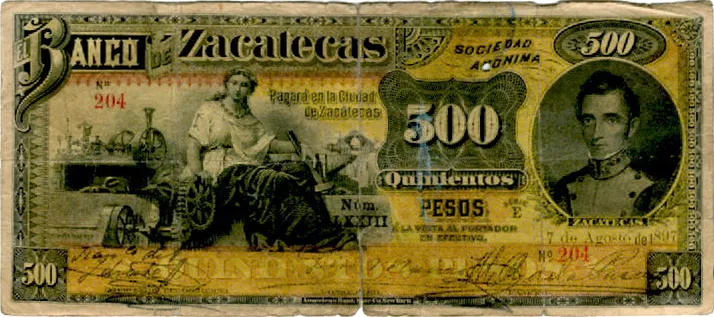
Engraved allegorical vignettes: a miner on the left, a female figure with goods in the center, and the profile portrait of a young man on the right
Reverse
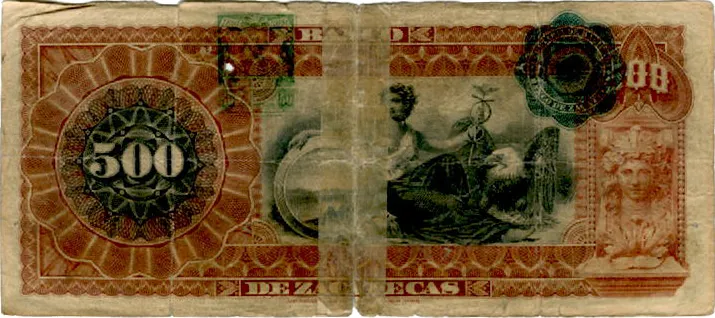
Scenes of mining and labor, or a monument set against the mountainous landscape of Zacatecas
About this banknote
If you inherited or found an 1897 Banco de Zacatecas 500 pesos note, here is the honest answer: this is not a Bank of Mexico bill you can spend. It is a private state-bank note from the Porfiriato era, over a century old, and its worth is purely collector value. Genuine, well-preserved examples of scarce issuing banks can sell for anywhere from a few hundred to several thousand US dollars, depending entirely on condition and rarity.
This is one of the more storied pieces in Mexican notaphily (the study and collecting of paper money), because of what it represents: a time before Mexico had a single central bank.
What this note actually is
Before 1925, Mexico had no single national issuer. Under President Porfirio Díaz (the period collectors call the Porfiriato), individual states licensed private banks to print their own paper money, backed by silver. The Banco de Zacatecas was one of them. Zacatecas is legendary mining country, so the note's engravings speak of mining, because the silver ore was literally the guarantee behind the paper.
This multi-bank system ended when the Banco de México (Mexico's central bank) was founded in 1925, which is why any note from these private state banks is automatically historical, not spendable currency.
Design details (verify yours against these):
- Front (anverso): engraved allegorical vignettes. A miner on the left, a female figure with merchandise in the center, and the portrait of a young man in profile on the right.
- Back (reverso): mining and labor scenes, or a monument set against the mountainous Zacatecas landscape.
- Denomination: 500 pesos.
- Issuer: Banco de Zacatecas (state bank of issue), dated 1897.
How much is it worth in 2026
The value driver here is not age. Almost every note from this era is old, so age alone means little. What matters is which bank issued it, how many survive, and the condition of your specific note.
Private-bank notes from the Porfiriato and revolutionary-era scrip form their own collecting market. Some banks printed large quantities and their notes are common; others are genuinely scarce, and many circulated so briefly that few complete examples survive today. The 500 pesos was a very high denomination for 1897, which usually means fewer were printed and fewer survive intact.
Condition follows the standard world-paper-money grading language collectors use:
| Condition | What it means | Effect on value |
|---|---|---|
| Uncirculated (UNC) | No folds, crisp paper, full corners | Highest value, can multiply the price |
| Very Fine (VF) | Light handling, minor folds | Solid mid-range |
| Fine / Good | Heavy folds, soft paper, edge wear | Bottom of the range |
| Damaged / repaired | Tears, tape, missing pieces, stains | Sharply reduced |
Because survival rates for individual Banco de Zacatecas notes vary so widely, we do not quote a single fixed figure. An honest working range for a genuine example runs from a few hundred US dollars for a heavily circulated common variety up to several thousand for a scarce, high-grade note. Before you sell or buy, get it identified against a catalog or by a serious dealer. Do not trust the first internet price you see.
How to tell if yours is genuine
Reproductions and outright fakes of attractive antique notes exist, and the 500 pesos is exactly the kind of showpiece that gets copied. Check these:
- Paper feel. Genuine notes are printed on quality bank-note paper. Reproductions often use smooth, modern paper with flat, printer-like color.
- Engraving depth. Original vignettes were engraved and printed with fine, sharp line detail. Reprints look soft or dot-patterned under magnification.
- Color. Real notes have layered ink tones; reproductions tend to look uniformly flat.
- Signatures and serial numbers. These were applied to genuine issued notes. Compare the design, wording, and layout against verified reference images before you conclude anything.
Many surviving examples are also remainders or specimens (unissued sheets that never entered circulation), which is normal for this era and does not make a note fake, but it does affect value. If you are unsure, post clear photos of both sides in the Pesoteca forum and the community can weigh in.
Where to sell it
To sell an 1897 Banco de Zacatecas 500 pesos note without getting shortchanged:
- Use a verified numismatic dealer from the Pesoteca directory, who can value it on the spot.
- Or list it in the Pesoteca buy-and-sell forum, where collectors who actually understand Porfiriato bank notes are watching.
- For a scarce high-grade example, an established world-paper-money auction is worth considering, since serious bidders drive the strongest prices.
Always photograph both faces in good light, note the serial number, and describe the condition honestly. Avoid dumping it to the first buyer on social media, that is how genuinely scarce notes get sold for a fraction of their worth.
Think you have a real Banco de Zacatecas note? Post both sides in the Pesoteca forum and let collectors help you pin down the variety and grade.
Historical context
The Banco de Zacatecas issued, over more than two decades, notes of up to 500 pesos, its highest denomination. This 1897 500-peso example belongs to the bank's period of greatest solidity, when it already operated branches outside the state in Aguascalientes and San Juan de los Lagos, extending its paper money across the Bajío.
The obverse composition repeats the house's visual language: the miner, emblem of Zacatecas's silver-mining vocation; the female figure of commerce; and the youthful portrait in profile. The reverse, with its scenes of mining labor, reinforced that territorial identity.
Engraved by the American Bank Note Company of New York, this very high denomination note did not circulate in retail: it was an instrument for large payments among commercial houses, landowners, and banks, in a Mexico still anchored in metallic currency.
Frequently asked questions
How much is the 1897 Banco de Zacatecas 500 pesos note worth?
It has no spendable face value, it is purely a collector item. A genuine example can run from a few hundred US dollars for a heavily circulated note up to several thousand for a scarce, uncirculated one. Condition and how many survive from that specific bank decide the price.
Is the 1897 500 pesos banknote rare?
It can be. Some Porfiriato private-bank notes are common, others are genuinely scarce. The 500 pesos was a very high denomination in 1897, so fewer were printed and fewer survive intact, which tends to favor rarity. The exact variety of your note determines this, so get it identified against a catalog.
How can I tell if my note is genuine?
Check the paper (real notes use quality bank-note paper, reproductions feel smooth and modern), the engraving (original line detail is sharp, reprints look soft or dotted under magnification), and the color layering. Compare the design, signatures, and serial number against verified reference images. If in doubt, post photos of both sides in the Pesoteca forum.
Where can I sell the 1897 500 pesos banknote?
Use a verified dealer from the Pesoteca directory for an on-the-spot valuation, or list it in the Pesoteca buy-and-sell forum among collectors. For a scarce, high-grade example, an established world-paper-money auction can bring the strongest bidders. Photograph both faces clearly and describe condition honestly before selling.
Características Banxico
LXXIII
Familia PRIV
This banknote belongs to the BIL-PRIV family within the Sistema PSM . Explore all the banknotes that share origin, era and design with this piece.
Ver todos los billetes de la familia PRIV →