
500 Pesos Banknote (1895), Banco de Zacatecas
Familia PRIV · algodón
Period: Bancos privados de emisión
Design
Banxico
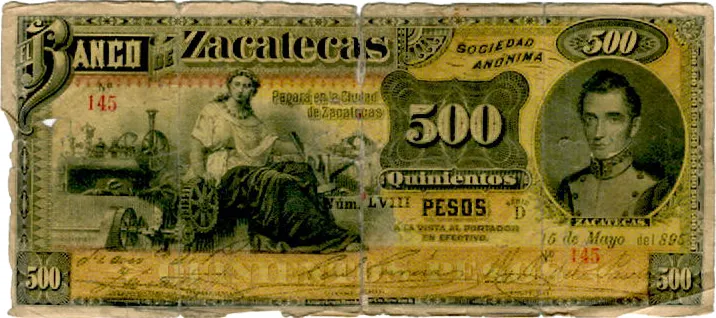
Obverse
Banco de Zacatecas
Engraved allegorical vignettes: a miner on the left, a female figure with goods in the center, and the profile portrait of a young man on the right
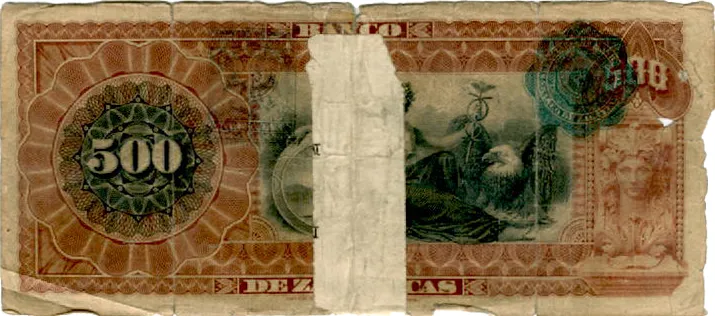
Reverse
Scenes of mining and labor, or a monument set against the mountainous landscape of Zacatecas
About this banknote
If you inherited an 1895 500 pesos note from the Banco de Zacatecas, you're holding a piece of Mexico's private-bank era, not modern currency. It has no face value today, only collector value. Depending on condition and how many survive, these notes trade anywhere from roughly 30 dollars for a worn example to several hundred, and rare high-grade pieces can reach four figures.
This is not a modern Banco de México bill. It comes from a time before Mexico had a single central bank, when individual states licensed private banks to print their own paper money, each backed by silver. Zacatecas was one of the great silver-mining states, so the Banco de Zacatecas issued notes backed by the metal coming out of its mines. That system of multiple issuing banks ended when the Banco de México was founded in 1925, which is why these older notes are collector items rather than legal tender.
What it actually is
The Banco de Zacatecas was one of the state issuing banks of the Porfiriato, the long rule of Porfirio Díaz (roughly 1876 to 1911). These banks printed notes that circulated regionally and were redeemable in silver. The mining imagery on the 500 pesos note is deliberate: the silver in the ground was the guarantee behind the paper.
Front (obverse): Engraved allegorical vignettes. A miner on the left, a female figure with goods at the center, and the portrait of a young man in profile on the right.
Back (reverse): Scenes of mining and labor, or a monument set against the mountainous Zacatecas landscape.
What it's worth in 2026
This is historic paper money, well over a century old, so every dollar of its value is collector value. Two things drive the price: condition (grade) and rarity of the issuing bank and denomination.
Private-bank notes from the Porfiriato behave very differently from one bank to the next. Some issues are relatively common and affordable. Others are genuinely scarce because they circulated briefly, were redeemed and destroyed, or simply did not survive in decent shape. High denominations like the 500 pesos were used less in everyday commerce, so fewer entered circulation, but the ones that did often show heavy handling.
| Condition | What it looks like | Typical value range (USD) |
|---|---|---|
| Well-circulated | Folds, soiling, edge wear, maybe small tears | ~30 to 120 |
| Fine to Very Fine | Whole, moderate wear, no major damage | ~120 to 400 |
| Extremely Fine / About Uncirculated | Crisp, minimal handling | ~400 to 1,200+ |
| Uncirculated / high certified grade | No folds, original paper | Four figures for scarce examples |
These are ranges, not fixed prices. A serious mismatch, a repaired tear, cancellation punches, or a reprint can pull a note far below these figures. Get it graded before you assume a number.
What makes one worth more
- Grade above everything. A crisp, unfolded note can be worth ten times a soft, worn one of the same type. Collectors of world paper money pay steeply for original, uncirculated paper.
- A remainder vs. an issued note. Some of these notes survive as "remainders," printed but never signed, dated, or put into circulation. Fully issued notes with signatures and serial data can be scarcer and more desirable.
- Serial number features. A low serial number or a palindrome (a number that reads the same both ways) adds a premium.
- Printing errors. Genuine factory errors, misaligned cuts, ink smears, mismatched serials, raise value. Ordinary wear from handling is not an error.
Notes people overrate
"It's from 1895, so it must be worth a fortune" is the most common mistake with these. Age alone does not make a banknote valuable. What matters is how many survive and in what condition. A heavily circulated, common private-bank note can be worth less than a modern collectible. The value lives in scarcity plus grade, not the date on the paper.
How to check what yours is worth
- Photograph both sides in good, even light, flat, no glare. Front and back matter equally.
- Grade it honestly. Look for folds, tears, stains, pinholes, and missing corners. Any of these lowers the grade.
- Check for genuineness. Compare the paper, the engraving detail, the vignettes, and the signatures against reference images. Original notes from this era have engraved intaglio detail with a tactile relief. Reproductions and photocopies tend to have flat color and smooth, lifeless paper.
- Get a second opinion. For anything you think is scarce or high-grade, professional certification (for example through a third-party grading service that covers world paper money) protects both you and any future buyer.
Where to sell it
Your safest route is a verified dealer from the Pesoteca shop directory, who can value it in person, or the Pesoteca buy-and-sell forum where world-paper-money collectors trade directly. Before you agree to any price, confirm the serial number, the condition, and clear photos of both sides. Skip the impulse of dumping it on a social-media marketplace to the first bidder, high-denomination Porfiriato notes are exactly the kind of piece that gets undervalued that way.
If you're unsure whether yours is genuine, a remainder, or an issued note, post clear photos in the Pesoteca forum and let collectors who handle these notes take a look before you commit to buying or selling. What do the vignettes and signatures on your note look like?
Historical context
With a concession from 1891 and the backing of local mining entrepreneurs, the Banco de Zacatecas was part of the network of private banks of issue that made up for Mexico's lack of a central bank. This 500-peso note of 1895 represents the institution's highest denomination, suited to large-scale transactions.
Its iconography keeps the bank's hallmark: the miner paying tribute to Zacatecan silver, the female allegory of commerce, and the young man portrayed in profile, with scenes of mining and mountain landscape on the reverse. The whole set sought to convey solidity and regional roots.
The printing was handled by the American Bank Note Company, a global reference in steel engraving. A 500-peso piece in 1895 amounted to a fortune for the ordinary citizen; it circulated mainly within the banking and mercantile circuit.
Frequently asked questions
How much is an 1895 Banco de Zacatecas 500 pesos note worth?
It has no face value today, only collector value. A well-circulated example typically runs about 30 to 120 USD, a whole note in Fine to Very Fine condition around 120 to 400 USD, and a crisp, high-grade or certified piece can reach four figures. Condition and rarity decide everything.
Is the 1895 Banco de Zacatecas 500 pesos note rare?
It depends on the specific issue and how many survived. High denominations like the 500 pesos circulated less and are harder to find whole and crisp. Some private-bank notes from the Porfiriato are relatively common; others are genuinely scarce. A low serial number, a palindrome serial, or a printing error makes any example more sought after.
How can I tell if my 1895 500 pesos note is genuine?
Look at the paper and the engraving. Original notes from this era have intaglio-engraved vignettes with a tactile relief and fine detail. Compare the design, signatures, and serial style against reference images. Reproductions and photocopies usually have flat, lifeless color and smooth paper. If in doubt, post clear photos of both sides in the Pesoteca forum for a second opinion.
Where can I sell an 1895 Banco de Zacatecas 500 pesos note?
The safest options are a verified dealer from the Pesoteca shop directory, who can appraise it on the spot, or the Pesoteca buy-and-sell forum where world-paper-money collectors trade directly. Photograph both sides in good light, note any low or palindrome serial or printing error since these raise value, and avoid selling to the first bidder on social media.
Características Banxico
LVIII
Familia PRIV
This banknote belongs to the BIL-PRIV family within the Sistema PSM . Explore all the banknotes that share origin, era and design with this piece.
Ver todos los billetes de la familia PRIV →