
Mexican 50 Pesos Revolution Treasury Note: Value & Rarity
Familia REV · algodón
Period: Revolución Mexicana
Design
Banxico
Obverse
Erario Federal
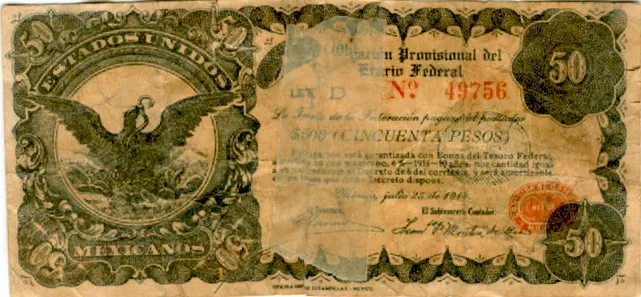
The Mexican eagle and the text of the provisional obligation of the Federal Treasury
Reverse
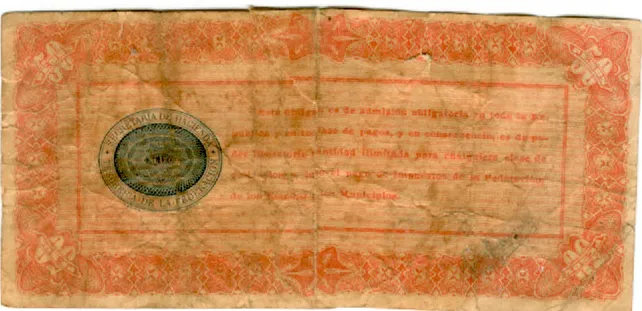
Text of the obligation, guaranteed by Federal Treasury bonds
About this banknote
Most old Mexican Revolution notes are worth a few dollars, but this one is different. The 50 pesos Obligación Provisional del Erario Federal (Provisional Obligation of the Federal Treasury) is genuine century-old government paper, and clean survivors trade among collectors for anywhere from about 20 USD to a few hundred USD depending on condition and issuer. Here's how to tell what yours is worth.
What this note actually is
During the Mexican Revolution (roughly 1910 to 1920), cash ran short and the government improvised. The Obligación Provisional del Erario Federal was not a normal banknote. It was public debt turned into circulating paper: the Federal Treasury (Erario Federal) backed these obligations with Treasury bonds (bonos del Tesoro), and ordinary people spent them like money because there was nothing else to spend.
That blurred line between government IOU and paper currency is exactly what makes these pieces interesting to collectors of world paper money (a hobby called notaphily). You are holding a physical record of a country running its finances on emergency scrip.
The design
- Front (obverse): the Mexican eagle and the text identifying it as a provisional obligation of the Federal Treasury.
- Back (reverse): the terms of the obligation, stating it is guaranteed by federal Treasury bonds.
- Denomination: 50 pesos.
How much is it worth in 2026
This note has zero face value today. It has not been legal tender for over a century, so any worth is purely collector value. Two things drive that value: condition (grade) and the specific issuer.
Revolution-era emergency paper is a mixed market. Some issues were printed in large numbers and survive easily, so they stay cheap. Others circulated so briefly, or were pulled and destroyed so fast, that intact examples are genuinely scarce. Because these notes passed through many hands during a chaotic period, most survivors are heavily worn, torn, or repaired. A crisp, undamaged example is the exception, and that is what pushes the price up.
| Condition | What it looks like | Typical collector range (USD) |
|---|---|---|
| Well-circulated | Soft, limp, folds, small tears or stains | 10 to 30 |
| Circulated, sound | Clear detail, minor folds, no tears | 25 to 75 |
| About uncirculated / crisp | Sharp corners, bright paper, minimal handling | 75 to 300+ |
These are collector ranges for the type, not a guaranteed quote. A rare issuer variety in high grade can exceed the top of this table, while a common, damaged one sits near the bottom. If a website tells you a piece like this is "worth thousands," treat that as clickbait until you see a real sale to back it up.
What makes one worth more than another
- Grade. Paper money value is brutal about condition. No folds, no tears, no writing, no tape. A single hard center fold can cut the price in half.
- Issuer and variety. Different treasury offices and printings exist. The scarce ones command a premium that catalog references and specialist dealers track.
- Serial numbers. A very low serial number (like 00000012) or a palindrome (a serial that reads the same backward, sometimes called a radar note) adds a premium collectors will pay for.
- Printing errors. Genuine factory errors (misaligned cuts, ink smears, mismatched serials, off-center printing) turn a common note into a standout. Ordinary wear and use damage is not an error and does not add value.
The myth to ignore
The most common mistake we see is assuming "old equals valuable." Age alone means almost nothing in paper money. A worn, torn 100-year-old note can be worth less than a crisp modern commemorative. What matters is how many survived, how many collectors want them, and what condition yours is in. Being from the Revolution is a nice story, but the market prices the paper, not the history lesson.
How to tell if yours is genuine
Reproductions and modern souvenir reprints of Revolution-era paper do circulate. Check for:
- Paper feel. Original notes are printed on period paper with a distinct texture. Reprints often feel smooth, glossy, or too white.
- Color depth. Genuine notes show layered, slightly uneven ink from period printing. Fakes tend to look flat and uniform.
- Detail sharpness. Compare the eagle, the lettering, and any signatures against reference images. Blurry or pixelated detail signals a scan-and-print copy.
- Aging. Real century-old paper ages honestly. Artificially "aged" fakes often have even, painted-on staining.
When in doubt, post clear photos of both sides in the Pesoteca forum and let experienced collectors weigh in before you buy or sell.
Where to sell or appraise it
- Get it graded honestly first. Handle it by the edges, photograph both sides in good light, and note the serial number.
- Use a verified dealer. A numismatic shop from the Pesoteca dealer directory can value it on the spot and buy without middleman markup.
- Sell collector-to-collector. The Pesoteca buy-and-sell forum connects you with people who actually know this series and will pay a fair price.
Avoid dumping it to the first bidder on a general marketplace. Buyers there rarely recognize the issuer variety or reward a low serial, and you may leave real money on the table.
Have one of these Treasury obligation notes sitting in a drawer? Post the front, the back, and the serial number in the Pesoteca forum and let's find out whether yours is a common survivor or the scarce issue collectors chase.
Historical context
Another Provisional Obligation of the Federal Treasury, in a denomination of 50 pesos, within the complex system of emergency money left by the Mexican Revolution. It is not a bank note in the usual sense: it is a State debt instrument that people used as cash, backed by Federal Treasury bonds.
To understand it, one must picture the country between 1913 and 1916: war, empty coffers, and a metal coinage that disappeared because everyone hid it away. With no silver or gold to back the paper, the authority promised to pay it later, relying on bonds. The obverse bears the Mexican eagle alongside the legal text of the obligation; the reverse explains that guarantee. Everything revolved around trust, the scarcest good of the period.
These issues coexisted with constitutionalist notes and those of other factions, feeding an inflation that eroded the value of the paper with enormous speed. As a collector's piece, this 50-peso obligation is direct testimony to a State that, in the midst of the Revolution, financed its expenses with printed promises instead of metal money.
Frequently asked questions
How much is the Mexican 50 pesos Treasury Obligation note worth?
It has no face value anymore, so worth is purely collector value. Well-circulated examples trade for roughly 10 to 30 USD, sound circulated notes 25 to 75 USD, and crisp, near-uncirculated pieces from 75 to 300 USD or more. Condition and the specific issuer variety decide where yours lands.
Is the 50 pesos Revolution Treasury note rare?
It depends on the issuer and printing. Some issues survive easily and stay affordable, while others circulated briefly and are genuinely scarce today. Because most passed through heavy use during the Revolution, high-grade survivors of any variety are the exception, and that scarcity of condition is often what drives the price.
Where can I sell or appraise a 50 pesos Treasury Obligation note?
The safest options are a verified shop from the [Pesoteca dealer directory](/tiendas), which values it in person, or the [Pesoteca buy-and-sell forum](/foro/compra-venta) among collectors. Photograph both sides in good light and note the serial number before selling. Avoid dumping it on a general marketplace where buyers may not recognize its value.
How can I tell if my 50 pesos Treasury note is genuine?
Check the paper texture (originals feel like period paper, not smooth or glossy), the ink depth (genuine notes show layered, uneven color while fakes look flat), and detail sharpness on the eagle and lettering against reference images. Beware artificially aged reprints with even, painted-on staining. If unsure, post photos in the [Pesoteca forum](/foro) for a second opinion.
Familia REV
This banknote belongs to the BIL-REV family within the Sistema PSM . Explore all the banknotes that share origin, era and design with this piece.
Ver todos los billetes de la familia REV →