
50 Pesos Banknote from the Bank of Zacatecas (1906)
Familia PRIV · algodón
Period: Bancos privados de emisión
Design
Banxico
Obverse
Banco de Zacatecas
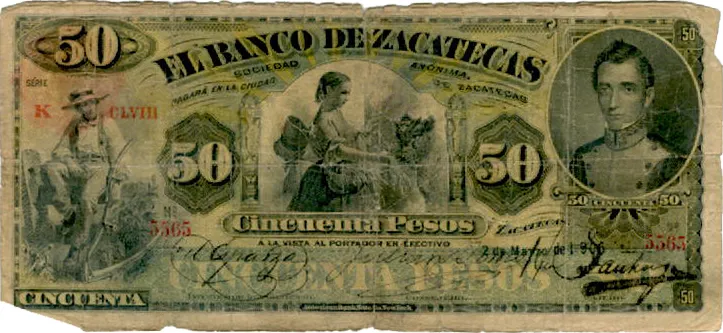
Engraved allegorical vignettes: a miner on the left, a female figure with goods in the center, and the profile portrait of a young man on the right
Reverse
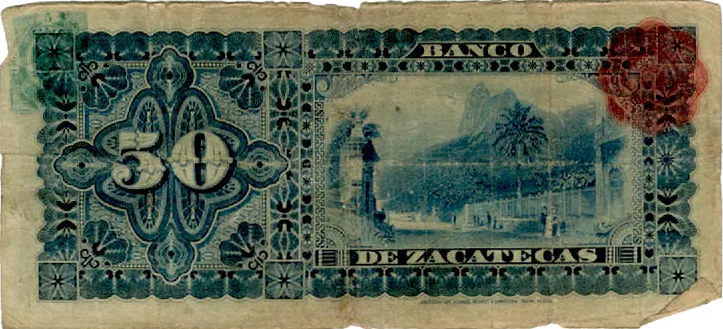
Scenes of mining and labor, or a monument set against the mountainous landscape of Zacatecas
About this banknote
Most old Mexican banknotes turn up worth a few dollars, but pre-1925 private bank notes are a different animal. The 1906 50 pesos note from the Banco de Zacatecas is a genuine collector piece, and depending on condition it can move from a few dollars for a worn example to a few hundred USD for a crisp, uncirculated one. What follows is how to tell which one you have.
This note is not a Banco de México issue. It predates Mexico's central bank entirely. During the Porfiriato (the long rule of Porfirio Díaz, roughly 1876 to 1911), Mexico had no single national issuer. Instead, individual states licensed private banks to print their own paper money, each note backed by silver held in reserve. Zacatecas was mining country, so its bank, the Banco de Zacatecas, tied its notes to the metal coming out of the ground. That is why the vignettes show miners: the ore was the guarantee.
This system of multiple issuing banks ended when the Banco de México was founded in 1925 and took over as the country's only note-issuing authority. That break is exactly what makes these earlier notes interesting to collectors of world paper money (notaphily), because they represent a monetary era that no longer exists.
What the 1906 Zacatecas 50 pesos note looks like
The face carries engraved allegorical vignettes: a miner on the left, a female figure holding goods in the center, and a portrait of a young man in profile on the right. The back shows mining and labor scenes, or a monument set against the mountainous Zacatecas landscape. The design language is entirely about mining, wealth from the ground, and the silver that backed the paper.
Keep in mind that private banks issued notes across several denominations and dates in this period, so small differences in date, signatures, and serial number ranges matter when you identify yours.
What it's worth today
This is historical paper money, well over a century old, so its value is purely collector value. There is no face-value floor to fall back on, because these notes were demonetized long ago. Two things drive the price: condition and rarity of the issuing bank.
Private Porfiriato bank notes and later Revolution-era scrip trade in their own market. Some issuers are common and some are genuinely scarce. Many of these notes circulated so little, or survived so poorly, that a complete, intact example is hard to find. As a broad guide for the Zacatecas 50 pesos:
| Condition | What it looks like | Approximate collector value (USD) |
|---|---|---|
| Well-worn / damaged | Heavy folds, tears, staining, pieces missing | A few dollars to about 30 |
| Circulated but intact | Folds and handling, no major damage | Roughly 40 to 120 |
| Crisp / uncirculated | No folds, sharp corners, bright color | Several hundred, depending on the specific issue |
These are indicative ranges, not fixed prices. The exact figure depends on the precise date, the specimen versus issued status, and how the market values that particular bank in the year you sell. High-grade certified examples from scarce issuers can exceed these ranges.
Watch for specimens and remainders
A large share of surviving Porfiriato bank notes are specimens or remainders: notes that were printed but never actually put into circulation, often unsigned or overprinted with the word "SPECIMEN" or perforated with holes. These are legitimate collector items, but they trade differently from a genuinely issued, hand-signed note that saw real use. If your note is pristine, that can be a very good sign, or it can mean it never circulated because it was a remainder. Neither is bad; you just need to know which you have to price it correctly.
The myth: "it's over 100 years old, so it must be worth a fortune"
Age alone does not make paper money valuable. Plenty of century-old notes are worth pocket change because they survive in large numbers. What actually moves the price is scarcity of that specific bank and denomination, condition, and collector demand. Do not take the first online listing as gospel; sellers routinely ask far more than notes actually sell for. Look at completed sales, not asking prices.
How to check what yours is worth
- Grade the condition honestly. Lay the note flat and look for folds, tears, pinholes, staining, and missing corners. Crisp and flat beats worn and creased by a wide margin.
- Read the details. Note the exact date, the bank name, the serial number, and whether it is signed or marked as a specimen. Compare against reference images.
- Check for authenticity. Genuine period notes were engraved on quality paper with fine, raised line work you can sometimes feel. Reproductions and modern reprints tend to have flat, printed-looking color, smooth paper, and blurry detail. Compare the design, paper, and signatures against verified reference images.
- Consider certification. For a note that might be worth several hundred dollars, third-party grading from PMG (Paper Money Guaranty) protects both authenticity and grade, and typically raises what a buyer will pay.
Where to sell it
For a note like this, sell to people who actually collect world paper money. A verified numismatic dealer from the Pesoteca directory can value it on the spot, and the Pesoteca buy and sell forum puts you in front of collectors who know these Porfiriato issues. Photograph both sides in good light, note the date and serial number, and get more than one opinion before you accept an offer. Avoid dumping it to the first buyer on a general marketplace, where these notes are routinely underpriced by people who do not recognize them.
If you also have Banco de México notes in the same box, those follow a different pricing logic based on series letter and signature; check those separately.
Have one of these Zacatecas notes, or another private bank issue from the Porfiriato? Post clear photos of the front and back in the Pesoteca forum and let collectors help you identify the exact issue and what it's really worth.
Historical context
The Banco de Zacatecas maintained its high-denomination note issue throughout the first decade of the 20th century, when the circulation of regional bank paper was a normal part of the economy. Founded in 1891, it rested its prestige on the state's mining, one of Mexico's great suppliers of silver.
This 50-peso note of 1906 belongs to the last stable years of the Porfiriato, before the Revolution altered the country's financial life. Fifty pesos served substantial commerce and formal operations. Its obverse brings together the series' vignettes: a miner on the left as an emblem of Zacatecan silver, a female figure with goods in the center, and a young man in profile on the right, with mining scenes on the reverse. The printing was carried out by the American Bank Note Company of New York. This entire scheme of regional issuance would disappear with the creation of the Banco de México in 1925.
Frequently asked questions
How much is the 1906 Bank of Zacatecas 50 pesos note worth?
It has no face value anymore, so its worth is purely collector value. A worn or damaged example may bring only a few dollars up to about 30 USD, a clean circulated note roughly 40 to 120 USD, and a crisp uncirculated example several hundred USD depending on the specific issue. Condition and the rarity of the issuing bank decide the price.
Is the 1906 Zacatecas 50 pesos note rare?
It's scarcer than common circulation notes but not extremely rare. Many Porfiriato private bank notes survive as specimens or remainders that never circulated. A genuinely issued, hand-signed note that saw real use, especially in high grade, is harder to find and worth more than a common specimen.
Where can I sell my 1906 Zacatecas banknote?
Sell to collectors of world paper money, not a general marketplace. A verified dealer from the [Pesoteca directory](/tiendas) can value it in person, and the [Pesoteca buy and sell forum](/foro/compra-venta) reaches collectors familiar with Porfiriato bank notes. Photograph both sides in good light, record the date and serial number, and get more than one offer before selling.
How can I tell if my 1906 Zacatecas note is genuine?
Genuine period notes were engraved on quality paper with fine, sometimes raised line work, and the signatures and serial numbers show real detail. Reproductions tend to have flat printed color, smooth paper, and blurry lines. Compare against verified reference images, and for a valuable note consider third-party grading from PMG. If unsure, post clear photos in the [Pesoteca forum](/foro).
Características Banxico
Firmas autógrafas, CLVIII, S07
Familia PRIV
This banknote belongs to the BIL-PRIV family within the Sistema PSM . Explore all the banknotes that share origin, era and design with this piece.
Ver todos los billetes de la familia PRIV →