
Banco de Zacatecas 50 Pesos (1903)
Familia PRIV · algodón
Period: Bancos privados de emisión
Design
Banxico
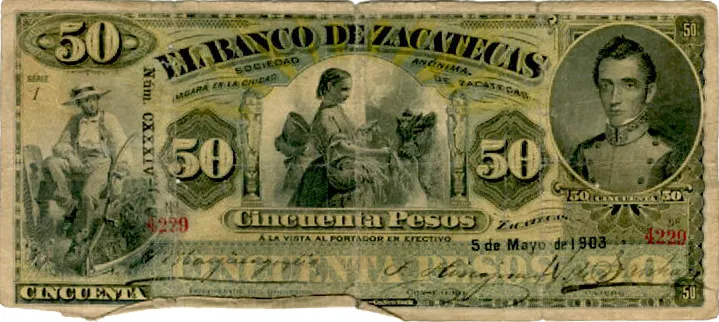
Obverse
Banco de Zacatecas
Engraved allegorical vignettes: a miner on the left, a female figure with goods in the center, and the profile portrait of a young man on the right
Reverse
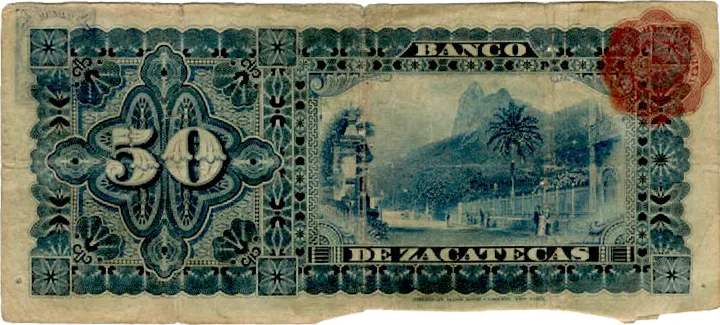
Scenes of mining and labor, or a monument set against the mountainous landscape of Zacatecas
About this banknote
Most old Mexican banknotes are worth a few dollars, but a genuine 1903 Banco de Zacatecas 50 pesos note is a different animal. These are pre-central-bank private bank issues over a century old, and depending on condition they trade among world paper money (notaphily) collectors from roughly 20 USD for a worn example to several hundred USD for a crisp, uncirculated one. Here is what yours is worth and how to verify it.
This is not a modern circulating note. It predates the Banco de México (founded 1925) by more than two decades. Its value is purely collectible, driven by condition, rarity of the issuing bank, and whether it survived intact.
What this note actually is
Before Mexico had a single central bank, each state hosted private banks licensed to print their own paper money, backed by silver. The Banco de Zacatecas was one of them, operating in a state that was one of the great silver-mining centers of the world. That mining heritage is stamped all over the design: the vignettes reference ore and labor because minerals were the literal collateral behind the note.
This system of multiple issuing banks ended when the Banco de México was established in 1925 and took over sole authority to print currency. Notes like this one became instant relics.
The design
- Obverse (front): engraved allegorical vignettes. A miner on the left, a female figure with merchandise in the center, and the profile portrait of a young man on the right.
- Reverse (back): scenes of mining and labor, or a monument set against the mountainous Zacatecas landscape.
- Issuer: Banco de Zacatecas, a state-level bank of issue during the Porfiriato (the long presidency of Porfirio Díaz).
How much is it worth in 2026
Honest answer: it ranges widely, and condition is the single biggest factor. Private Porfiriato bank notes and later Revolution-era scrip form their own collecting niche. Some are common; others are genuinely scarce because they circulated so little or were redeemed and destroyed.
| Condition | What it means | Approximate value (USD) |
|---|---|---|
| Heavily circulated | Soft paper, tears, missing corners | 15 to 40 USD |
| Fine to Very Fine | Folds present, still whole and legible | 40 to 120 USD |
| Uncirculated / crisp | No folds, sharp corners, full color | 150 to 400+ USD |
| Specimen or proof | Marked SPECIMEN, no serial, from bank archives | Can exceed the above significantly |
These are collector ranges for genuine, correctly attributed examples. A note with a low serial number, an unusual signature combination, or a printing error sits at the high end or above it. Do not trust the first price you see on a general marketplace listing. Ask in the Pesoteca forum or a serious dealer before you sell.
What raises the value
- Condition above all. An uncirculated note can be worth five to ten times a folded one of the same type.
- Low or unusual serial numbers. A very low serial or a palindrome (radar) serial draws extra demand.
- Printing errors. Misaligned cuts, ink smears, factory folds, or off-center serials turn a common note into a genuine rarity. Normal wear from use is not an error.
- Specimen and proof notes. Archive pieces marked SPECIMEN, often with zero serials or punch cancellations, command premiums.
The myth to kill
"It's over 100 years old, so it must be worth thousands." Age alone does almost nothing. Millions of these notes existed, and survivors are not automatically rare. What moves the price is condition and the specific scarcity of that bank and denomination, not the calendar. A tattered example is still a modest note.
How to tell if yours is genuine
Reproductions and reprints of Porfiriato bank notes exist. Check these before you value it:
- Paper. Original notes use rag-content paper with texture and slight translucency. Reproductions feel smooth and flat.
- Engraving depth. Genuine notes were intaglio printed; the lines have subtle relief you can sometimes feel. Fakes print flat with muddy detail.
- Color. Originals show layered, slightly uneven inking. Reproductions look uniform and photographic.
- Signatures and serials. Compare against verified images of Banco de Zacatecas issues. Modern digital "reprints" often lack proper serial fonts.
When in doubt, post clear, well-lit photos of both sides in the Pesoteca forum so the community can weigh in before you buy or sell.
Where to sell it
To sell an 1903 Banco de Zacatecas note safely, use a verified dealer from the Pesoteca shop directory, who can appraise it on the spot, or list it in the collector buy-and-sell forum. Photograph both faces in good light and note any low serial, radar serial, or error, since those raise the price. Avoid dumping it to the first bidder on a social feed. For a broader view of what Mexican paper money brings today, our guide to valuable Mexican banknotes puts this issue in context.
Have one of these in a family collection, or found one tucked in an old book? Share the front and back in the forum and let's figure out exactly what you're holding.
Historical context
The Banco de Zacatecas passed through the first decade of the 20th century in full boom, favored by the stability of the Porfiriato. Founded in 1891, it printed backed notes of various denominations, among them the high 50-peso value, intended for larger-scale commerce and finance.
This 50-peso note of 1903 corresponds to those years of prosperity before the Revolution. Its obverse shows the bank's distinctive iconography: a miner on the left, a direct reference to the industry that made Zacatecas famous, a female figure with goods in the center, and a young man in profile on the right, with mining labor motifs on the reverse. Engraved by the American Bank Note Company of New York, it is a good example of the refinement reached by the issues of Mexican private banking. This system of state banks of issue would be replaced by the Banco de México starting in 1925, when the authority to print currency was centralized.
Frequently asked questions
How much is the 1903 Banco de Zacatecas 50 pesos note worth?
As a collectible, a genuine example runs from roughly 15 to 40 USD when heavily circulated, 40 to 120 USD in Fine to Very Fine, and 150 to 400 USD or more when crisp and uncirculated. Condition and the rarity of the issuing bank drive the price, not age alone.
Is the 1903 Banco de Zacatecas note rare?
Some private Porfiriato bank notes are common and others are genuinely scarce. Many circulated so little, or were redeemed and destroyed, that intact survivors are hard to find. High-grade, low-serial, or error examples are the rare and valuable ones.
Where can I sell my 1903 Banco de Zacatecas 50 pesos note?
The safest options are a verified dealer from the [Pesoteca shop directory](/tiendas), who appraises it in person, or the [collector buy-and-sell forum](/foro/compra-venta). Photograph both sides clearly and flag any low serial, radar serial, or printing error, since those raise the value.
How do I tell if my 1903 Banco de Zacatecas note is genuine?
Check the paper (originals are textured rag paper, not smooth), the engraving (genuine intaglio printing has subtle relief), and the color layering. Compare signatures and serial fonts to verified Banco de Zacatecas images. If unsure, post photos of both sides in the [Pesoteca forum](/foro).
Características Banxico
Firmas autógrafas, CXXXIV
Familia PRIV
This banknote belongs to the BIL-PRIV family within the Sistema PSM . Explore all the banknotes that share origin, era and design with this piece.
Ver todos los billetes de la familia PRIV →