
50 Pesos Banknote (1900), Banco de Zacatecas
Familia PRIV · algodón
Period: Bancos privados de emisión
Design
Banxico
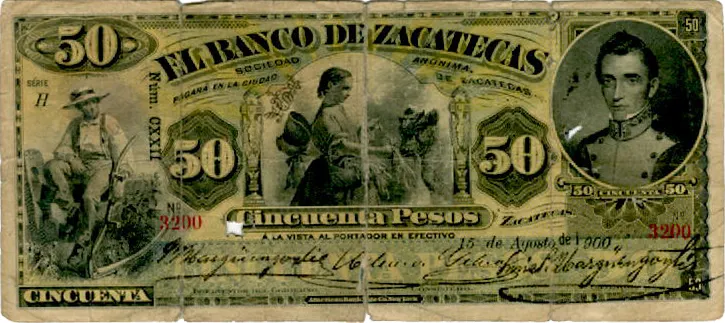
Obverse
Banco de Zacatecas
Engraved allegorical vignettes: a miner on the left, a female figure with goods in the center, and the profile portrait of a young man on the right
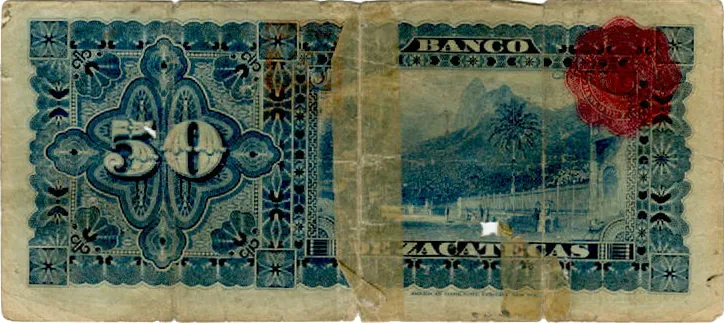
Reverse
Scenes of mining and labor, or a monument set against the mountainous landscape of Zacatecas
About this banknote
Most old Mexican banknotes are worth a few dollars. But a genuine 1900 Banco de Zacatecas 50 pesos note is not one of them. This is private-bank paper money from the Porfiriato era, and depending on condition it can move from roughly 100 USD in worn shape to well over 1,000 USD for a crisp, high-grade example. Rarity of the issuing bank and condition drive everything.
What it is
Before Mexico had a single central bank, individual states ran private banks licensed to print their own paper money, backed by silver. The Banco de Zacatecas was one of them. Zacatecas is classic mining country, so the note's imagery is all about mining, because the silver in the ground was literally the guarantee behind the paper. This system of multiple issuing banks ended when the Banco de México was founded in 1925, which is why every note from this earlier era is now a collectible relic rather than legal tender.
The face (anverso) carries engraved allegorical vignettes: a miner on the left, a female figure with goods in the center, and the profile portrait of a young man on the right. The back (reverso) shows mining and labor scenes, or a monument set against the mountainous Zacatecas landscape.
How much is it worth in 2026
This is historical paper money, over a century old, so it has zero face value today. Its worth is purely collector value, and two things decide it: the rarity of the issuing bank and the physical condition of the note.
Private-bank notes from the Porfiriato and the emergency scrip (vales) of the Mexican Revolution have their own active market in the world paper money hobby. Some issues are common and trade cheaply. Others are genuinely scarce, because they circulated so little, or so hard, that few survive intact today. A note that is torn, taped, or heavily worn sits near the bottom of the range. A note that is crisp, uncirculated, and problem-free can sell for many times more.
Because the spread is so wide, do not trust the first price you see online. The same catalog number can be worth 80 USD or 1,200 USD depending only on grade and eye appeal.
| Note | Bank | Date | Typical value range (USD) | Where it sells |
|---|---|---|---|---|
| 50 pesos | Banco de Zacatecas | 1900 | ~100 to 1,500+ (condition dependent) | Heritage Auctions, Stack's Bowers, specialist dealers |
| Common Porfiriato private-bank notes | Various | 1897-1913 | ~20 to 150 | Dealer stock, collector forums |
| Scarce private-bank issues | Various | 1897-1913 | Several hundred to low thousands | Major world-paper auctions |
These ranges reflect what specialist world-banknote auctions and dealers realize for this class of material. Exact figures for a specific serial and grade require inspection.
The myth: "it's old, so it's a fortune"
Age alone means almost nothing in paper money. A 120-year-old note that survived in large numbers is worth pocket change. What actually pushes value up is scarcity of the issuing bank, high grade, and desirable serial numbers. A well-preserved note from a bank that issued very little can outsell a beat-up note that is technically older. Condition and rarity beat age every time.
What makes yours worth more
Three things separate a common note from a prize:
- Condition. No folds, no tears, no tape, bright color, sharp corners. Uncirculated or near-uncirculated notes command a large premium. Professional grading by PMG (Paper Money Guaranty) can add both value and trust for higher-end pieces.
- Serial number. A very low serial or a palindrome (radar) number is chased by collectors.
- Printing errors. Genuine factory errors, misaligned cuts, ink smears, mismatched serials, off-center printing, turn a common note into a rarity worth several times face-class value. Note that ordinary wear and use damage is not an error.
How to tell if it's genuine
With notes this old, authentication is about matching the physical piece to the record:
- Compare the design, the signatures, and the vignettes against documented examples in world paper money catalogs.
- Check the paper. Period banknote paper has texture and a feel that modern reproductions rarely match; reproductions tend to have smooth stock and flat, printed color.
- Look at the engraving depth. Genuine notes were engraved and printed by security printers of the era, with fine line detail that photocopies and inkjet fakes cannot reproduce.
- If value is on the line, submit it to a third-party grading service like PMG for authentication and encapsulation.
If you are unsure, post clear photos of both sides in the Pesoteca forum and let collectors weigh in before you buy or sell.
Where to sell it
For a note in this class, your best options are:
- A verified numismatic dealer from the Pesoteca shop directory, who can appraise it on the spot.
- The Pesoteca buy-and-sell forum, where you reach collectors directly.
- For a high-grade or scarce example, a major world paper money auction (Heritage, Stack's Bowers) will reach the deepest pool of buyers and often the best price.
Whatever you do, photograph both faces in good light, note the serial number, and get a second opinion before accepting an offer. Don't dump a genuinely scarce Porfiriato note to the first buyer on social media.
Have one of these Banco de Zacatecas notes, or another old Mexican private-bank issue? Post the serial and clear photos in the Pesoteca forum and let the community help you pin down what it's really worth.
Historical context
As the 20th century began, the Banco de Zacatecas maintained its prestige as one of the principal banks of issue in the north-central part of the country. It belonged to the private banking system unified by the General Law of Credit Institutions of 1897, which authorized each state to have its own issuer of backed paper money.
This 50-peso note of 1900 opens the new century with a high denomination, suited to larger-volume commerce and to financial operations. On the obverse coexist the series' vignettes: a miner representing Zacatecan silver, a female allegory of commerce in the center, and the portrait of a young man in profile on the right, with mining scenes on the reverse. The printing was carried out by the American Bank Note Company of New York. These images were not mere ornament: they tied the note's solvency to the region's tangible wealth. This model of a plurality of issuers would disappear when the Banco de México was founded in 1925.
Frequently asked questions
How much is the 1900 Banco de Zacatecas 50 pesos note worth?
It has no face value today; its worth is purely collector value. A worn example may bring around 100 USD, while a crisp, uncirculated note can reach 1,000 USD or more. Condition and the rarity of the issuing bank decide the price, so grade it or get it appraised before selling.
Is the 1900 Banco de Zacatecas 50 pesos note rare?
Some Porfiriato private-bank notes are common, but scarce issues from banks that printed little are genuinely hard to find in good condition. Many circulated so little, or so hard, that few survive intact. A high-grade or low-serial example is the most sought after in the world paper money market.
Where can I sell a 1900 Banco de Zacatecas banknote?
Use a verified dealer from the [Pesoteca shop directory](/tiendas) for an on-the-spot appraisal, or the [Pesoteca buy-and-sell forum](/foro/compra-venta) to reach collectors directly. For a scarce or high-grade note, a major world paper money auction like Heritage or Stack's Bowers reaches the most buyers. Always photograph both sides and get a second opinion first.
How can I tell if my Banco de Zacatecas note is genuine?
Compare the design, signatures, and vignettes against documented catalog examples. Genuine notes have textured period paper and deep engraving detail; reproductions use smooth stock and flat printed color. For anything valuable, submit it to PMG for authentication, or post clear photos of both sides in the [Pesoteca forum](/foro) for a community check.
Características Banxico
Firmas autógrafas, CXXII
Familia PRIV
This banknote belongs to the BIL-PRIV family within the Sistema PSM . Explore all the banknotes that share origin, era and design with this piece.
Ver todos los billetes de la familia PRIV →