
Mexico 50 Pesos (1897) Banco de Zacatecas Note
Familia PRIV · algodón
Period: Bancos privados de emisión
Design
Banxico
Obverse
Banco de Zacatecas
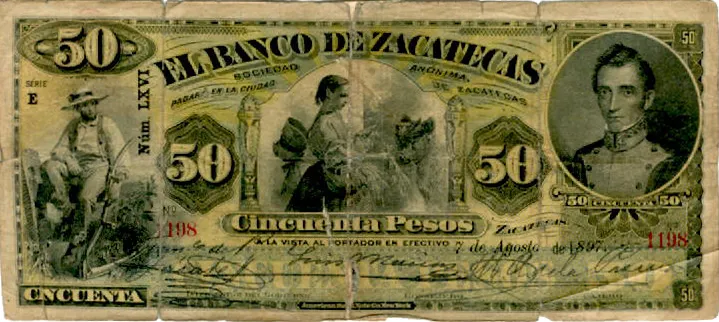
Engraved allegorical vignettes: a miner on the left, a female figure with goods in the center, and the profile portrait of a young man on the right
Reverse
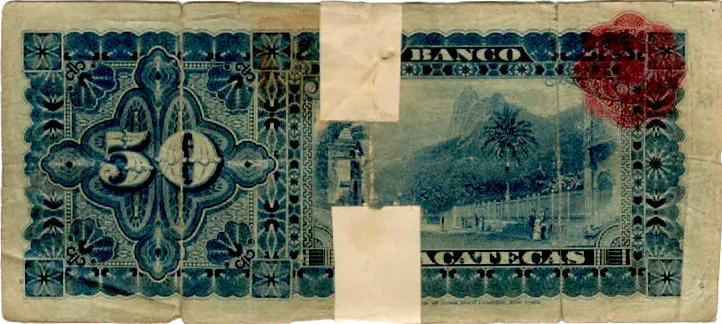
Scenes of mining and labor, or a monument set against the mountainous landscape of Zacatecas
About this banknote
Most old Mexican banknotes sell for a few dollars to a few hundred, not a fortune. The 1897 Banco de Zacatecas 50 pesos note sits at the higher end for one reason: it is a private-bank issue from the Porfiriato era, over 125 years old, and survivors in good condition are genuinely scarce. Condition and rarity decide everything here.
In 2026, a heavily worn or partial example may bring only USD 15 to 40, while a clean, well-preserved note can reach several hundred dollars or more at specialist auction. There is no fixed price. This is not modern currency with a face value you can spend; it is historic paper money with a collector market.
What this note actually is
Before Mexico had a single central bank, each state licensed its own private banks to print paper money, each note backed by silver reserves. Zacatecas, one of the great silver-mining regions of the country, had the Banco de Zacatecas, and its notes reflect that: the engraved scenes celebrate mining because the metal was the guarantee behind the paper.
This system of multiple issuing banks ended in 1925 when the Banco de México was founded as the sole note-issuing authority. That makes every surviving Banco de Zacatecas note a relic of a banking era that no longer exists, which is a large part of why collectors want them.
The design
- Front (obverse): allegorical engraved vignettes. A miner on the left, a female figure with goods at the center, and a young man's portrait in profile on the right.
- Back (reverse): mining and labor scenes, or a monument set against the mountainous Zacatecas landscape.
- Issuer: Banco de Zacatecas, a state-chartered private bank of the Porfiriato (the long rule of President Porfirio Díaz, roughly 1876 to 1911).
- Denomination: 50 pesos, dated 1897.
What drives the value
Four things move the price of a note like this, in order of impact:
- Condition (grade). A crisp, uncirculated note with no folds, tears, stains, or pinholes is worth many times a soft, worn example. Collectors use the same grading language as US paper money: Good, Fine, Very Fine, Extremely Fine, About Uncirculated, Uncirculated.
- Whether it is a genuine issued note or a remainder/specimen. Some Porfiriato notes survive as unissued remainders (no serial signatures) or printer's specimens marked "SPECIMEN" or "MUESTRA." These trade differently and are often the cleanest survivors.
- Serial number. A low serial number or a palindrome (radar) serial adds a premium.
- Printing errors. Misaligned cuts, ink smears, or offset printing turn a common note into a rarity worth several times the norm. Normal wear is not an error.
Real market context
Mexican private-bank notes from the Porfiriato and vouchers (vales) from the Revolution have their own active market among world paper money collectors. Some issuing banks are common; others are extremely scarce. Many of these notes circulated so briefly, or were redeemed and destroyed, that complete surviving examples are hard to find today. Banco de Zacatecas notes appear at specialist auctions such as Stack's Bowers and Heritage in their world paper money sessions, where the exact hammer price depends heavily on grade and whether the note is issued, a remainder, or a specimen.
Because condition swings the value so widely, treat any single online "price" with caution. Two notes of the same denomination and date can be worth USD 30 and USD 400 depending entirely on how they survived.
How to check what yours is worth
- Grade it honestly. Lay the note flat in good light. Look for folds, tears, missing corners, stains, and pinholes. The fewer, the better.
- Confirm it is genuine. Compare the paper, engraving, and printing to reference images. Period notes are printed on quality banknote paper with sharp intaglio engraving and often visible signatures. Photocopies and reproductions show flat color, smooth modern paper, and no relief to the ink.
- Check the serial and hand-signatures. Issued notes carry serial numbers and signatures; remainders often do not.
- Photograph both sides in bright, even light before asking for an appraisal or listing it.
Where to sell it
For a note this old, get more than one opinion. A verified numismatic dealer can appraise and buy it on the spot, and world paper money auction houses reach the collectors who pay the most for scarce Porfiriato issues. Avoid dumping it to the first buyer on a social media marketplace, where these notes are routinely undersold. You can also post clear photos of both sides in the Pesoteca forum to get a read from collectors before you commit to a price, and browse the buy and sell board to see what comparable notes are actually trading for.
Got a Banco de Zacatecas note tucked in a family album? Post photos of the front and back in the Pesoteca forum and let the community help you tell a common survivor from a genuinely scarce one.
Historical context
In 1897, the Banco de Zacatecas operated under the recently enacted General Law of Credit Institutions, which gave legal uniformity to the country's issuing banks. The institution, born in 1891, kept high denominations like this one for the large-scale commerce of the mining state.
This 50-peso note of 1897 coincides with the moment of ordering of the Mexican banking system. The 50 pesos constituted a considerable sum, reserved for formal transactions. Its obverse brings together the bank's iconographic set: a miner on the left, symbol of Zacatecan silver, a female allegory of commerce at the center, and a young man in profile on the right, with mining scenes on the reverse. Engraved by the American Bank Note Company of New York, it combined economic backing and a visual narrative of prosperity. The plurality of state issuers to which this piece belonged would end with the birth of Banco de México in 1925, which centralized the issuance of currency throughout the country.
Frequently asked questions
How much is the 1897 Banco de Zacatecas 50 pesos note worth?
It is a collector item, not spendable currency, so value depends on condition and rarity. A worn or damaged example may bring only USD 15 to 40, while a clean, well-preserved note can reach several hundred dollars or more at specialist auction. Grade and whether it is issued, a remainder, or a specimen decide the price.
Is this note rare?
It is scarce rather than ultra-rare. Banco de Zacatecas was a private state bank of the Porfiriato, and many of its notes circulated briefly before being redeemed and destroyed, so complete high-grade survivors are hard to find. Notes with low serial numbers, palindrome serials, or printing errors are the most sought after.
Where can I sell a Banco de Zacatecas 50 pesos note?
Use a verified numismatic dealer who can appraise it in person, or a world paper money auction house such as Stack's Bowers or Heritage for the best reach to serious collectors. Photograph both sides in good light and check for a low or palindrome serial and any printing error first. You can gauge value in the [Pesoteca buy and sell board](/foro/compra-venta) before pricing it, and avoid selling to the first offer on social media.
How can I tell if my 1897 note is genuine?
Compare the paper, engraving, and printing to reference images. A period note uses quality banknote paper with sharp intaglio engraving you can feel, plus serial numbers and hand-signatures on issued examples. Reproductions and photocopies have flat color, smooth modern paper, and no raised ink. If in doubt, post clear photos of both sides in the [Pesoteca forum](/foro) for a second opinion.
Características Banxico
Firmas autógrafas, LXVI
Familia PRIV
This banknote belongs to the BIL-PRIV family within the Sistema PSM . Explore all the banknotes that share origin, era and design with this piece.
Ver todos los billetes de la familia PRIV →