
50 Pesos 1895 Banco de Zacatecas Note: Value & Prices
Familia PRIV · algodón
Period: Bancos privados de emisión
Design
Banxico
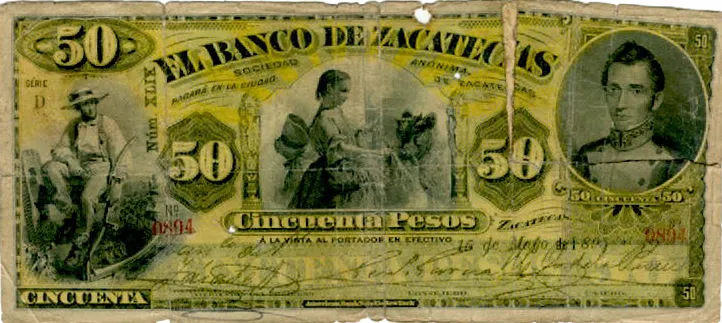
Obverse
Banco de Zacatecas
Engraved allegorical vignettes: a miner on the left, a female figure with goods in the center, and the profile portrait of a young man on the right
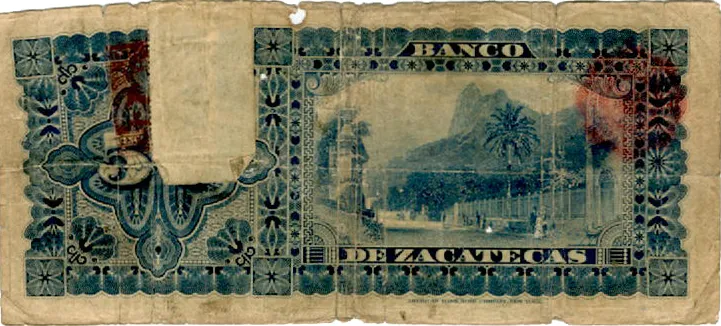
Reverse
Scenes of mining and labor, or a monument set against the mountainous landscape of Zacatecas
About this banknote
Most people who inherit a 19th-century Mexican banknote assume it's worth a fortune. Usually it isn't. But the 1895 Banco de Zacatecas 50 pesos note sits in an active collector niche where clean, genuine examples can bring anywhere from a few dozen to several hundred US dollars, and top-condition survivors well beyond that. Here's what actually drives the number.
What this note actually is
This is a 50 pesos note issued by the Banco de Zacatecas, one of the private state-charter banks that printed paper money in Mexico during the Porfiriato (the long rule of Porfirio Díaz, roughly 1876 to 1911).
Before Mexico had a single central bank, there was no Banco de México. Instead, individual states hosted privately chartered banks that were authorized to issue their own paper money, each note backed by silver held in reserve. Zacatecas was one of Mexico's great mining states, so the bank's silver production was its guarantee. This system of multiple issuing banks ended when the Banco de México was founded in 1925 and took over all note issue.
So you are holding an obsolete private bank note, not a government-issued bill. In the English-language collecting world (notaphily) these are cataloged as Mexican "emergency and state bank" issues, and they trade internationally.
How to identify it
- Issuer: Banco de Zacatecas
- Denomination: 50 pesos
- Era: Porfiriato, private silver-backed issue
- Front (obverse): engraved allegorical vignettes. A miner at left, a female figure with goods at center, and a portrait of a young man in profile at right. The mining imagery is deliberate: the ore was the collateral.
- Back (reverse): scenes of mining and labor, or a monument set against the mountainous Zacatecas landscape
If your note says "Banco de México" anywhere, it is not this issue and is worth far less as a collectible.
How much is it worth
This is historical paper money, more than a century old, so its value is purely as a collectible. It has no face value in circulation; you cannot spend it. Two things drive the price: condition and the rarity of the issuing bank.
Porfiriato private bank notes and later Revolution-era scrip form their own market. Some banks' notes are common; others are extremely scarce. Many of these notes circulated so heavily, or were redeemed and destroyed, that intact examples are genuinely hard to find today. That scarcity is what a serious buyer pays for, not simply the age.
| Condition | What it looks like | Approximate collector value (USD) |
|---|---|---|
| Well worn / damaged | Heavy folds, tears, stains, pieces missing | A few dollars to ~30 |
| Circulated, intact | Even wear, no tears, all corners present | ~40 to 150 |
| Nice, minimal wear | Bright color, light handling only | ~150 to 400 |
| Uncirculated / crisp | No folds, original body, sharp corners | Several hundred and up |
These are working ranges for the collector market, not a fixed price list. A specimen note, a low or repeating serial number, or a documented printing error can push any of these figures higher. Because prices for state-bank issues vary sharply by bank and grade, do not trust the first number you see online. Confirm it before you sell.
What raises the value
- Condition above all. A crisp, unfolded note can be worth ten times a soft, worn one.
- Serial number. A low serial number or a palindrome (a number that reads the same forwards and backwards) attracts extra demand.
- Printing errors. Genuine factory errors (misaligned cuts, ink smears, off-center printing) turn a common note into a rarity. Ordinary wear and use damage do not count as errors.
- Third-party grading. A note certified by PMG (Paper Money Guaranty), the main international grading service for banknotes, sells for more and faster because the buyer trusts the grade.
The myth to ignore
Age alone does not make a banknote valuable. There are 19th-century notes that trade for a few dollars because they survived in quantity. What you want to confirm is which specific bank and denomination you have, and what condition it's in. A worn, common Zacatecas note is a modest collectible. A crisp, scarce one is a real prize. The difference is condition and rarity, not the date on the paper.
How to tell if yours is genuine
Reproductions and modern reprints of Porfiriato notes exist. Check the physical piece:
- Paper. Genuine notes are printed on banknote paper with a distinct feel. Reproductions often use smooth, modern paper with flat, uniform color.
- Engraving detail. Original intaglio engraving shows fine, crisp lines and slight relief you can sometimes feel. Fakes look soft or pixelated under magnification.
- Signatures and serial. Compare the layout, signatures and serial-number style against verified images of Banco de Zacatecas issues.
- When in doubt, post clear, well-lit photos of both sides in the Pesoteca forum and let the community weigh in before you buy or sell.
Where to sell it
To sell an 1895 Banco de Zacatecas 50 pesos note safely, use a channel where knowledgeable buyers actually value what you have:
- A verified dealer from the Pesoteca shop directory can appraise it in person, no middleman markup.
- The Pesoteca buy-and-sell forum puts you in front of collectors who specifically want state-bank issues.
- For higher-grade or scarce examples, an international auction house that handles world paper money reaches the deepest pool of buyers.
Photograph both sides in good light, note the serial number, and check for low or palindromic serials and any error before you list. Avoid dumping it to the first offer on social media; scarce state-bank notes are exactly the kind of piece that gets undervalued in a quick sale.
Think you have a scarce Zacatecas issue, or a note from a different Porfiriato bank you can't identify? Post photos of both sides in the Pesoteca forum and get a read from collectors who track this market.
Historical context
The Banco de Zacatecas, founded in 1891, backed its paper money with the state's mining wealth, famous for its silver since colonial times. High-denomination notes, like this 50-peso one, served formal commerce and larger-value operations within the system of private banks of issue.
This 50-peso note of 1895 corresponds to the bank's early years, when it was consolidating its presence in the regional economy under the Porfiriato. Its obverse shows the institution's distinctive iconography: a miner on the left, a female figure with goods in the center alluding to commerce, and the portrait of a young man in profile on the right, with mining and mountain motifs on the reverse. The printing was carried out by the American Bank Note Company of New York, a guarantee of quality and security. These vignettes tied the note's backing to the activity that gave Zacatecas its fame and its livelihood. Private issuance would come to an end with the creation of the Banco de México in 1925.
Frequently asked questions
How much is the 1895 Banco de Zacatecas 50 pesos note worth?
Its value is purely as a collectible, since it can no longer be spent. A worn, common example brings a few dollars to about 30 USD. An intact circulated note runs roughly 40 to 150 USD, and a crisp, uncirculated survivor can bring several hundred USD or more. Condition and the rarity of the issuing bank drive the number.
Is the 1895 Banco de Zacatecas 50 pesos note rare?
It depends on condition. These Porfiriato private bank notes circulated heavily, and many were redeemed and destroyed, so intact high-grade examples are genuinely scarce. Worn examples are more common. A low or palindromic serial number, or a documented printing error, adds significant rarity value.
Where can I sell an 1895 Banco de Zacatecas 50 pesos note?
The safest routes are a verified dealer from the [Pesoteca shop directory](/tiendas), who can appraise it in person, or the [Pesoteca buy-and-sell forum](/foro/compra-venta), where collectors of state-bank issues gather. For a high-grade or scarce example, an international auction house that handles world paper money reaches the most serious buyers. Photograph both sides first.
How do I tell if my 1895 Banco de Zacatecas note is genuine?
Check the paper, the engraving and the printing. Genuine notes use banknote paper with fine intaglio engraving that shows crisp lines and slight relief. Reproductions tend to use smooth modern paper with flat, uniform color. Compare signatures and serial-number style to verified images. When unsure, post clear photos of both sides in the [Pesoteca forum](/foro).
Características Banxico
Firmas autógrafas, XLIX
Familia PRIV
This banknote belongs to the BIL-PRIV family within the Sistema PSM . Explore all the banknotes that share origin, era and design with this piece.
Ver todos los billetes de la familia PRIV →